C41
Kodak Portra 400
Kodak Portra 400 is a professional C-41 color negative film known for flexible exposure latitude, natural skin tones, and fine grain.
View profile35mm SLR
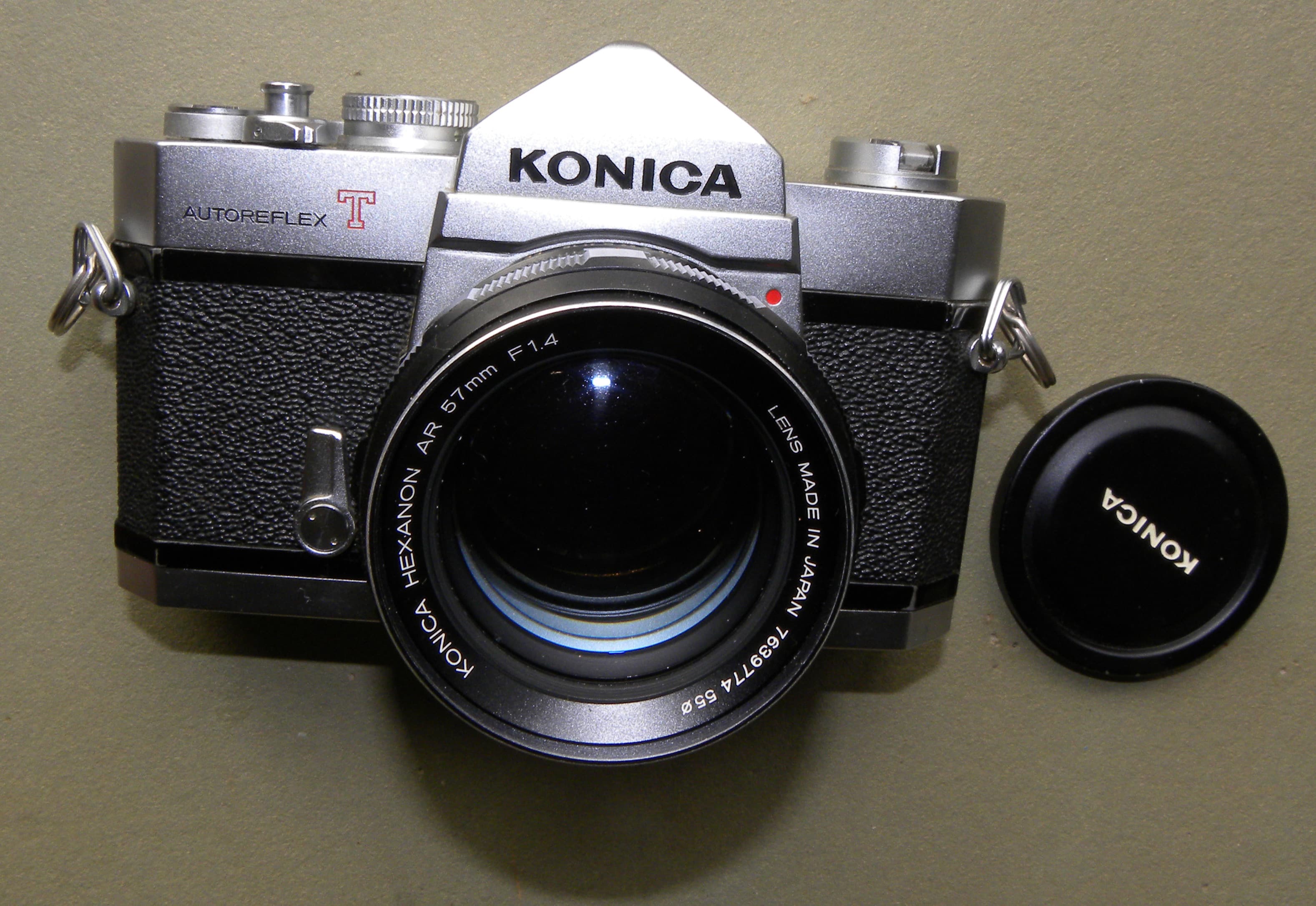
The Konica Autoreflex T (1968) is the second Konica AR-mount SLR and the first to carry the "Autoreflex T" designation, distinguishing it from the original Auto-Reflex (1965). Where the Auto-Reflex was notable for its half-frame/full-frame switching mechanism, the Autoreflex T focused the feature set on autoexposure: a TTL CdS centre-weighted metering system coupled to shutter-priority automatic exposure. The photographer sets the shutter speed; the camera selects the corresponding aperture via a coupling between the meter and the AR-mount's automatic aperture mechanism.
Reference
Recommended film stocks for the 35mm format your camera takes.
C41
Kodak Portra 400 is a professional C-41 color negative film known for flexible exposure latitude, natural skin tones, and fine grain.
View profileBW
Kodak Tri-X 400 is a classic black-and-white film known for strong tonality, visible grain, and documentary character.
View profileC41
Kodak Gold 200 is a daylight-balanced C-41 color negative film with warm color, moderate grain, and a classic consumer-film look.
Develop 35mm film
Labs in our directory that process 35mm film.
Before you buy used
About this camera
The camera that established shutter-priority TTL autoexposure in the Konica AR-mount SLR line.
| Field | Value |
|---|
| Format | 35mm |
| Mount | Konica AR bayonet |
| Years | ~1968–1970 |
| Shutter | 1s – 1/1000s + B, horizontal cloth focal plane |
| Flash sync | ~1/60s |
| Meter | TTL CdS centre-weighted |
| Modes | Shutter-priority auto / Manual |
| Viewfinder | Pentaprism |
| Battery | 1x PX625 mercury (required) |
| Mechanical fallback | None |
Konica (Konishiroku) launched the original Auto-Reflex in 1965 as the AR mount's debut, featuring half/full-frame switching. The Autoreflex T (1968) dropped the half-frame mechanism to deliver a cleaner full-frame body with TTL shutter-priority autoexposure - the defining characteristic of the entire subsequent Autoreflex T line. The shutter-priority paradigm was Konica's deliberate design choice; contemporaries like the Pentax Spotmatic offered match-needle manual metering, and the Minolta SRT-101 (1966) provided similar TTL metering but required manual aperture selection. Konica's auto-aperture coupling was among the earlier practical TTL shutter-priority implementations in a Japanese SLR.
The Autoreflex T was produced for roughly two years before being updated through internal variants leading to the T3 (1973). The T3 refined the shutter mechanism to a vertical metal design and improved durability. The TC (1976) further simplified the body for a budget market. The original Autoreflex T is now the rarest and least commonly seen Konica SLR body in used markets.
The Autoreflex T is the origin of the Konica shutter-priority AE system that would run through the TC, T3, and T4 bodies. Its significance is primarily historical: it established the operational model - set the shutter speed, let the camera work the aperture - that Konica would refine and maintain until the FT-1 (1983) shifted the line to aperture-priority.
For collectors, the Autoreflex T represents the first practical realisation of the "Autoreflex" concept after the engineering experiment of the original Auto-Reflex. Bodies in working condition are less common than T3 or TC examples and command a modest premium accordingly.
The AR-mount Hexanon lenses - all compatible - are the main draw for practical shooters. The 52mm f/1.8 kit lens that often accompanies T-series bodies is a capable performer; the 57mm f/1.4 and 57mm f/1.2 fast primes stand as the optical highlights of the system.
Full Konica AR mount compatibility. All Hexanon AR lenses produced 1965 onwards will fit and couple for shutter-priority AE. Key lenses for the T body era:
Konica AR lenses are adaptable to Sony E, Micro Four Thirds, and Fuji X mounts with passive adapters.
C41
Fujifilm Superia X-TRA 400 (marketed as Superia 400 in some regions) is an ISO 400 C-41 consumer color negative film in 135 format, one of Fujifilm's most popular consumer films. It delivers warm, vibrant colors with moderate grain and remains in production in some markets.
View profileBW
Ilford HP5 Plus is a flexible ISO 400 black-and-white film with classic grain and strong push-processing tolerance.
View profileC41
Kodak Ektar 100 is a fine-grain C-41 color negative film with saturated color and high sharpness.
View profile