C41
Kodak Portra 400
Kodak Portra 400 is a professional C-41 color negative film known for flexible exposure latitude, natural skin tones, and fine grain.
View profile35mm SLR
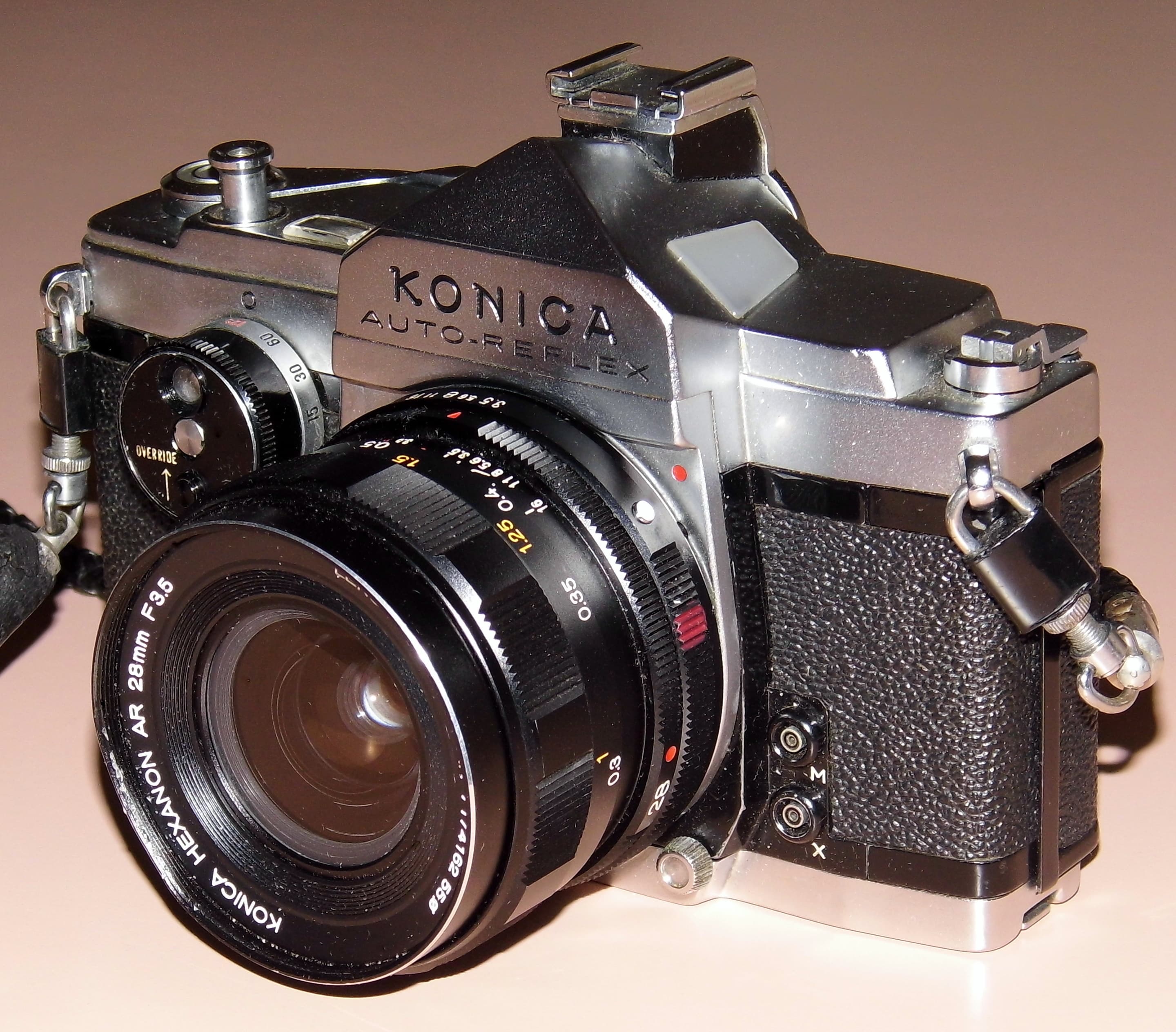
The Konica Auto-Reflex (1965) is a Japanese 35mm SLR notable for one engineering first: a built-in mechanism allowing the photographer to switch between **full-frame (24x36mm)** and **half-frame (18x24mm)** format in mid-roll, without changing backs or film. Turning a selector on the camera body engaged a mask in the film gate, doubling the number of exposures per roll. This was achieved without interchangeable backs - a proprietary mechanical solution integrated into the body. The Auto-Reflex launched the **Konica AR lens mount**, which remained in production through the 1980s. The kit lens was the Hexanon AR 52mm f/1.8.
Reference
Recommended film stocks for the 35mm format your camera takes.
C41
Kodak Portra 400 is a professional C-41 color negative film known for flexible exposure latitude, natural skin tones, and fine grain.
View profileBW
Kodak Tri-X 400 is a classic black-and-white film known for strong tonality, visible grain, and documentary character.
View profileC41
Kodak Gold 200 is a daylight-balanced C-41 color negative film with warm color, moderate grain, and a classic consumer-film look.
Develop 35mm film
Labs in our directory that process 35mm film.
Before you buy used
About this camera
The world's first SLR switchable between full-frame 35mm and half-frame in a single camera body.
| Field | Value |
|---|
| Format | 35mm full-frame or half-frame (switchable) |
| Mount | Konica AR |
| Kit lens | Hexanon AR 52mm f/1.8 |
| Years | 1965–~1967 |
| Shutter | ~1s – 1/1000s + B, focal plane |
| Flash sync | ~1/60s |
| Meter | TTL CdS, aperture-priority auto |
| Modes | Aperture priority, manual |
| Battery | 1× PX625 mercury |
Konica entered the 35mm SLR market with the Auto-Reflex in 1965, competing against established players (Nikon F, Pentax Spotmatic, Canon FP). The half/full-frame switching mechanism was the differentiator, patented by Konica. It introduced the Konica AR bayonet mount - all subsequent Konica SLRs through the 1980s (Autoreflex T, T2, T3, TC, FS-1, FT-1) used AR-mount lenses, giving the system long tail compatibility. The Auto-Reflex itself was succeeded quickly by the Autoreflex T (~1967), which refined the exposure system. Production of the original Auto-Reflex was short — roughly two years. Exact production numbers are not published.
The half-frame/full-frame switching is historically significant as an engineering first. No other SLR before it offered this capability in a single integrated body. Practically, in 1965 it addressed a real economy-of-film concern for amateur photographers: a 36-exposure roll became 72 half-frame shots. For 2026 collectors, the Auto-Reflex is the origin point of the entire Konica AR system and the camera that established the mount used by the Hexanon AR lenses (40/1.8 pancake, 50/1.4, 57/1.2) still valued today.
The TTL aperture-priority metering was competitive for 1965 - contemporaries like the Pentax Spotmatic had through-the-lens metering too, but the Auto-Reflex's aperture-priority automation was among the early implementations in a production SLR.
Konica AR mount - bayonet, non-AI. All Konica Hexanon AR lenses are compatible. Notable lenses:
Konica AR lenses can be adapted to Sony E, Micro Four Thirds, and Fuji X mounts with inexpensive passive adapters.
C41
Fujifilm Superia X-TRA 400 (marketed as Superia 400 in some regions) is an ISO 400 C-41 consumer color negative film in 135 format, one of Fujifilm's most popular consumer films. It delivers warm, vibrant colors with moderate grain and remains in production in some markets.
View profileBW
Ilford HP5 Plus is a flexible ISO 400 black-and-white film with classic grain and strong push-processing tolerance.
View profileC41
Kodak Ektar 100 is a fine-grain C-41 color negative film with saturated color and high sharpness.
View profile