C41
Kodak Portra 400
Kodak Portra 400 is a professional C-41 color negative film known for flexible exposure latitude, natural skin tones, and fine grain.
View profile35mm SLR
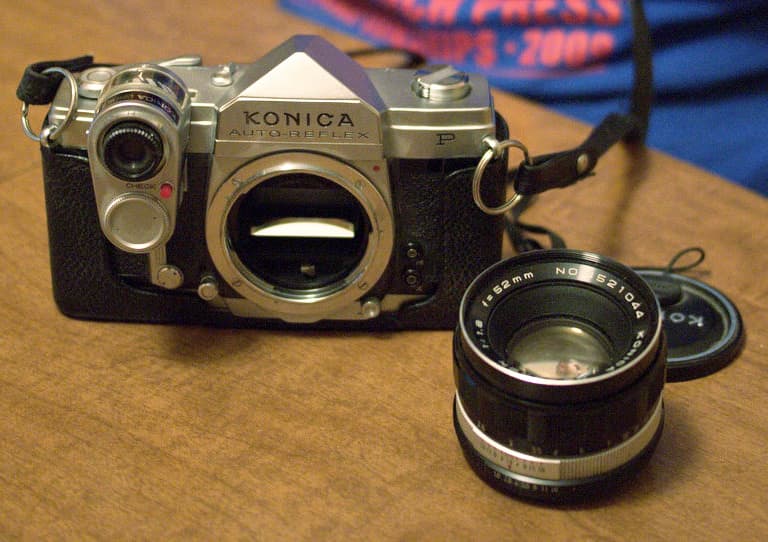
The Konica Autoreflex P (1968) was introduced alongside the Autoreflex T as a simplified, lower-cost entry into the Konica AR-mount SLR system. Where the Autoreflex T implemented shutter-priority autoexposure - the photographer sets the shutter speed and the camera selects the aperture - the Autoreflex P inverted this logic: the photographer sets the aperture and the camera determines the appropriate shutter speed. This aperture-priority arrangement was simpler to implement mechanically and was considered more intuitive by Konica for amateur users who wanted depth-of-field control without managing shutter speeds.
Reference
Recommended film stocks for the 35mm format your camera takes.
C41
Kodak Portra 400 is a professional C-41 color negative film known for flexible exposure latitude, natural skin tones, and fine grain.
View profileBW
Kodak Tri-X 400 is a classic black-and-white film known for strong tonality, visible grain, and documentary character.
View profileC41
Kodak Gold 200 is a daylight-balanced C-41 color negative film with warm color, moderate grain, and a classic consumer-film look.
Develop 35mm film
Labs in our directory that process 35mm film.
Before you buy used
About this camera
The simplified companion to the Autoreflex T, offering fixed aperture-priority AE on the AR mount.
| Field | Value |
|---|
| Format | 35mm |
| Mount | Konica AR bayonet |
| Years | ~1968–? |
| Shutter | 1s – 1/1000s + B, horizontal cloth focal plane |
| Flash sync | ~1/60s |
| Meter | TTL CdS centre-weighted |
| Modes | Aperture-priority auto |
| Viewfinder | Pentaprism |
| Battery | 1x PX625 mercury (required) |
| Mechanical fallback | None |
The Autoreflex P emerged from Konica's strategy of segmenting its AR-mount SLR line by complexity and price. The original Auto-Reflex (1965) had been an engineering showcase - it offered half-frame/full-frame switching - but was not positioned as a simple camera. When Konica redesigned the line in 1968, it produced two contemporaneous bodies: the Autoreflex T (shutter-priority, with manual override) aimed at enthusiasts and the Autoreflex P (aperture-priority only) aimed at the capable amateur who wanted automation without complexity.
The aperture-priority approach placed the Autoreflex P conceptually closer to later cameras like the Pentax ME (1976) and Olympus OM-10 (1979), though the P predates those designs by nearly a decade. In the late 1960s Japanese SLR market, fully automatic exposure of any kind was still a differentiating feature; the P occupied a distinct market position despite its reduced feature set relative to the T.
The Autoreflex P appears to have had a shorter production life than the T, and surviving examples are less frequently encountered in the used market. The subsequent Autoreflex line (T3, TC, T4) retained shutter-priority as the preferred AE mode, suggesting the P's aperture-priority approach was not carried forward as Konica's primary design direction.
The Autoreflex P is historically notable as an early aperture-priority automatic SLR, predating the Pentax ME and Olympus OM-10 by nearly a decade. It demonstrates that Konica was experimenting with different AE paradigms simultaneously in 1968, producing both a shutter-priority and an aperture-priority body in the same model year.
For collectors, the P occupies a secondary position relative to the better-documented Autoreflex T. Its aperture-priority-only design makes it less versatile for practical shooting, and its relative rarity in working condition means service can be uncertain. It is of primary interest as a piece of Konica system history and as an early example of dedicated aperture-priority automation.
Full Konica AR mount compatibility. All Hexanon AR lenses produced from 1965 onwards fit and provide automatic aperture coupling. The aperture-priority mode works by the photographer selecting an aperture on the lens ring while the camera sets shutter speed via the TTL CdS reading.
Key lenses usable with the Autoreflex P:
All Konica AR lenses are adaptable to Sony E, Micro Four Thirds, and Fuji X mounts with passive adapters.
C41
Fujifilm Superia X-TRA 400 (marketed as Superia 400 in some regions) is an ISO 400 C-41 consumer color negative film in 135 format, one of Fujifilm's most popular consumer films. It delivers warm, vibrant colors with moderate grain and remains in production in some markets.
View profileBW
Ilford HP5 Plus is a flexible ISO 400 black-and-white film with classic grain and strong push-processing tolerance.
View profileC41
Kodak Ektar 100 is a fine-grain C-41 color negative film with saturated color and high sharpness.
View profile