C41
Kodak Portra 160
Kodak Portra 160 is a professional C-41 color negative film with fine grain, soft contrast, and natural color.
View profileLarge Format & View
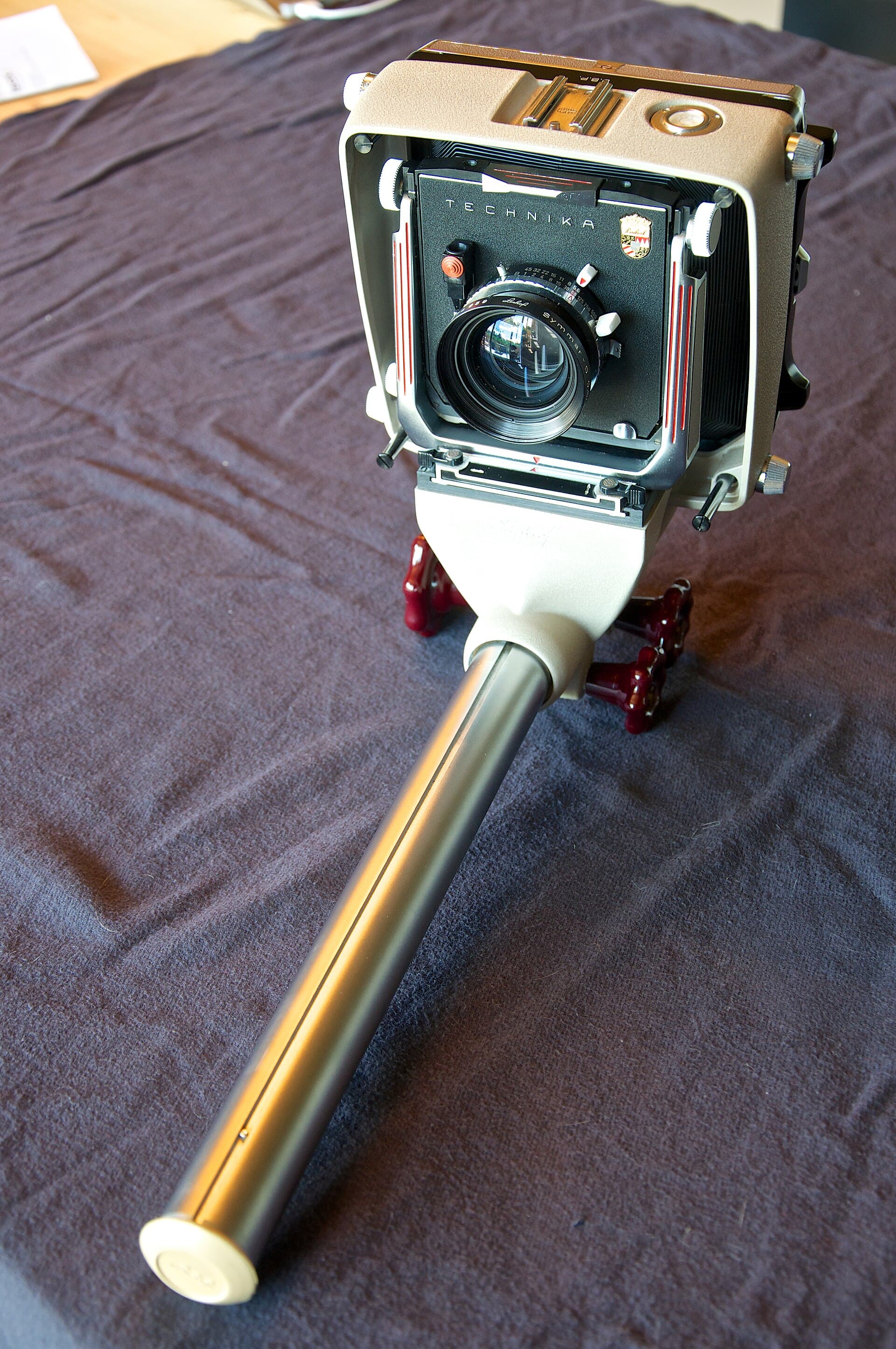
The Master Technika is a 4×5 large-format folding field/press camera. It supports full view-camera movements (front rise, fall, shift, tilt, swing; rear tilt, swing) plus an optional **rangefinder** that couples to specific cammed lenses for hand-held use. Bellows extension is moderate (~430 mm). Build is German aerospace-grade — aluminum and magnesium with leather. It's the only modern large-format camera that's been in continuous production since 1972 and the only one designed to be used hand-held when needed.
Reference
Recommended film stocks for the 4x5 format your camera takes.
C41
Kodak Portra 160 is a professional C-41 color negative film with fine grain, soft contrast, and natural color.
View profileBW
Kodak T-Max 100 (TMX) is a professional ISO 100 black-and-white T-grain negative film celebrated for its extremely fine grain, high sharpness, and wide tonal range — one of the finest-grained B&W films available in 135 and 120.
View profileBW
Ilford HP5 Plus is a flexible ISO 400 black-and-white film with classic grain and strong push-processing tolerance.
Develop 4x5 film
Labs in our directory that process 4x5 film.
Before you buy used
About this camera
The German press camera that survived into the 21st century. A 4×5 field/press hybrid that does what no other LF camera does — couple a rangefinder to a cammed lens.
| Field | Value |
|---|
| Format | 4×5 |
| Mount | Linhof Technika lensboard |
| Years | 1972–present |
| Bellows | ~430 mm extension |
| Movements | Front: rise/fall, shift, tilt, swing. Rear: tilt, swing. |
| Rangefinder | Optional, cam-coupled to specific lenses |
| Weight | 2,700 g |
| Battery | None |
Linhof founded 1887 in Munich. The Technika line started 1934 — a folding metal field camera that became standard issue for press photographers in the 1950s/60s. The Technika III (1946), IV (1956), and V (1963) refined it; the Master Technika (1972) added geared movements and modernized rangefinder coupling. The Master Technika 2000 (1992) further improved precision; the Master Technika 3000 (1999, current production) offers extended bag bellows for wide lenses. A Classic trim is sold for traditionalists. Production has never stopped — Linhof remains a Munich family-run company in 2026.
For news photographers in the 1950s, the Technika was the press camera. You could focus by rangefinder, hand-hold the body, fire the leaf shutter at a sporting event or a court hearing, and get a 4×5 negative — quality on par with anything in studio LF. As 35mm SLRs took over press work, the Technika morphed into a field camera for landscape and architectural photographers, retaining the rangefinder and adding precise movements.
It's the camera you choose when you want LF discipline (every frame intentional, ground-glass composing) but also hand-hold capability (rangefinder coupling for street or reportage). Few photographers use both modes; many appreciate that they could.
All Linhof Technika lensboards (small format) fit. Lenses can be cammed for rangefinder coupling, but uncammed lenses still focus on ground glass. Common lenses:
Roll-film backs: Linhof Super Rollex (6×7, 6×9, 6×12), Sinar Zoom, Horseman backs. Polaroid 545i back. International graflok backs accept Lab 4×5 holders or Polaroid 4×5 backs.
E6
Fujifilm Fujichrome Velvia 50 (RVP 50) is the legendary professional E6 reversal slide film at ISO 50 that defined landscape and nature photography for a generation. Characterized by extreme saturation, deep contrast, and ultra-fine grain, it remains in active production as of 2026.
View profileC41
Kodak Portra 400 is a professional C-41 color negative film known for flexible exposure latitude, natural skin tones, and fine grain.
View profileBW
Kodak Tri-X 400 is a classic black-and-white film known for strong tonality, visible grain, and documentary character.
View profile