C41
Lomography Negative 400
Lomography Color Negative 400 is a versatile ISO 400 C-41 color negative film with vivid, saturated colors, believed to be a Kodak Alaris-manufactured emulsion, available in 35mm and 120 formats.
View profileToy & Novelty
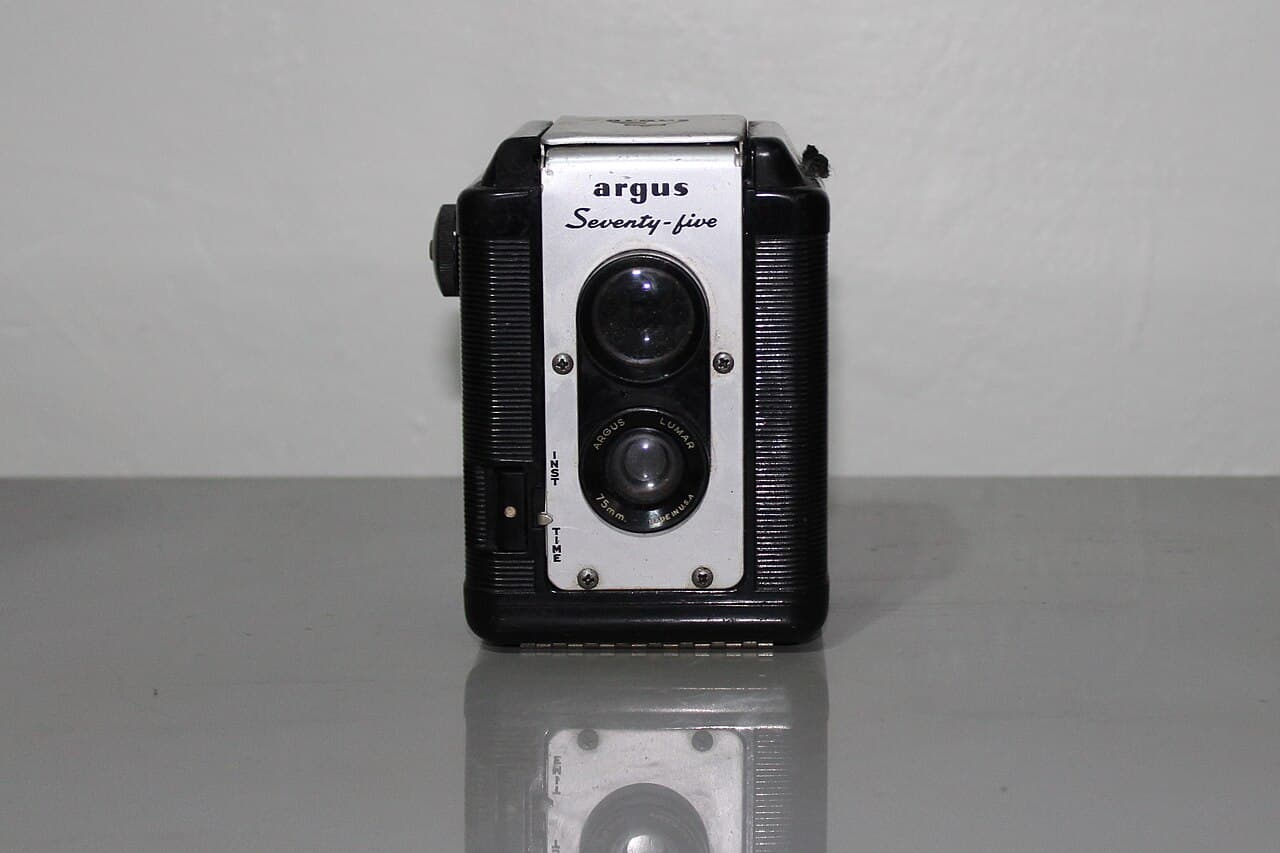
The Argus 75 is a medium-format box camera introduced by Argus around 1949 and produced through the early 1950s. It takes the visual form of a twin-lens reflex - a large waist-level finder on top, a taking lens below - but it is not a true TLR: the top lens is a simple optical viewfinder, not a coupled reflex ground glass. The camera uses 620 roll film to produce twelve 6x6 cm square exposures per roll. Exposure is fully automatic by the standard of box cameras: one shutter speed (approximately 1/50s), a fixed aperture, fixed focus, and a PC flash socket for synchronized flashbulb use. The Argus 75 was aimed squarely at the family snapshot market, competing with Kodak Brownie box cameras at the same low price point.
Reference
Recommended film stocks for the — format your camera takes.
C41
Lomography Color Negative 400 is a versatile ISO 400 C-41 color negative film with vivid, saturated colors, believed to be a Kodak Alaris-manufactured emulsion, available in 35mm and 120 formats.
View profileC41
Lomography Color Negative 800 is a high-speed ISO 800 C-41 color negative film widely suspected to be a Kodak-manufactured emulsion, delivering vibrant colors and adequate grain for challenging lighting conditions.
View profileC41
Develop — film
We're growing the lab directory near you. Browse all labs.
Before you buy used
About this camera
A postwar American Bakelite box camera styled like a TLR, made for 620 roll film.
| Field | Value |
|---|
| Format | 620 roll film (12 exp, 6x6 cm) |
| Lens | ~75mm fixed-focus meniscus |
| Shutter | Single speed, ~1/50s, leaf |
| Aperture | Fixed, ~f/11 |
| Flash sync | PC socket |
| Meter | None |
| Focus | Fixed |
| Battery | None |
| Body | Bakelite |
| Viewfinder | Optical direct (top-mounted, pseudo-TLR style) |
Argus introduced the 75 in 1949 as the Ann Arbor company expanded beyond its established 35mm line (the A-series and the C3 rangefinder) into the medium-format snapshot market. The 620 format was at that point still actively supported by Kodak as a consumer roll-film standard alongside 120, and the square 6x6 negative offered generously large images suitable for contact printing or modest enlargement without the precision handling that 35mm demanded.
The TLR-like body styling was a cosmetic choice: the twin-lens silhouette read as "sophisticated camera" to postwar American consumers who had seen professional-looking TLRs in magazine advertisements, and Argus reproduced that form factor in Bakelite at a fraction of the cost of a Rolleiflex or Yashicaflex. The top finder lens has no optical connection to the taking lens; it is simply a direct-vision viewfinder window.
Production appears to have continued into the early-to-mid 1950s, after which Argus's attention shifted toward its 35mm consumer lines and eventual transition to more modern camera designs.
The Argus 75 occupies the same cultural space as the Kodak Brownie: a functional, affordable snapshot camera that required no photographic knowledge to operate. Its significance is primarily sociological rather than photographic - it represents the postwar democratization of medium-format image-making for American families who would otherwise have had no access to 6x6 cm negatives.
The pseudo-TLR styling is a minor footnote in industrial design history, illustrating how manufacturers used the visual language of professional equipment to lend aspirational appeal to mass-market goods. The Argus 75 did not produce exceptional photographs - fixed focus, a single shutter speed, and a meniscus lens are a recipe for competent but undistinguished snapshots - but that was the point: competent snapshots, reliably, at low cost.
Kodak Gold 200 is a daylight-balanced C-41 color negative film with warm color, moderate grain, and a classic consumer-film look.
C41
Fujifilm Superia X-TRA 400 (marketed as Superia 400 in some regions) is an ISO 400 C-41 consumer color negative film in 135 format, one of Fujifilm's most popular consumer films. It delivers warm, vibrant colors with moderate grain and remains in production in some markets.
View profileC41
Kodak Portra 400 is a professional C-41 color negative film known for flexible exposure latitude, natural skin tones, and fine grain.
View profileBW
Kodak Tri-X 400 is a classic black-and-white film known for strong tonality, visible grain, and documentary character.
View profile