C41
Kodak Portra 400
Kodak Portra 400 is a professional C-41 color negative film known for flexible exposure latitude, natural skin tones, and fine grain.
View profile35mm Compact
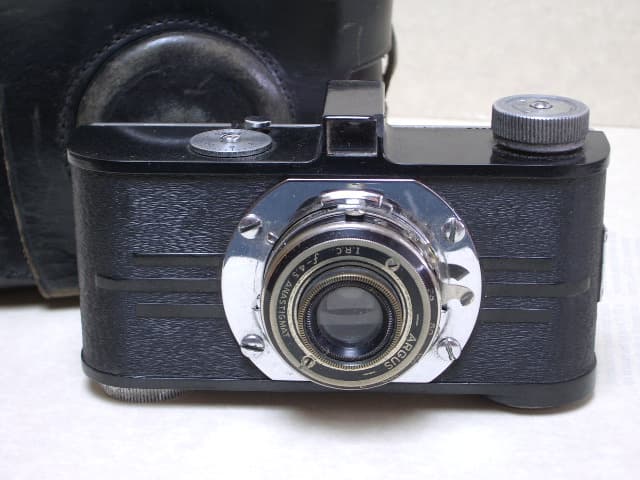
The Argus A (1936-1941) was the first 35mm camera manufactured in the United States to achieve genuine mass-market success. Produced by International Research Corporation in Ann Arbor, Michigan, it brought 35mm film photography to American consumers at a price point far below imported German cameras. The body is molded Bakelite with a collapsible lens, a simple leaf shutter, and zone focus - no rangefinder, no meter, no battery. At $12 retail (roughly $250 in 2026 dollars), it undercut Leica IIIs by a factor of twenty or more. The Argus A established the Ann Arbor company's direction and directly led to the more refined C-series cameras that followed.
Reference
Recommended film stocks for the 35mm format your camera takes.
C41
Kodak Portra 400 is a professional C-41 color negative film known for flexible exposure latitude, natural skin tones, and fine grain.
View profileC41
Kodak Gold 200 is a daylight-balanced C-41 color negative film with warm color, moderate grain, and a classic consumer-film look.
View profileC41
Fujifilm Superia X-TRA 400 (marketed as Superia 400 in some regions) is an ISO 400 C-41 consumer color negative film in 135 format, one of Fujifilm's most popular consumer films. It delivers warm, vibrant colors with moderate grain and remains in production in some markets.
Develop 35mm film
Labs in our directory that process 35mm film.
Before you buy used
About this camera
The camera that started American 35mm photography - a Bakelite zone-focus compact sold for $12 in 1936.
| Field | Value |
|---|
| Format | 35mm |
| Lens | 50mm f/4.5 Anastigmat (coated, fixed) |
| Years | 1936-1941 |
| Shutter | ~1/25s - ~1/200s + B, leaf |
| Flash sync | None (no sync socket on base model) |
| Meter | None |
| Focus | Zone focus, distance scale |
| Battery | None |
| Body | Bakelite |
International Research Corporation (IRC) introduced the Argus A in 1936, the same year the company was reorganized from the former Detrola camera business. The camera was designed to be manufactured cheaply in quantity using Bakelite, the early thermosetting plastic that had proven itself in radios, telephones, and other consumer goods. The 50mm f/4.5 Anastigmat lens (later designated the Ilex) was an unexceptional but serviceable optic for the price. Film advance and shutter cocking were separate operations - the user advanced the film with a knob, then cocked the shutter with a separate lever, a pattern that persisted into the C3.
The A remained in production through 1941, overlapping briefly with the introduction of the Argus AF and the C3 (1939). It was succeeded by several variants - the A2 with a faster f/3.5 lens, the AF with an optical finder improvement - but the basic A body design was retired as the C-series took precedence. Production almost certainly ceased with the US entry into World War II in December 1941, which suspended civilian camera manufacturing across American industry.
The Argus A matters because it worked and it was cheap enough to buy. Before 1936, 35mm photography in the United States meant importing German cameras (Leica, Contax, Zeiss) at prices that placed them firmly in the hands of professionals and affluent amateurs. The Argus A changed the economics. It was not a technically distinguished camera - the zone focus system required careful distance estimation, the shutter speed range was narrow, the lens was adequate rather than excellent - but it was reliable enough to make properly exposed, sharply focused photographs in decent light, and it cost twelve dollars.
The A established a template that Argus refined for two decades: a Bakelite body with a metal chassis, a modest fixed lens, no battery dependence, and a price low enough to reach middle-income Americans. The C3 (1939), which outsold everything, descended directly from the engineering decisions made for the A.
C41
Kodak UltraMax 400 is a versatile consumer-grade ISO 400 daylight-balanced color negative film with T-grain emulsion, delivering warm Kodak colors, fine-for-speed grain (PGI 46), and wide exposure latitude. Currently in production and available globally as a single-roll and multi-pack.
View profileC41
Kodak ColorPlus 200 is an affordable, consumer-oriented daylight-balanced color negative film at ISO 200. Known for warm, slightly muted color rendition, fine grain, and wide exposure latitude, it is currently in production and widely available in Asia and select global markets.
View profileBW
Kodak Tri-X 400 is a classic black-and-white film known for strong tonality, visible grain, and documentary character.
View profile