C41
Kodak Portra 160
Kodak Portra 160 is a professional C-41 color negative film with fine grain, soft contrast, and natural color.
View profileLarge Format & View
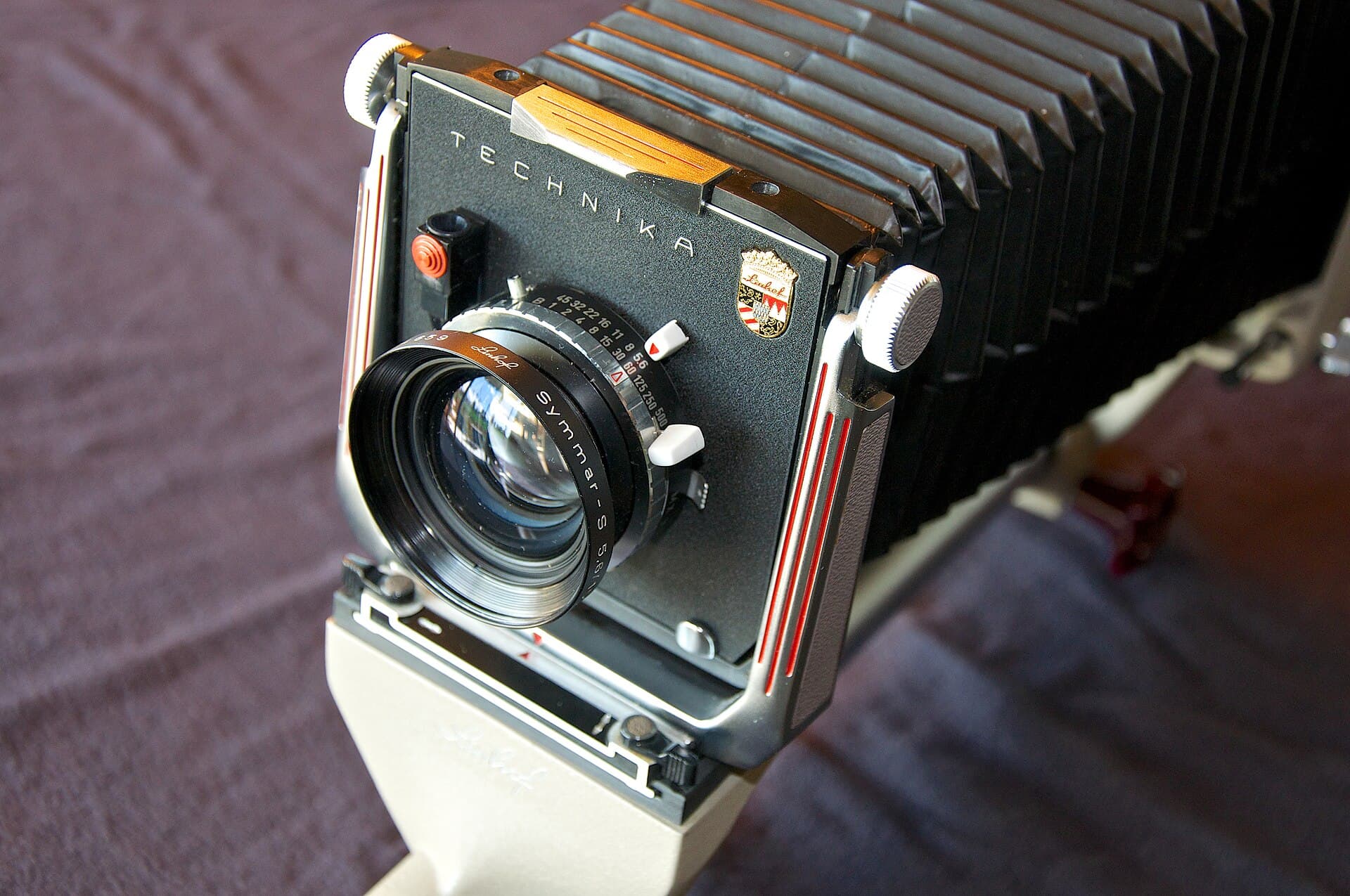
The Linhof Aero Technika is a specialized derivative of the Linhof Technika large-format camera family, adapted for aerial and oblique reconnaissance photography. Introduced around 1956, it stripped the standard field camera of its rangefinder coupling and movements and replaced them with a rigid, vibration-resistant body configuration suited to aircraft mounting. Film magazines were designed for rapid exchange. The camera was sold primarily to government survey agencies, military branches, and geographic research institutions rather than through commercial retail channels.
Reference
Recommended film stocks for the 4x5 format your camera takes.
C41
Kodak Portra 160 is a professional C-41 color negative film with fine grain, soft contrast, and natural color.
View profileBW
Kodak T-Max 100 (TMX) is a professional ISO 100 black-and-white T-grain negative film celebrated for its extremely fine grain, high sharpness, and wide tonal range — one of the finest-grained B&W films available in 135 and 120.
View profileBW
Ilford HP5 Plus is a flexible ISO 400 black-and-white film with classic grain and strong push-processing tolerance.
Develop 4x5 film
Labs in our directory that process 4x5 film.
Before you buy used
About this camera
Linhof's 4x5 reconnaissance variant - the Technika adapted for aerial photography missions.
| Field | Value |
|---|
| Format | 4x5 |
| Mount | Linhof Technika lensboard |
| Year introduced | ~1956 |
| Status | Rare / discontinued |
| Shutter | Lens-mounted leaf (Compur/Synchro-Compur) |
| Shutter range | ~1s - 1/500s (lens-dependent) |
| Battery | None |
| Focus | Ground glass (pre-focused for altitude in operation) |
| Movements | None (fixed for aerial use) |
Linhof's Munich factory had supplied precision optical and camera equipment to German military and government agencies since before World War II. After the war, as West German government and allied survey operations resumed aerial mapping in the 1950s, Linhof adapted the Technika platform - already trusted for precision - into a purpose-built aerial variant.
The Aero Technika used the same general lensboard mount and body construction discipline as the civilian Technika IV and V, but with a rigid non-folding configuration in most configurations and an interchangeable film magazine system suited to pre-loading and quick swapping in the field. Lenses were typically calibrated Schneider or Rodenstock optics optimized for even corner-to-corner illumination across the 4x5 frame. The camera was not designed for hand-held ground use in the way the civilian Technika was; in aerial deployment it was typically mounted in an aircraft hatch or gun port.
Production wound down as dedicated aerial survey cameras from companies like Zeiss, Wild, and Williamson displaced purpose-adapted press cameras in professional survey use. The Aero Technika occupies a transitional moment between improvised military press-camera adaptation and true purpose-built survey equipment.
The Aero Technika represents the top end of what a general-purpose large-format press camera platform could be pushed to do. Linhof's reputation for precision made the Technika the natural base for aerial adaptation in an era when dedicated aerial cameras were scarce or extremely expensive. The resulting cameras are highly collectible today as specialized variants - complete examples with original magazines and lenses are rare because institutional owners rarely maintained them in the civilian used market.
From a technical standpoint the Aero Technika illustrates the difference between photographic precision and survey precision: even the best press-camera adaptation could not match the geometric accuracy of true mapping cameras, and this tension drove the eventual retirement of adapted cameras from serious aerial survey work.
Lenses were specified by the purchasing institution and often calibrated individually. Common choices:
Film magazines varied by variant. Some bodies accepted standard 4x5 film holders; others used proprietary bulk magazines.
E6
Fujifilm Fujichrome Velvia 50 (RVP 50) is the legendary professional E6 reversal slide film at ISO 50 that defined landscape and nature photography for a generation. Characterized by extreme saturation, deep contrast, and ultra-fine grain, it remains in active production as of 2026.
View profileC41
Kodak Portra 400 is a professional C-41 color negative film known for flexible exposure latitude, natural skin tones, and fine grain.
View profileBW
Kodak Tri-X 400 is a classic black-and-white film known for strong tonality, visible grain, and documentary character.
View profile