C41
Kodak Portra 400
Kodak Portra 400 is a professional C-41 color negative film known for flexible exposure latitude, natural skin tones, and fine grain.
View profileMedium Format SLR
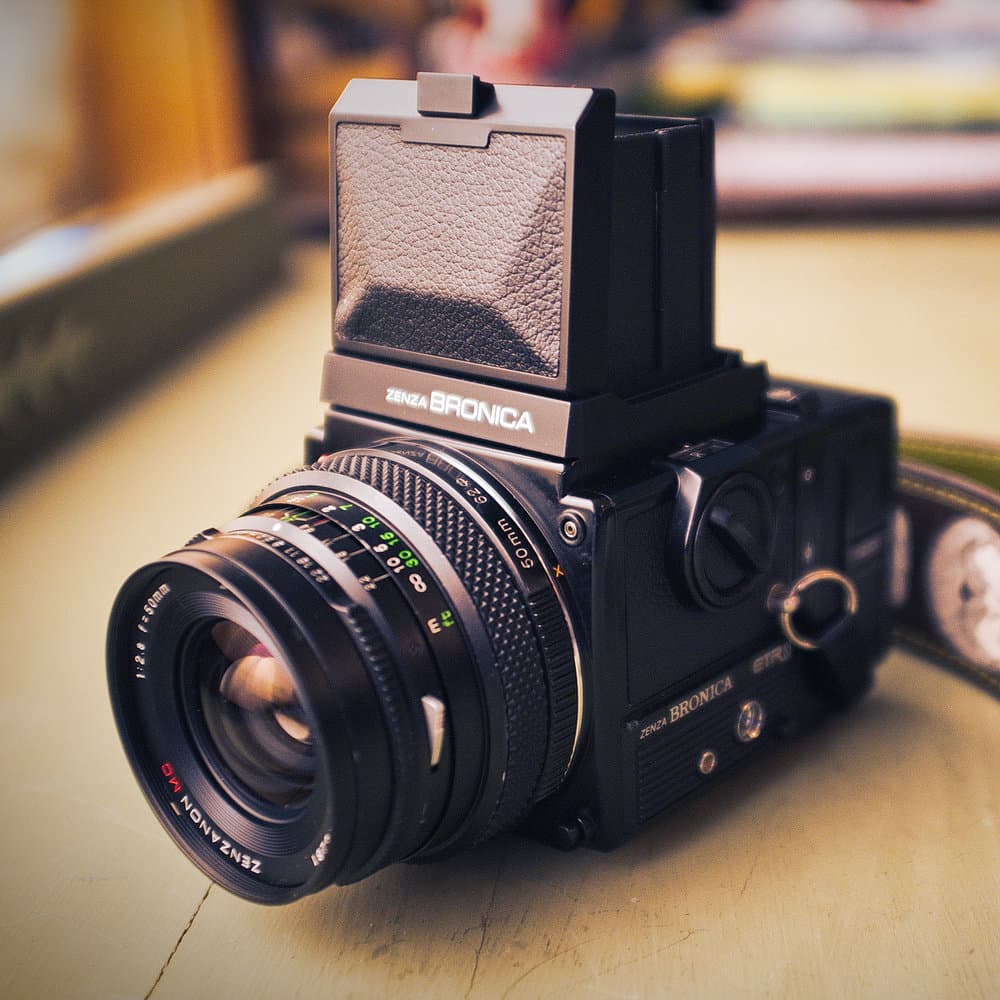
The Zenza Bronica ETR Black is the black-body variant of the original ETR, Bronica's first 645-format (6x4.5 cm) medium-format SLR. Introduced in 1976, the ETR marked a major strategic shift for Bronica: away from the heavy focal-plane 6x6 S-line toward a lighter, leaf-shutter-in-lens modular 645 system. The black finish version was produced alongside the chrome, appealing to photographers who preferred discrete field use or the professional aesthetic of a non-reflective body. Functionally identical to the chrome ETR: manual-only body, leaf shutter in each Zenzanon lens, and the same modular back and finder system shared across all ETR-series bodies.
Reference
Recommended film stocks for the — format your camera takes.
C41
Kodak Portra 400 is a professional C-41 color negative film known for flexible exposure latitude, natural skin tones, and fine grain.
View profileC41
Kodak Portra 160 is a professional C-41 color negative film with fine grain, soft contrast, and natural color.
View profileC41
Kodak Ektar 100 is a fine-grain C-41 color negative film with saturated color and high sharpness.
Develop — film
We're growing the lab directory near you. Browse all labs.
Before you buy used
About this camera
The black-body version of Bronica's 1976 645 SLR - the camera that opened medium format to a wider market.
| Field | Value |
|---|
| Format | 120 / 220 (6x4.5 cm, 15 frames on 120) |
| Mount | Bronica ETR (leaf shutter integral to lenses) |
| Years | 1976 - ~1979 |
| Shutter | 8s - 1/500s + B, leaf shutter in lens |
| Flash sync | 1/500s (all speeds) |
| Meter | None (body); TTL via AE prism finder |
| Modes | Manual |
| Weight | ~900 g (body only) |
| Battery | None (body); required for AE prism |
| Viewfinder | Waist-level (standard); prism optional |
Bronica launched the ETR in 1976 as a direct competitor to the Mamiya M645, targeting photographers who wanted a medium-format system lighter than the Hasselblad 500C/M or the existing Bronica S-line. The 645 format offered 15 frames per 120 roll versus 12 frames on 6x6, and the overall system was meaningfully lighter and smaller. The ETR was succeeded by the ETRS (~1979), which added a multiple-exposure function and other refinements, and later the ETRS, ETRS-Pro, ETRSI, and various anniversary variants. The ETR-series ran in production (in evolving forms) through to ~2004. The black variant of the original ETR is now one of the rarer body configurations in the line.
The ETR was the camera that proved 645-format medium format was commercially viable as a complete professional system, competing with Mamiya's 645 offerings and later influencing the entire segment. The leaf-shutter-in-lens design meant full flash sync at all shutter speeds - a significant practical advantage over focal-plane-shutter cameras for studio and fill-flash work. The ETR Black specifically appeals to collectors and photographers who want the earliest version of this historically important body in a visually distinct form.
The ETR uses Bronica's ETR-mount Zenzanon-E lenses, which contain the leaf shutter mechanism. Core lenses: 75mm f/2.8 (standard), 50mm f/2.8 (wide), 40mm f/4, 100mm f/3.5, 150mm f/3.5, 200mm f/4.5, 250mm f/5.6. Film backs: 120 (15 exposures), 220 (30 exposures), Polaroid. Finders: waist-level, AE prism (adds TTL metering and aperture-priority AE), speed magnifier. Motor drive winder available.
E6
Fujifilm Fujichrome Velvia 50 (RVP 50) is the legendary professional E6 reversal slide film at ISO 50 that defined landscape and nature photography for a generation. Characterized by extreme saturation, deep contrast, and ultra-fine grain, it remains in active production as of 2026.
View profileBW
Ilford HP5 Plus is a flexible ISO 400 black-and-white film with classic grain and strong push-processing tolerance.
View profileBW
Kodak Tri-X 400 is a classic black-and-white film known for strong tonality, visible grain, and documentary character.
View profile