C41
Kodak Portra 400
Kodak Portra 400 is a professional C-41 color negative film known for flexible exposure latitude, natural skin tones, and fine grain.
View profileMedium Format SLR
The Bronica ETR (1976) is the founding model of Zenza Bronica's ETR series — a modular 6×4.5 cm medium-format SLR system positioned between 35mm SLRs and full 6×6 or 6×7 medium-format systems. The 645 format produces 15 frames on a 120 roll, offering more frames than 6×6 or 6×7 while still delivering a negative area roughly 2.7× larger than 35mm. The ETR body is fully modular: lenses (with integral Seiko leaf shutters), film backs, viewfinders, and winders interchange, following the same architectural philosophy as Hasselblad but at a significantly lower price point.
Reference
Recommended film stocks for the — format your camera takes.
C41
Kodak Portra 400 is a professional C-41 color negative film known for flexible exposure latitude, natural skin tones, and fine grain.
View profileC41
Kodak Portra 160 is a professional C-41 color negative film with fine grain, soft contrast, and natural color.
View profileC41
Kodak Ektar 100 is a fine-grain C-41 color negative film with saturated color and high sharpness.
Develop — film
We're growing the lab directory near you. Browse all labs.
Before you buy used
About this camera
The camera that made professional-grade 645 modular photography affordable — the Bronica ETR launched the ETR system in 1976 and established a lens and accessory ecosystem that lasted until 2004.
| Field | Value |
|---|
| Format | 120 / 220 film (6×4.5 cm, 15/30 frames) |
| Mount | Bronica ETR bayonet |
| Years | 1976–1979 |
| Shutter | Seiko leaf in lens: 8s – 1/500s + B |
| Flash sync | All speeds (leaf shutter) |
| Meter | None built-in |
| Modes | Manual (AE prism available with later PE lenses) |
| Finder | Waist-level (standard); prism options available |
| Weight | ~1,100 g (body only) |
| Battery | Not required for body operation |
Zenza Bronica had been producing medium-format SLRs since the 1959 Bronica Z — a 6×6 focal-plane-shutter camera with interchangeable Nikkor lenses. By the mid-1970s, Hasselblad had established the premium standard for 6×6 leaf-shutter medium-format SLRs, but the market lacked an affordable 6×4.5 professional system. Bronica responded with the ETR, launching a new mount and a comprehensive system of Zenzanon-E lenses from 40mm to 500mm.
The ETR was succeeded by the ETR-S (1979), which added a multiple-exposure capability and a new AE metered finder (the AE-III) compatible with Zenzanon-PE lenses for aperture-priority shooting. The ETRSi (1989) completed the series with TTL OTF flash metering. All ETR, ETR-S, and ETRSi bodies share the same lens mount and are fully cross-compatible with the entire ETR lens and back system.
The Bronica ETR created the affordable professional 645 category. Before it, photographers who wanted modular medium-format had to spend Hasselblad prices for a 6×6 body. The ETR offered most of the same capabilities — interchangeable lenses, backs, and finders; leaf-shutter flash sync at all speeds; robust mechanical construction — at roughly a third of the cost.
For contemporary film photographers, the ETR is the most affordable entry point into the ETR system. Its primary limitation relative to the ETR-S and ETRSi is the absence of multiple-exposure mode and TTL flash metering, but these are rarely critical features. The ETR-mounted Zenzanon-PE lenses (with PE AE-coupling) do not couple for AE on the original ETR body (which has no metered prism circuit of its own), but all lenses function in manual mode.
The 6×4.5 format works natively in a portrait-orientation 645 frame, which many photographers prefer over the square 6×6 for editorial and portrait applications.
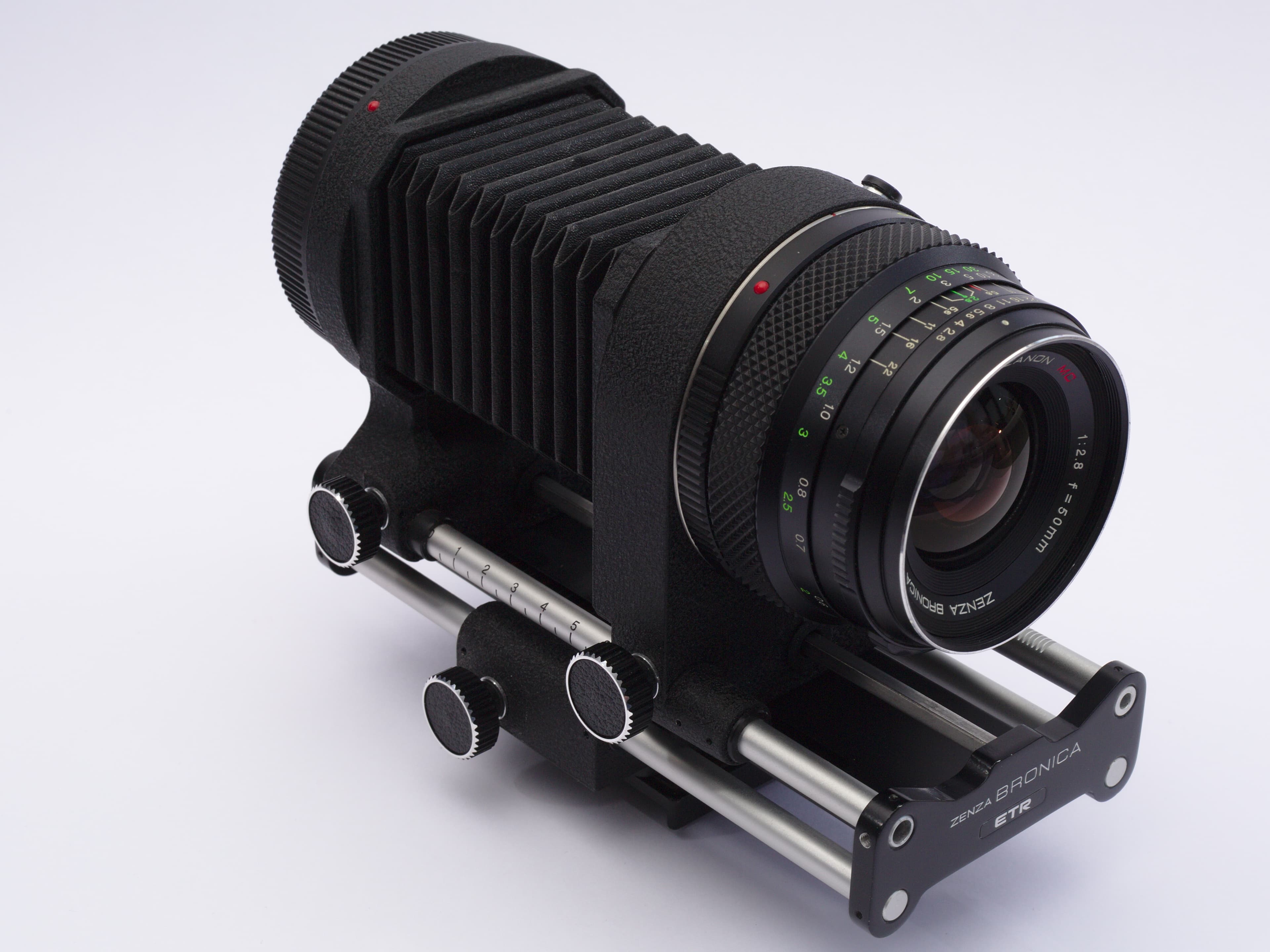
Bronica ETR bayonet mount. Zenzanon-E (manual diaphragm) and Zenzanon-PE (AE-coupled) lenses all fit: 40/4 E (fisheye-ish), 50/2.8 E, 60/3.5 E, 75/2.8 PE (standard), 100/2.8 PE, 105/3.5 MC, 150/3.5 PE, 200/4.5 PE, 250/5.6, 500/8. Accessories: 120 and 220 film backs (E-series, interchangeable); waist-level finder; 45° prism; AE-III metered prism (with PE lenses); Motor Winder E (AA batteries); hand grip; extension tubes; bellows unit.
E6
Fujifilm Fujichrome Velvia 50 (RVP 50) is the legendary professional E6 reversal slide film at ISO 50 that defined landscape and nature photography for a generation. Characterized by extreme saturation, deep contrast, and ultra-fine grain, it remains in active production as of 2026.
View profileBW
Ilford HP5 Plus is a flexible ISO 400 black-and-white film with classic grain and strong push-processing tolerance.
View profileBW
Kodak Tri-X 400 is a classic black-and-white film known for strong tonality, visible grain, and documentary character.
View profile