C41
Kodak Portra 400
Kodak Portra 400 is a professional C-41 color negative film known for flexible exposure latitude, natural skin tones, and fine grain.
View profile35mm SLR
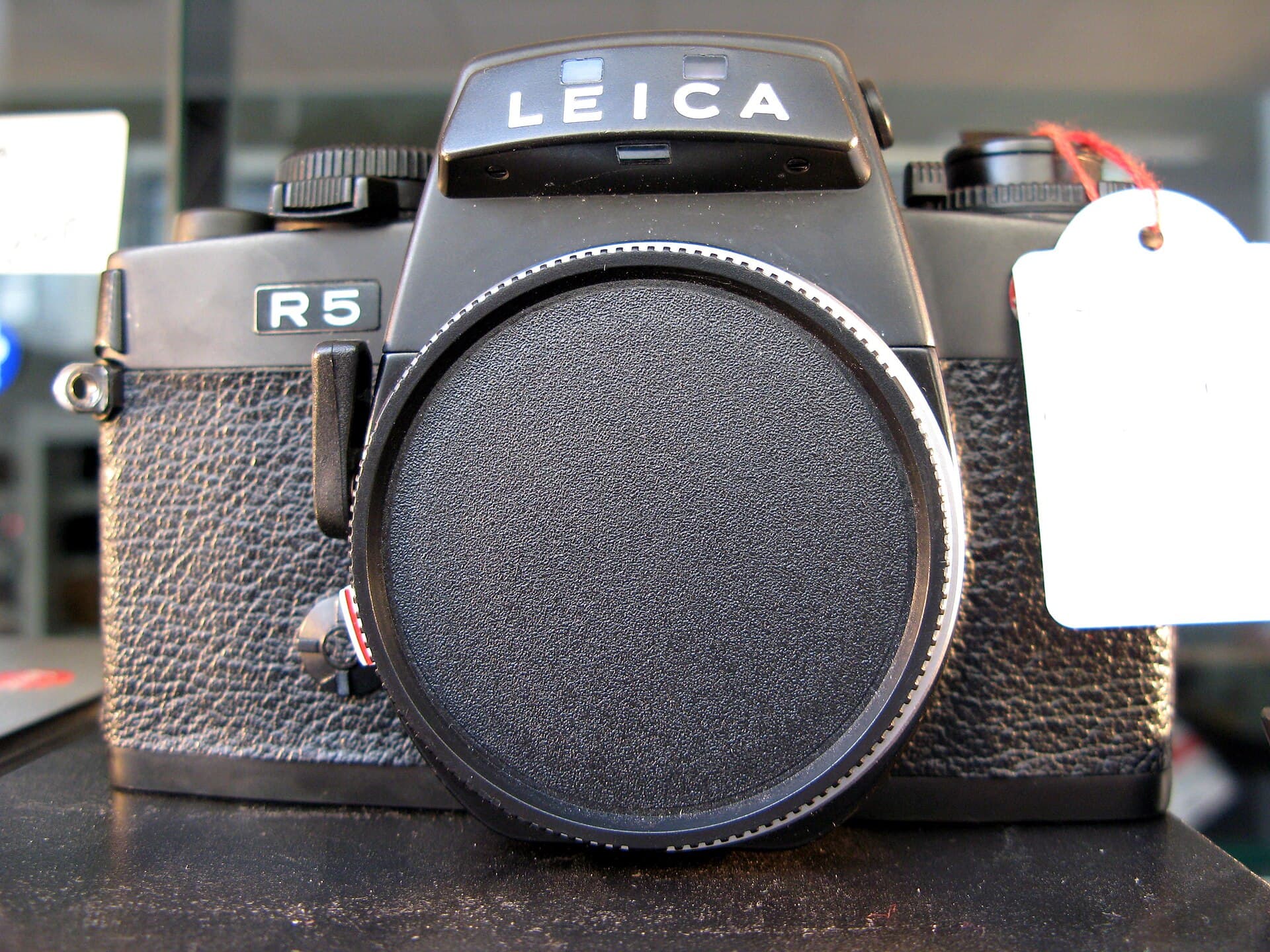
The Leica R5 (1987) is the fourth body in Leica's electronically controlled R-series, succeeding the R4 and itself succeeded by the R6 (mechanical) and R7. Built on the Minolta XD platform heritage — as were the R3 and R4 — the R5 retains full PASM exposure modes and the R-mount's 3-cam coupling, but adds two significant improvements over the R4: a multi-field selective metering pattern (in addition to the R4's spot and averaging modes) and full TTL flash metering via the SCA 300/500 system.
Reference
Recommended film stocks for the 35mm format your camera takes.
C41
Kodak Portra 400 is a professional C-41 color negative film known for flexible exposure latitude, natural skin tones, and fine grain.
View profileBW
Kodak Tri-X 400 is a classic black-and-white film known for strong tonality, visible grain, and documentary character.
View profileC41
Kodak Gold 200 is a daylight-balanced C-41 color negative film with warm color, moderate grain, and a classic consumer-film look.
Develop 35mm film
Labs in our directory that process 35mm film.
Before you buy used
About this camera
The R5 refined the Minolta-platform R body with multi-segment metering and TTL flash — the most capable R camera before the mechanical R6 and the electronic R7.
| Field | Value |
|---|
| Format | 35mm |
| Mount | Leica R bayonet (3-cam) |
| Years | 1987–1992 |
| Shutter | 8s – 1/2000s + B, vertical metal focal plane |
| Flash sync | 1/100s (mechanical fallback at 1/100s) |
| Meter | TTL multi-field selective + spot + averaging, EV 1–20 |
| Modes | P / Av / Tv / M |
| Viewfinder | Pentaprism, 0.75× |
| Weight | ~620 g body only |
| Battery | 2× CR1/3N lithium |
| Mechanical fallback | 1/100s only |
The R5 addressed the principal criticism of the R4: its metering system was limited to a single spot pattern (roughly 12% of the frame) plus an averaging mode, with no multi-segment or selective-area option. Multi-segment metering was by 1985 a feature of competing professional 35mm SLRs from Nikon (Matrix), Canon (evaluative), and Minolta (honeycomb). Leica's three-field selective metering in the R5 was not as sophisticated as these multi-zone systems but gave the photographer meaningful subject-biased measurement without committing to the narrow spot.
The TTL flash addition was equally important commercially: the R4 had no TTL flash capability, requiring manual flash-to-guide-number calculation. The R5's SCA-system TTL allowed compatible flash units to integrate fully with the exposure system, auto-cutting flash output at the correct exposure.
The R5 was produced from 1987 to 1992, overlapping briefly with the R6 (1992, mechanical) and the R7 (1992, electronic). The R5 and R7 serve different philosophies: the R5 is the feature-complete electronic body of its era; the R6 and R7 came after in the same year — R6 for mechanical-shutter purists, R7 as the updated electronic successor.
The R5 is the culmination of the Minolta-platform Leica R bodies — the point at which Leica's R-series became genuinely competitive with contemporary Japanese SLRs on technical grounds, not just optical quality. Its full PASM mode set, TTL flash, and multi-field metering left R-mount photographers without any functional excuse to switch systems.
For collectors and users today, the R5 occupies a sweet spot: it is capable enough for serious work, less expensive than the R6 or R7, and fully compatible with the R-mount lens range including the outstanding later ROM lenses (though the R5 predates ROM and does not use it). A clean R5 with a Summicron-R 50/2 or Elmarit-R 28/2.8 ASPH is a highly capable film camera at a reasonable used price.
Full Leica R bayonet range, 1-/2-/3-cam. Open-aperture metering with 3-cam lenses; stop-down with 1-/2-cam. ROM lenses fit but ROM data is not used by R5. Key lenses: Summicron-R 50/2, Summilux-R 50/1.4, Elmarit-R 28/2.8 ASPH, APO-Elmarit-R 180/2.8, APO-Macro-Elmarit-R 100/2.8. Motor Drive R (winder); SCA 300 / 500 series TTL flash; interchangeable focusing screens.
C41
Fujifilm Superia X-TRA 400 (marketed as Superia 400 in some regions) is an ISO 400 C-41 consumer color negative film in 135 format, one of Fujifilm's most popular consumer films. It delivers warm, vibrant colors with moderate grain and remains in production in some markets.
View profileBW
Ilford HP5 Plus is a flexible ISO 400 black-and-white film with classic grain and strong push-processing tolerance.
View profileC41
Kodak Ektar 100 is a fine-grain C-41 color negative film with saturated color and high sharpness.
View profile