C41
Kodak Portra 400
Kodak Portra 400 is a professional C-41 color negative film known for flexible exposure latitude, natural skin tones, and fine grain.
View profile35mm SLR
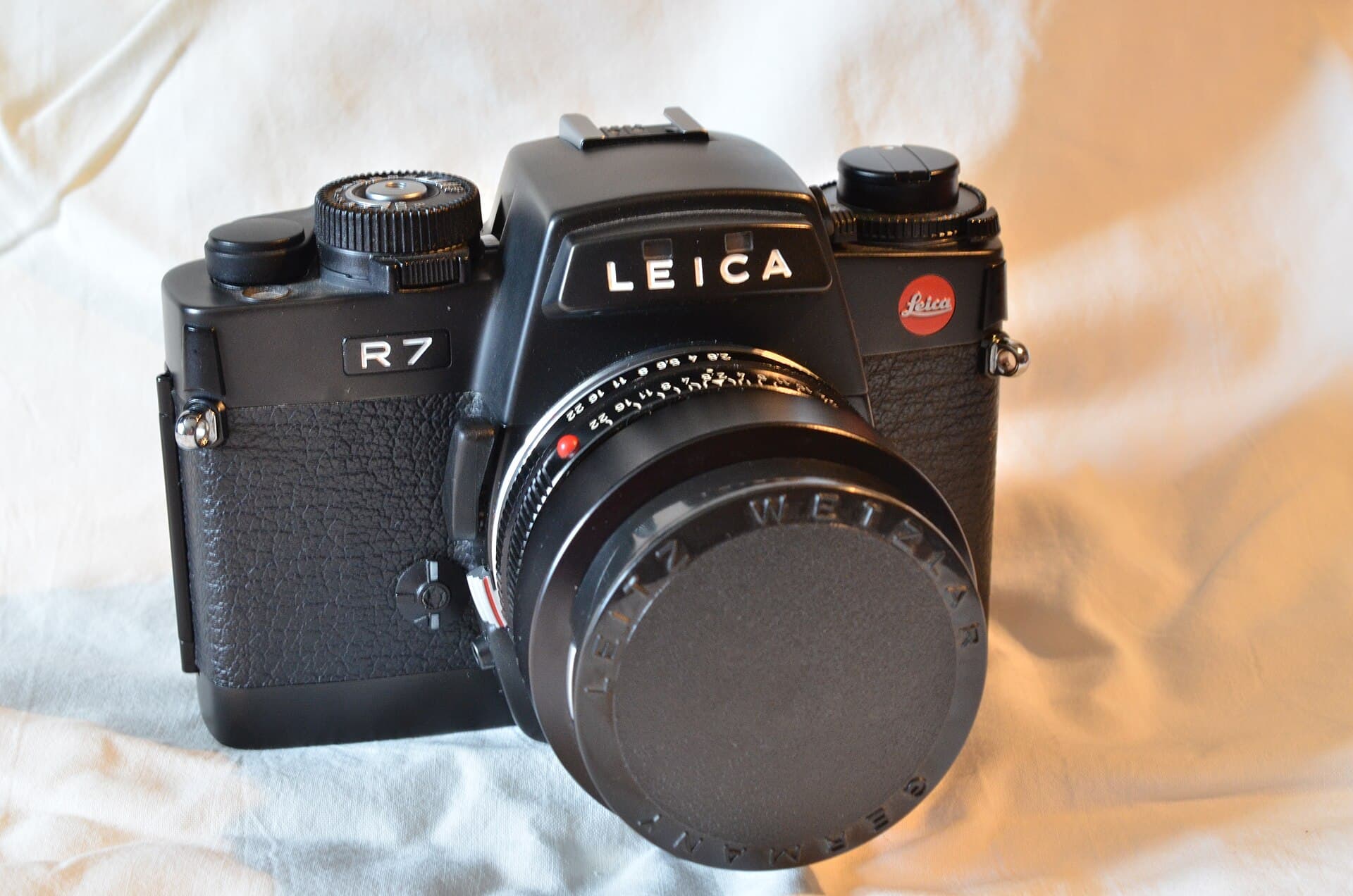
The Leica R7 (1992) is the fifth and final electronically controlled R-series body developed in collaboration with Minolta. Announced in the same year as the mechanical R6, the R7 sits at the opposite end of the philosophical spectrum: it is fully electronic, offering Program, Aperture Priority, Shutter Priority, and Manual modes, and it extends the selective-metering and TTL-flash integration first introduced in the R5.
Reference
Recommended film stocks for the 35mm format your camera takes.
C41
Kodak Portra 400 is a professional C-41 color negative film known for flexible exposure latitude, natural skin tones, and fine grain.
View profileBW
Kodak Tri-X 400 is a classic black-and-white film known for strong tonality, visible grain, and documentary character.
View profileC41
Kodak Gold 200 is a daylight-balanced C-41 color negative film with warm color, moderate grain, and a classic consumer-film look.
Develop 35mm film
Labs in our directory that process 35mm film.
Before you buy used
About this camera
The last Leica R body built on the Minolta platform — a refined electronic SLR that closed out an era before the radically redesigned R8 arrived in 1996.
| Field | Value |
|---|
| Format | 35mm |
| Mount | Leica R bayonet (3-cam + ROM contacts) |
| Years | 1992–1997 |
| Shutter | 8s – 1/2000s + B, vertical metal focal plane |
| Flash sync | 1/100s |
| Meter | TTL multi-field selective + spot + averaging, EV 1–20 |
| Modes | P / Av / Tv / M |
| Viewfinder | Pentaprism, 0.75× |
| Weight | ~640 g body only |
| Battery | 2× CR1/3N lithium |
| Mechanical fallback | 1/100s only |
| ROM compatibility | Partial (meter calibration; no data readout) |
The R7's development was driven by the need to provide Leica R users a contemporary electronic body while the mechanical R6 served purists. Leica's product strategy in 1992 was unusual: it simultaneously launched two bodies with opposed philosophies — the R6 (manual only, battery-independent shutter) and the R7 (full automation, battery-dependent).
The R7 was positioned as the working professional's electronic R camera, capable of handling the full automated exposure range required for news, editorial, and commercial work, while the R6 addressed documentary and reportage photographers. Both bodies used the same R-mount and the same vast R lens catalogue.
The R7 was the last Leica SLR to share its platform DNA with Minolta. When Leica developed the R8 (1996), they broke entirely from the Minolta relationship and designed a completely new body with new aesthetics (the asymmetric "humped" design by Manfred Meinzer) and new electronics.
The R7 matters as a capstone and as a practical shooter. As a capstone, it represents the perfected form of the Minolta-era Leica R camera — the final iteration of a design language that ran from the R3 (1976) through 16 years of refinement. As a practical tool, it is one of the most capable manual-focus 35mm SLRs ever made, with a superb viewfinder, metering flexibility, and access to the finest R-mount lenses including the late APO designs.
For photographers who want a capable electronic R body without the premium prices commanded by the R8 or R9, the R7 often represents the best value in the R lineup: more capable than the R5, more available than the R6, cheaper than the R8, and fully compatible with ROM lenses.
Full Leica R bayonet range including ROM-coded lenses (partial ROM use for meter calibration). 3-cam lenses give open-aperture metering; 2-cam and 1-cam require stop-down. Key lenses: Summicron-R 50/2, Summilux-R 50/1.4, Elmarit-R 28/2.8 ASPH, APO-Elmarit-R 180/2.8, APO-Macro-Elmarit-R 100/2.8, Vario-APO-Elmarit-R 70–180/2.8. Motor Drive R (winder); SCA 3000-series TTL flash (Metz, Leica); interchangeable focusing screens.
C41
Fujifilm Superia X-TRA 400 (marketed as Superia 400 in some regions) is an ISO 400 C-41 consumer color negative film in 135 format, one of Fujifilm's most popular consumer films. It delivers warm, vibrant colors with moderate grain and remains in production in some markets.
View profileBW
Ilford HP5 Plus is a flexible ISO 400 black-and-white film with classic grain and strong push-processing tolerance.
View profileC41
Kodak Ektar 100 is a fine-grain C-41 color negative film with saturated color and high sharpness.
View profile