C41
Kodak Portra 400
Kodak Portra 400 is a professional C-41 color negative film known for flexible exposure latitude, natural skin tones, and fine grain.
View profile35mm SLR
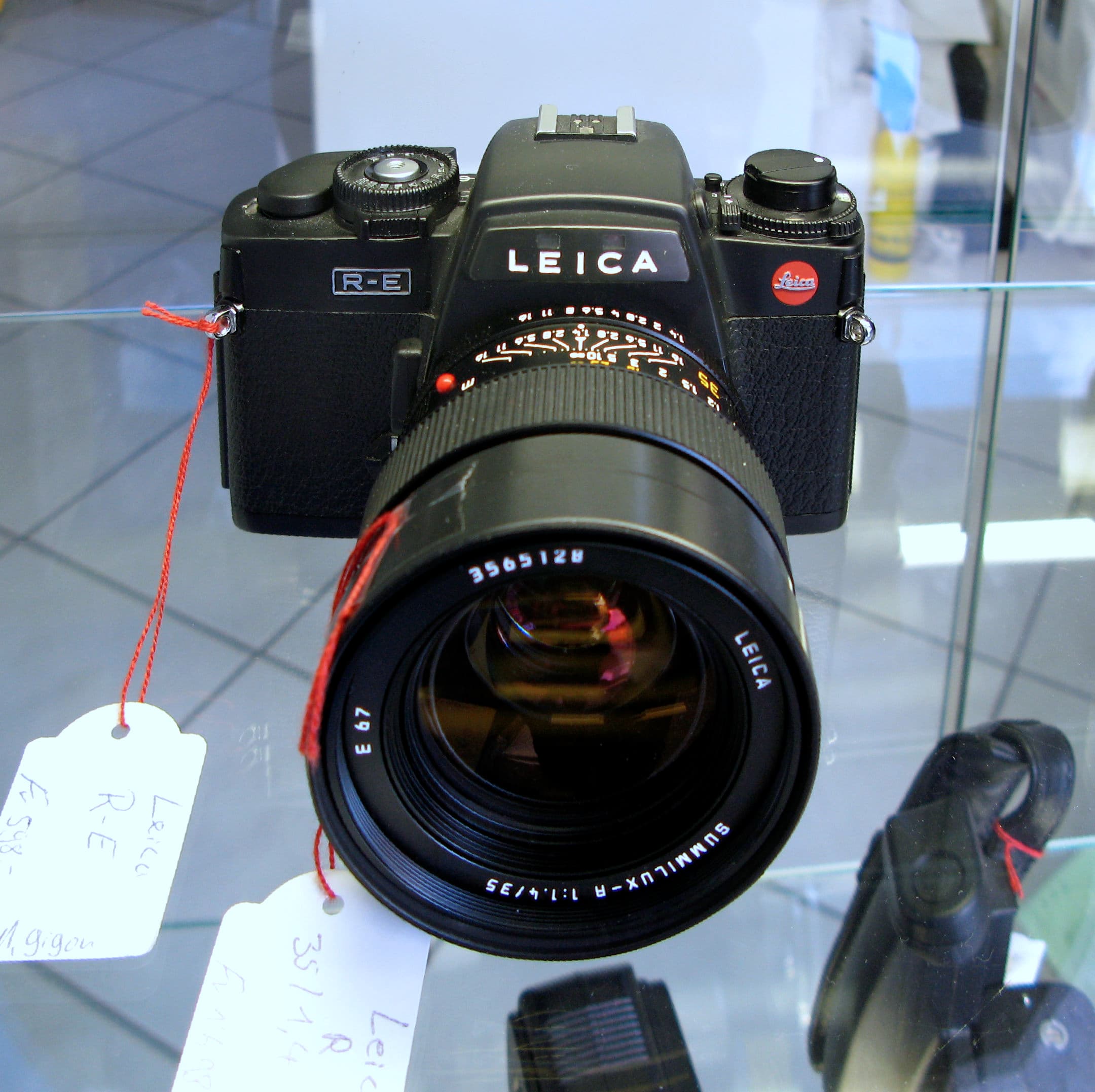
The Leica R-E (1990) is a reduced-specification variant of the Leica R-series, positioned below the R5 and alongside the purely mechanical R6. Where the R5 offered full PASM modes with selective/multi-field metering, the R-E was deliberately pared back: aperture-priority and manual exposure only, with a simpler averaging TTL meter rather than the R5's selective and spot modes. The shutter specification is identical to the R5 — focal-plane vertical metal, 8 seconds to 1/2000s, with a 1/100s mechanical fallback. The flash sync (1/100s) and battery type are also unchanged.
Reference
Recommended film stocks for the 35mm format your camera takes.
C41
Kodak Portra 400 is a professional C-41 color negative film known for flexible exposure latitude, natural skin tones, and fine grain.
View profileBW
Kodak Tri-X 400 is a classic black-and-white film known for strong tonality, visible grain, and documentary character.
View profileC41
Kodak Gold 200 is a daylight-balanced C-41 color negative film with warm color, moderate grain, and a classic consumer-film look.
Develop 35mm film
Labs in our directory that process 35mm film.
Before you buy used
About this camera
Leica's most affordable R-mount SLR — the R6's electronic cousin stripped to aperture-priority and manual, without spot metering, aimed at photographers who wanted R-mount optics at the lowest possible body price.
| Field | Value |
|---|
| Format | 35mm |
| Mount | Leica R bayonet (3-cam) |
| Years | 1990–1994 |
| Shutter | 8s – 1/2000s + B, vertical metal focal plane |
| Flash sync | 1/100s |
| Meter | TTL averaging, EV 1–20 |
| Modes | Av / M only |
| Viewfinder | Pentaprism, 0.75× |
| Weight | ~590 g body only |
| Battery | 2× CR1/3N lithium |
| Mechanical fallback | 1/100s only |
Leica introduced the R-E in 1990 as part of a commercial strategy to broaden R-system adoption. The R-series had always been the more expensive alternative to the Japanese SLR giants; the R-E attempted to lower the financial barrier while maintaining the brand integrity of a German-made Leica body.
The R-E was produced for only four years, discontinued in 1994. It was never followed by a direct successor in the same budget-oriented slot; by the mid-1990s the R7 (1992) became the primary electronic R body, and Leica concentrated on the R8 (1996) as its next flagship. The R-E therefore represents a brief and specific chapter in R-mount history: the moment when Leica experimented with accessible entry-level pricing in the film SLR segment.
The R-E is the entry point into the Leica R-mount system at the lowest body cost. Because its mechanical and optical performance is identical to the R5 when used in Av or M mode, it is often the recommended starting point for photographers who want to use R-mount glass — particularly the Summicron-R 50/2, Elmarit-R 28/2.8, or any of the later ASPH and ROM lenses — without paying the premium of an R5, R6, or R7 body.
Its averaging-only meter is less sophisticated than the R5's selective system, but for photographers accustomed to using an external meter or setting exposure manually, this is irrelevant. The R-E is often the most economical path to a working Leica R SLR.
Full Leica R bayonet range; open-aperture metering with 3-cam lenses, stop-down with 1-/2-cam. ROM lenses are physically compatible but ROM data is not used. Motor Drive R attaches via the base coupling. SCA-system TTL flash (SCA 300/500) works through the hotshoe, although TTL flash is less sophisticated than on the R5/R7. Interchangeable focusing screens are available.
C41
Fujifilm Superia X-TRA 400 (marketed as Superia 400 in some regions) is an ISO 400 C-41 consumer color negative film in 135 format, one of Fujifilm's most popular consumer films. It delivers warm, vibrant colors with moderate grain and remains in production in some markets.
View profileBW
Ilford HP5 Plus is a flexible ISO 400 black-and-white film with classic grain and strong push-processing tolerance.
View profileC41
Kodak Ektar 100 is a fine-grain C-41 color negative film with saturated color and high sharpness.
View profile