C41
Kodak Portra 400
Kodak Portra 400 is a professional C-41 color negative film known for flexible exposure latitude, natural skin tones, and fine grain.
View profile35mm SLR
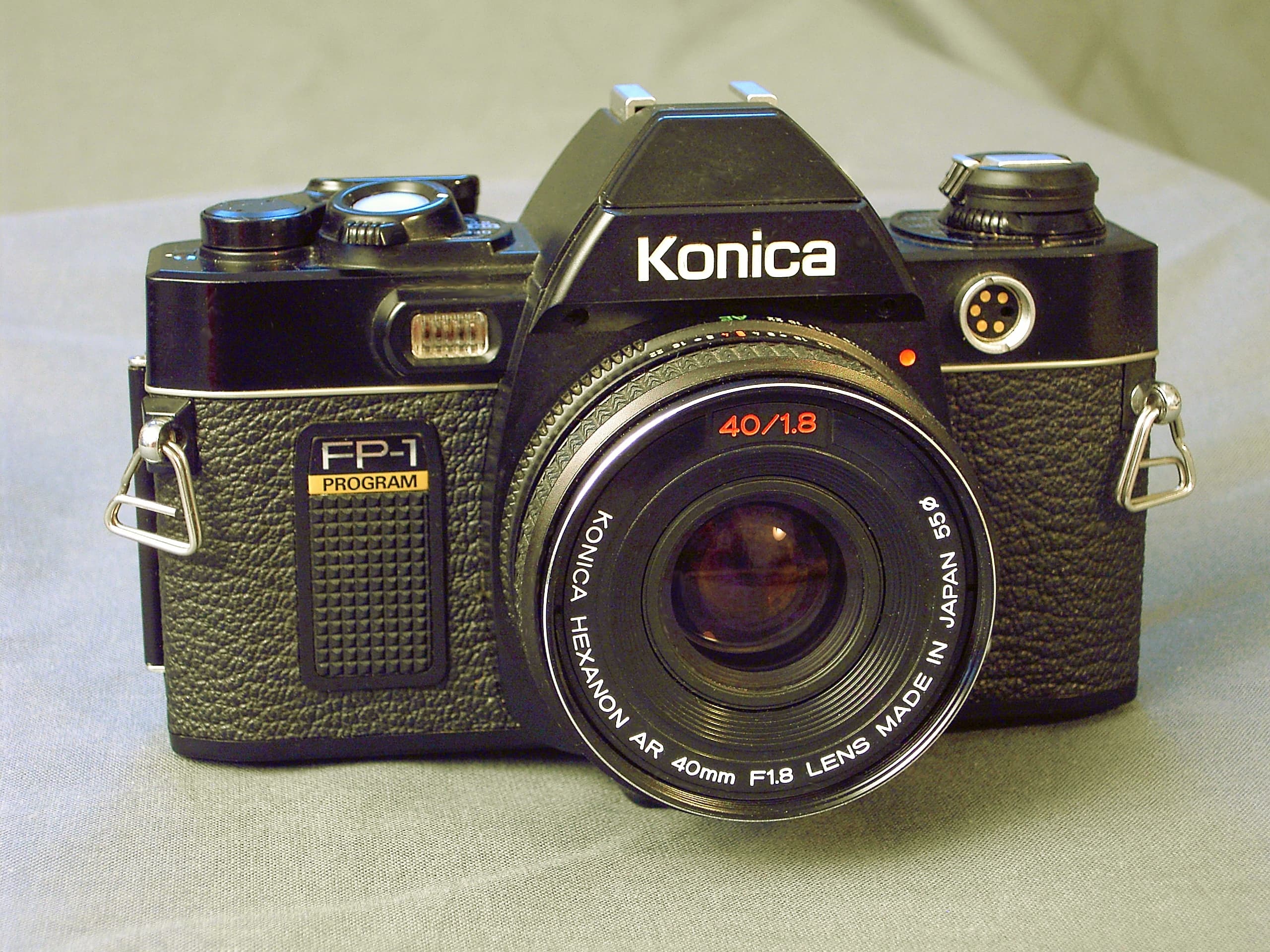
The Konica FP-1 (1980) is a consumer-grade 35mm SLR built around the Konica AR bayonet mount. It derives from the FS-1 (1979) platform but removes the integrated motor drive, producing a lighter and less expensive body aimed at the broad mid-market. The FP-1 offers two automatic exposure modes - programmed AE and aperture-priority AE - alongside an electronic vertical metal focal-plane shutter running from 2s to 1/1000s. Metering is TTL centre-weighted via a silicon cell. Power comes from four AA batteries; there is no mechanical fallback shutter speed.
Reference
Recommended film stocks for the 35mm format your camera takes.
C41
Kodak Portra 400 is a professional C-41 color negative film known for flexible exposure latitude, natural skin tones, and fine grain.
View profileBW
Kodak Tri-X 400 is a classic black-and-white film known for strong tonality, visible grain, and documentary character.
View profileC41
Kodak Gold 200 is a daylight-balanced C-41 color negative film with warm color, moderate grain, and a classic consumer-film look.
Develop 35mm film
Labs in our directory that process 35mm film.
Before you buy used
About this camera
A simplified FS-1 without the built-in motor drive - Konica's affordable two-mode SLR for the 1980s consumer market.
| Field | Value |
|---|
| Format | 35mm |
| Mount | Konica AR bayonet |
| Year introduced | 1980 |
| Shutter | 2s - 1/1000s + B, electronic vertical metal focal plane |
| Flash sync | ~1/100s |
| Meter | TTL silicon-cell centre-weighted |
| Modes | Program / Aperture-priority auto |
| Viewfinder | Pentaprism ~0.92x |
| Battery | 4x AA (required) |
| Mechanical fallback | None |
| Weight | ~510 g |
Following the FS-1's commercial underperformance - the built-in motor drive raised both cost and body bulk without winning the volume sales Konica needed - the company introduced the FP-1 in 1980 as a rationalised platform. The motor drive was dropped, the body was trimmed in size and price, and programmed AE was added alongside the aperture-priority mode carried over from the FS-1.
The addition of a full program mode reflected broader market trends: Canon had popularised program AE with the A-1 (1978) and the market was moving toward simplified operation for casual photographers. The FP-1's dual-mode approach positioned it as accessible for beginners while retaining the aperture-priority option for more deliberate shooting.
Konica phased out the FP-1 in the early-to-mid 1980s as the AR-mount SLR line contracted. The FT-1 (1983) and TC-X represented the final stages of Konica's SLR programme before the company exited the interchangeable-lens camera market.
The FP-1 is a workmanlike camera in a neglected corner of the AR-mount family. Its collector profile is low, which keeps used prices well below comparable bodies from Canon and Minolta of the same era. The chief reason to consider an FP-1 today is lens access: the Konica AR Hexanon range includes the 40mm f/1.8 and 50mm f/1.7 among the most optically respected standard primes in Japanese camera history, and the FP-1 provides a functional, inexpensive way to use them in their native mount.
The program mode is crude by later standards - fixed program curve, no shift - but functional for daylight snapshots. The aperture-priority mode is more versatile and the more useful of the two for deliberate photography. The electronic shutter's stepless control in AE mode gives slightly finer exposure accuracy than fixed-step mechanical shutters.
The FP-1 does not offer the historical novelty of the FS-1's motor drive or the extreme simplicity of the TC, and it sits in a no-man's-land between those two cameras. Its case for purchase rests primarily on the quality of the AR-mount lens ecosystem it opens up.
Full Konica AR bayonet mount compatibility. Key lenses: Hexanon AR 40mm f/1.8 (pancake), 50mm f/1.7, 50mm f/1.4, 57mm f/1.2, 28mm f/3.5, 28mm f/1.8, 85mm f/1.8, 135mm f/3.2, 200mm f/4. Third-party AR-mount glass from Tokina, Tamron, and Vivitar available. Accessories: standard hot-shoe flash, PC-sync cord, Konica cable releases.
C41
Fujifilm Superia X-TRA 400 (marketed as Superia 400 in some regions) is an ISO 400 C-41 consumer color negative film in 135 format, one of Fujifilm's most popular consumer films. It delivers warm, vibrant colors with moderate grain and remains in production in some markets.
View profileBW
Ilford HP5 Plus is a flexible ISO 400 black-and-white film with classic grain and strong push-processing tolerance.
View profileC41
Kodak Ektar 100 is a fine-grain C-41 color negative film with saturated color and high sharpness.
View profile