C41
Kodak Portra 400
Kodak Portra 400 is a professional C-41 color negative film known for flexible exposure latitude, natural skin tones, and fine grain.
View profile35mm SLR
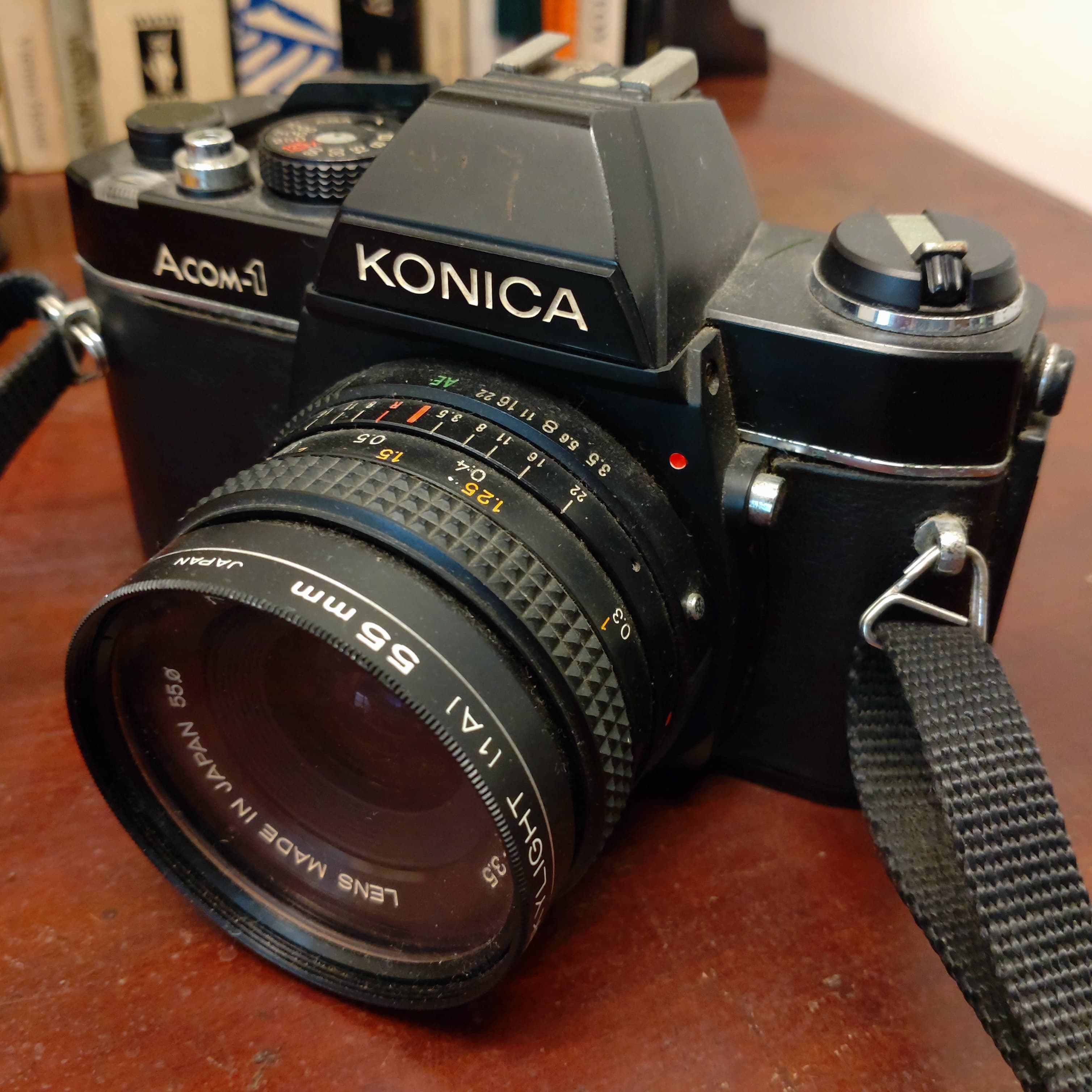
The Konica Acom-1 (1978) is a mid-range aperture-priority SLR that marks a significant shift in Konica's exposure philosophy. The Autoreflex line, from the original T in 1968 through the T3, T4, and TC, had used shutter-priority automatic exposure as its defining feature. The Acom-1 introduces aperture-priority AE to the Konica AR-mount system, following the direction set by competitors including the Olympus OM-2 (1975) and the Minolta XD-11 (1977).
Reference
Recommended film stocks for the 35mm format your camera takes.
C41
Kodak Portra 400 is a professional C-41 color negative film known for flexible exposure latitude, natural skin tones, and fine grain.
View profileBW
Kodak Tri-X 400 is a classic black-and-white film known for strong tonality, visible grain, and documentary character.
View profileC41
Kodak Gold 200 is a daylight-balanced C-41 color negative film with warm color, moderate grain, and a classic consumer-film look.
Develop 35mm film
Labs in our directory that process 35mm film.
Before you buy used
About this camera
Konica's mid-range aperture-priority SLR with an electronic shutter - a 1978 pivot from the Autoreflex line's shutter-priority heritage.
| Field | Value |
|---|
| Format | 35mm |
| Mount | Konica AR bayonet |
| Year introduced | 1978 |
| Shutter | ~4s - 1/1000s + B, electronic vertical metal focal plane |
| Flash sync | ~1/125s |
| Meter | TTL silicon-cell centre-weighted |
| Modes | Aperture-priority auto / Manual |
| Viewfinder | Pentaprism |
| Battery | 4x LR44 / SR44 (required for shutter and meter) |
| Mechanical fallback | None |
By the mid-1970s the Japanese SLR market was moving away from shutter-priority AE toward aperture-priority systems. Photographers and reviewers found aperture-priority more intuitive for controlling depth of field, and Olympus, Minolta, and Canon had launched successful aperture-priority bodies. Konica's TC (1976) had refreshed the shutter-priority formula in a compact body, but the Autoreflex line needed an aperture-priority answer.
The Acom-1 was introduced in 1978 as that answer. Konica simultaneously retained the TC in production for existing shutter-priority users and offered the Acom-1 for photographers who preferred the aperture-priority approach. The electronic shutter was a key enabling technology, allowing precise stepless control that mechanical shutters could not match.
The Acom-1's tenure in the line was relatively short. The FS-1 (1979), with its built-in motor winder, and the subsequent TC-X represented the next evolution, and the Acom-1 was phased out as Konica consolidated its SLR range in the early 1980s before exiting the SLR business.
The Acom-1 provides aperture-priority AE in the Konica AR mount at a very low used price. For photographers who own Hexanon lenses and want a body that prioritises depth-of-field control over shutter speed selection, it is the natural choice within the AR system - more appropriate than the TC for controlled light situations, portraiture, or close-up work where aperture selection is primary.
The electronic shutter's stepless operation also enables finer AE precision than the fixed-stop mechanical shutters of the TC line. In practice this means the Acom-1 can expose more accurately in tricky mixed-light situations. The trade-off - total battery dependency - is worth acknowledging; unlike the TC (which also requires batteries for AE but at least fires the shutter), the Acom-1 is completely inoperable without power.
Full Konica AR bayonet mount. Compatible lenses: Hexanon AR 50mm f/1.7, 50mm f/1.4, 57mm f/1.2, 28mm f/3.5, 28mm f/1.8, 40mm f/1.8, 135mm f/3.2, 200mm f/4. Third-party AR-mount glass from Tokina, Tamron, Vivitar available. Accessories: Konica cable releases, standard hot-shoe electronic flash, PC-sync cord for studio flash.
C41
Fujifilm Superia X-TRA 400 (marketed as Superia 400 in some regions) is an ISO 400 C-41 consumer color negative film in 135 format, one of Fujifilm's most popular consumer films. It delivers warm, vibrant colors with moderate grain and remains in production in some markets.
View profileBW
Ilford HP5 Plus is a flexible ISO 400 black-and-white film with classic grain and strong push-processing tolerance.
View profileC41
Kodak Ektar 100 is a fine-grain C-41 color negative film with saturated color and high sharpness.
View profile