C41
Kodak Portra 400
Kodak Portra 400 is a professional C-41 color negative film known for flexible exposure latitude, natural skin tones, and fine grain.
View profile35mm SLR
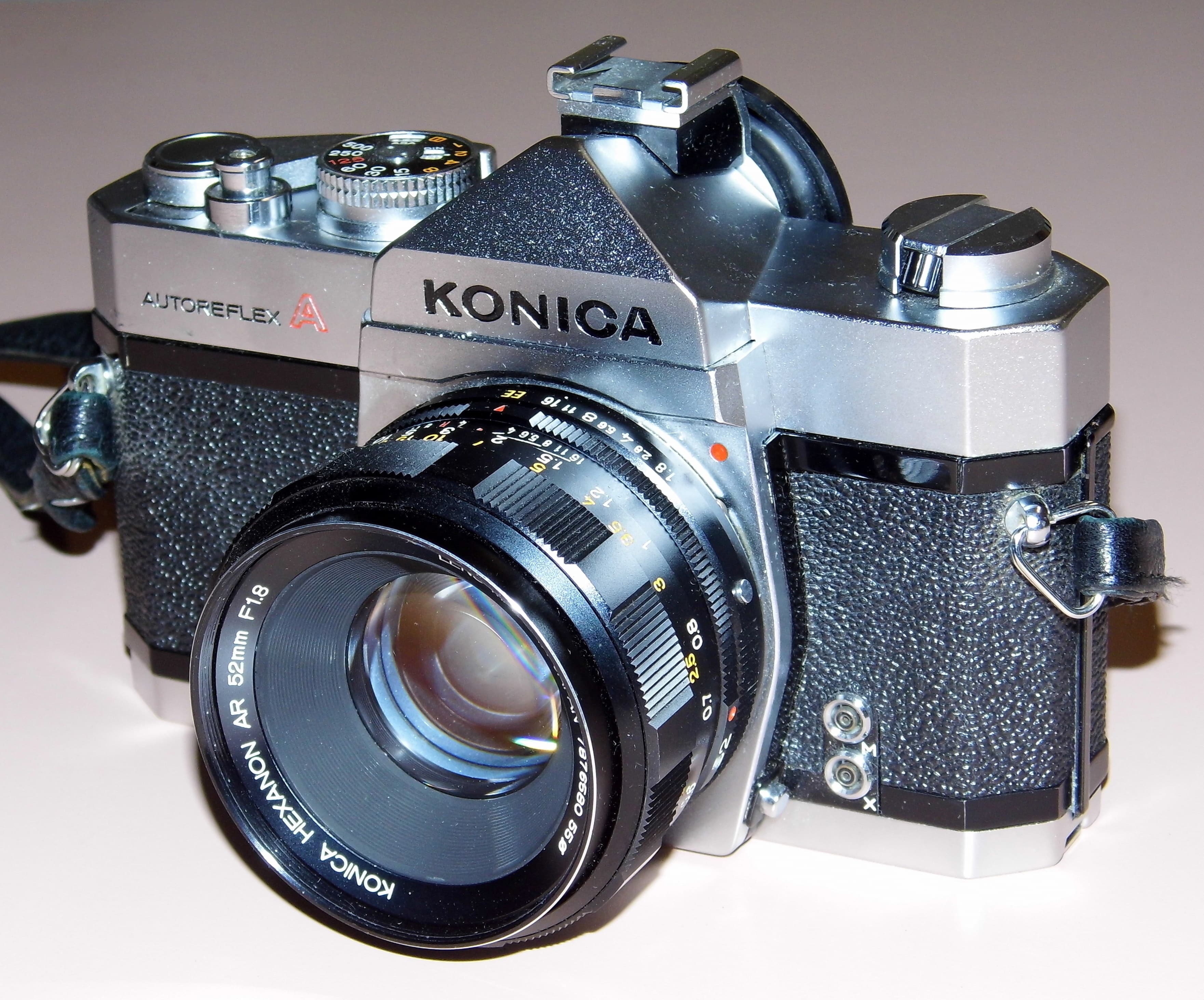
The Konica Autoreflex A3 (1968) is a manual-exposure-only SLR in the Autoreflex family, positioned as the budget entry point into the Konica AR-mount system. Where the original Autoreflex T and later T3 offered shutter-priority automatic exposure as a headline feature, the A3 removes that electronics entirely, providing a metered manual camera at a lower cost. The body shares the general construction and AR bayonet mount of its siblings, meaning it accepts the full range of Hexanon AR lenses without compromise.
Reference
Recommended film stocks for the 35mm format your camera takes.
C41
Kodak Portra 400 is a professional C-41 color negative film known for flexible exposure latitude, natural skin tones, and fine grain.
View profileBW
Kodak Tri-X 400 is a classic black-and-white film known for strong tonality, visible grain, and documentary character.
View profileC41
Kodak Gold 200 is a daylight-balanced C-41 color negative film with warm color, moderate grain, and a classic consumer-film look.
Develop 35mm film
Labs in our directory that process 35mm film.
Before you buy used
About this camera
The stripped-down Autoreflex — manual exposure only, full AR-mount compatibility, lower price of entry.
| Field | Value |
|---|
| Format | 35mm |
| Mount | Konica AR bayonet |
| Year introduced | 1968 |
| Shutter | 1s - 1/1000s + B, horizontal cloth focal plane |
| Flash sync | ~1/125s |
| Meter | TTL centre-weighted |
| Modes | Manual only |
| Viewfinder | Pentaprism |
| Battery | 1x PX625 (meter only) |
| Mechanical fallback | Yes - full shutter operation without battery |
Konica entered the SLR market with interchangeable-lens bayonet cameras in the mid-1960s. The Autoreflex T, launched in 1968, was notable for offering shutter-priority automatic exposure at a time when most Japanese SLRs were fully manual. The A3 was introduced concurrently as the no-AE sibling - a deliberate market segmentation to capture buyers who either could not justify the premium for AE or preferred manual operation on principle.
The A3 designation placed it below the T in the hierarchy. The camera's mechanical shutter fallback distinguished it from later AE-dependent bodies and made it a more durable proposition in the used market.
The Autoreflex range evolved through the T3, T4, TC, and eventually the FS-1 (1979). The A3 occupies the early, simpler end of that lineage, predating the feature escalation of the 1970s models.
The A3's significance is primarily as an access point. The Konica AR lens system - above all the Hexanon AR primes - is one of the undervalued optical lineages of the 35mm SLR era. The 50mm f/1.7 Hexanon is routinely benchmarked against Zeiss and Leica equivalents. The A3 provides a mechanical, no-electronics-required body that keeps these lenses operational indefinitely without concern for obsolete batteries or failed capacitors.
For photographers who find the TC's AE-dependency a liability in cold weather or after decades of storage, the A3's fully mechanical shutter makes it a more dependable host for Hexanon glass. At used prices that are among the lowest in the Autoreflex family, it represents good value for the cost-conscious manual shooter.
Full Konica AR bayonet mount. Key lenses compatible with the A3: Hexanon AR 50mm f/1.7 (benchmark performance, affordable), Hexanon AR 57mm f/1.2 (very fast, sought-after), Hexanon AR 28mm f/3.5, Hexanon AR 135mm f/3.2. Third-party AR-mount lenses from Tamron, Tokina, and Vivitar are also compatible. Accessories: cable release; Konica-branded filters; standard hot-shoe flash units with PC sync.
C41
Fujifilm Superia X-TRA 400 (marketed as Superia 400 in some regions) is an ISO 400 C-41 consumer color negative film in 135 format, one of Fujifilm's most popular consumer films. It delivers warm, vibrant colors with moderate grain and remains in production in some markets.
View profileBW
Ilford HP5 Plus is a flexible ISO 400 black-and-white film with classic grain and strong push-processing tolerance.
View profileC41
Kodak Ektar 100 is a fine-grain C-41 color negative film with saturated color and high sharpness.
View profile