C41
Kodak Portra 400
Kodak Portra 400 is a professional C-41 color negative film known for flexible exposure latitude, natural skin tones, and fine grain.
View profile35mm SLR
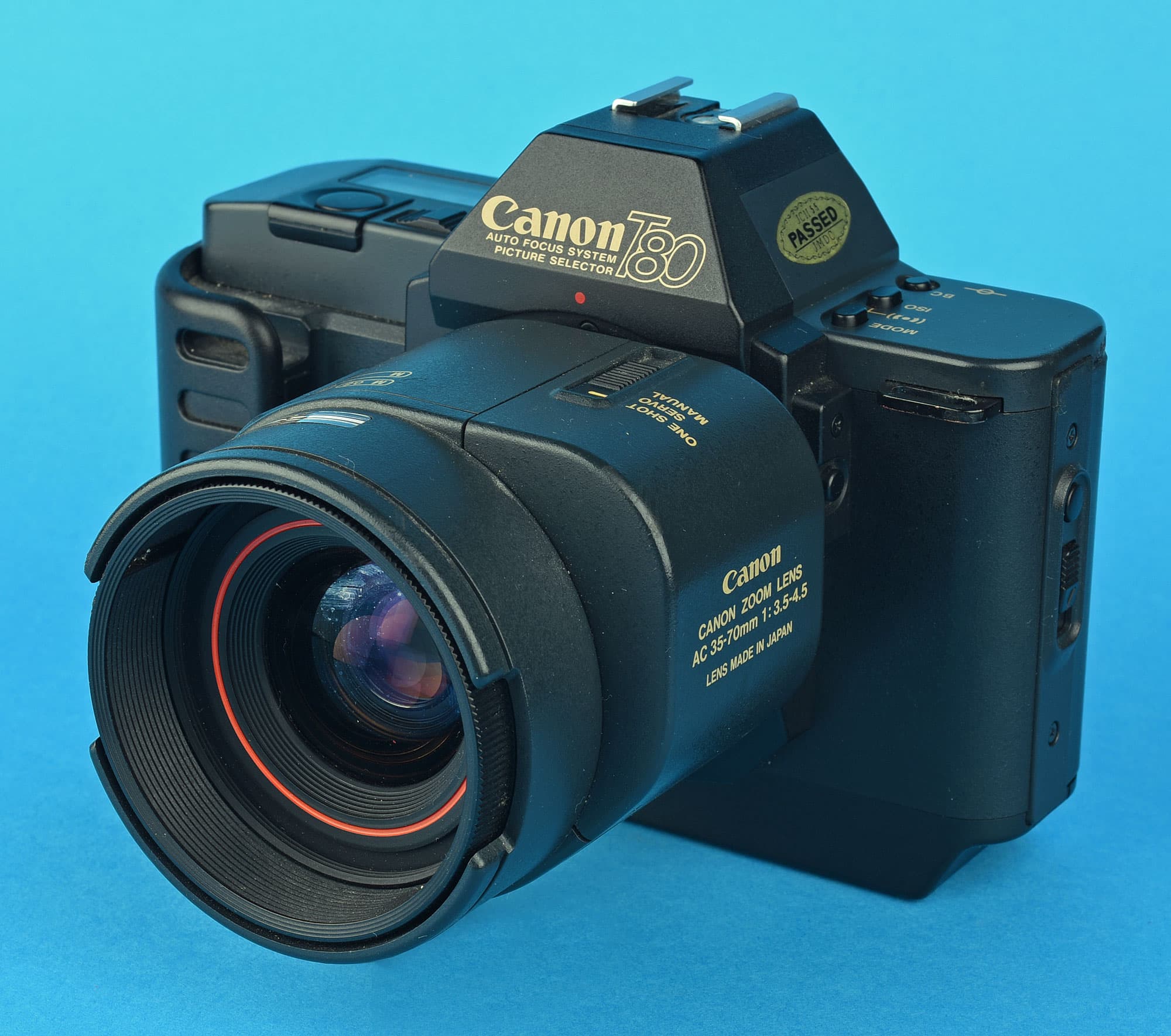
The T80, introduced in 1985, was Canon's initial attempt at an autofocus SLR. It used a proprietary Canon AC lens mount — distinct from both the FD mount and the later EOS mount — with motorized drive elements built into the lens rather than the body. The system was limited to a small set of dedicated AC lenses and was superseded within two years by the far more capable EOS system. The T80 is primarily of historical interest as Canon's autofocus learning exercise before EOS.
Reference
Recommended film stocks for the 35mm format your camera takes.
C41
Kodak Portra 400 is a professional C-41 color negative film known for flexible exposure latitude, natural skin tones, and fine grain.
View profileBW
Kodak Tri-X 400 is a classic black-and-white film known for strong tonality, visible grain, and documentary character.
View profileC41
Kodak Gold 200 is a daylight-balanced C-41 color negative film with warm color, moderate grain, and a classic consumer-film look.
Develop 35mm film
Labs in our directory that process 35mm film.
Before you buy used
About this camera
Canon's first autofocus SLR — a transitional curiosity that pointed toward EOS without quite getting there.
| Field | Value |
|---|
| Format | 35mm |
| Mount | Canon AC (proprietary, not FD-compatible) |
| Years | 1985–1986 |
| Shutter | 2s – 1/1000s, electronic horizontal cloth |
| Flash sync | 1/60s |
| Meter | Center-weighted, silicon |
| Battery | 4x AA |
| Exposure modes | Program, aperture-priority, shutter-priority, manual |
| Focus | Autofocus (contrast-detect via CCD sensor) |
Canon unveiled the T80 in 1985 as part of the T-series lineup that had begun with the T50 in 1983 and included the T70. Unlike those cameras, the T80 introduced autofocus, a feature Canon engineers were racing to deploy as Minolta's Maxxum 7000 had demonstrated AF's commercial viability in the same year. The AC mount lenses available at launch were few — reportedly three AC lenses were ever produced. By 1987 Canon abandoned the AC system entirely and released the EOS 650 with the new EF mount, which placed the AF motor fully inside the lens using a different architecture.
The T80 marks the dividing line between Canon's FD era and the EOS era. It shows that Canon understood by 1985 that autofocus would dominate, but had not yet solved the system design problem cleanly. The EOS EF mount — with its ultrasonic motor integration — was the correct answer; the T80 was the expensive draft. For historians of camera technology, the T80 illustrates that the Minolta Maxxum's 1985 launch jolted every major manufacturer into rapid, sometimes premature, AF development.
The Canon AC mount is incompatible with FD lenses and with EOS/EF lenses. AC lenses carry their own focus motor. The system is a dead end: no adapters exist to use AC glass on other bodies, and FD glass cannot be used on the T80. Collectors seeking the complete kit need an AC-mount lens to use the camera at all; a body alone is unusable for photography.
C41
Fujifilm Superia X-TRA 400 (marketed as Superia 400 in some regions) is an ISO 400 C-41 consumer color negative film in 135 format, one of Fujifilm's most popular consumer films. It delivers warm, vibrant colors with moderate grain and remains in production in some markets.
View profileBW
Ilford HP5 Plus is a flexible ISO 400 black-and-white film with classic grain and strong push-processing tolerance.
View profileC41
Kodak Ektar 100 is a fine-grain C-41 color negative film with saturated color and high sharpness.
View profile