C41
Kodak Portra 400
Kodak Portra 400 is a professional C-41 color negative film known for flexible exposure latitude, natural skin tones, and fine grain.
View profile35mm SLR
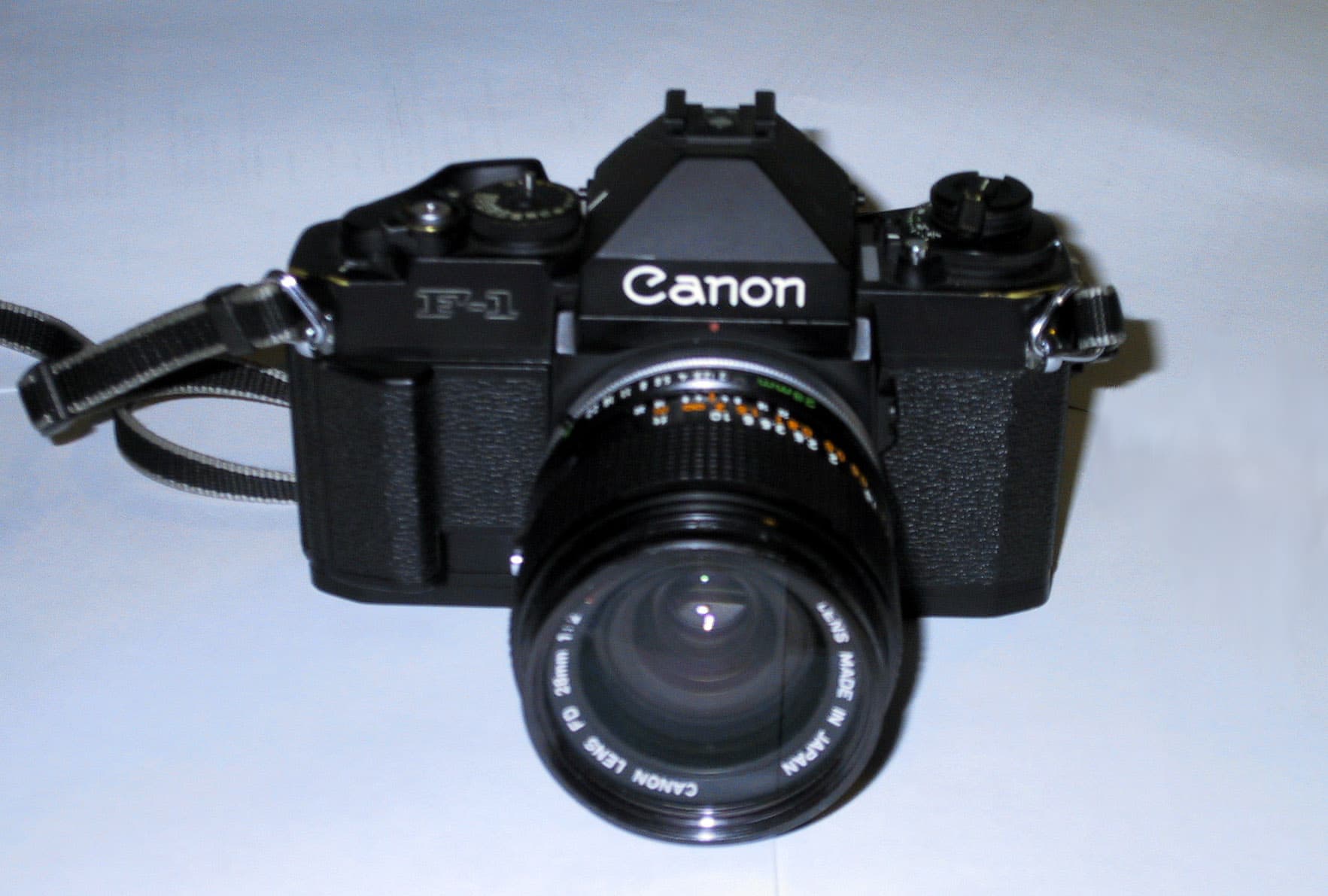
The Canon New F-1 (1981) is the second-generation F-1 professional system camera, a full redesign rather than a revision of the 1971 original. Its defining feature is a **hybrid shutter**: the fast speeds (1/2000s, 1/1000s, 1/500s, 1/250s, 1/125s, 1/90s, and B) are mechanically governed and run without battery; speeds from 1/60s down to 8s are electronically timed. Autoexposure is not built into the body -- it is added via the **AE Finder FN** (aperture-priority) or the **AE Motor Drive FN** (shutter-priority at up to 5 fps). The metering pattern changes with the installed focusing screen: center-weighted with the S screen, partial with the P screen, spot with the A screen.
Reference
Recommended film stocks for the 35mm format your camera takes.
C41
Kodak Portra 400 is a professional C-41 color negative film known for flexible exposure latitude, natural skin tones, and fine grain.
View profileBW
Kodak Tri-X 400 is a classic black-and-white film known for strong tonality, visible grain, and documentary character.
View profileC41
Kodak Gold 200 is a daylight-balanced C-41 color negative film with warm color, moderate grain, and a classic consumer-film look.
Develop 35mm film
Labs in our directory that process 35mm film.
Before you buy used
About this camera
Canon's 1981 professional flagship. Hybrid shutter, interchangeable finders, and AE via swappable prism -- built for the 1984 Olympics.
| Field | Value |
|---|
| Format | 35mm |
| Mount | Canon FD |
| Years | 1981–1992 |
| Shutter | 8s – 1/2000s + B; hybrid (mech 1/90s and faster, electronic 1/60s and slower) |
| Flash sync | 1/90s |
| Meter | TTL SPD; pattern determined by focusing screen installed |
| Modes | Manual (body); aperture-priority with AE Finder FN; shutter-priority with Motor Drive FN; program with both |
| Weight | 795 g |
| Battery | 1x 6V silver oxide (mech speeds work without) |
Canon launched the New F-1 in 1981 with the 1984 Los Angeles Olympics explicitly in mind -- Canon was the official Olympic camera supplier for LA 1984. The original F-1 (1971) had been built on a ten-year guarantee of no changes; the New F-1 fulfilled that promise by arriving in 1981 as a genuine successor rather than a mid-cycle patch. Production overlapped with the EOS-1 (1989), Canon's first autofocus professional body, and the FD line ended around 1992. Late production New F-1 bodies are sometimes called "F-1N" in the secondhand market, though Canon did not use that designation officially.
The New F-1 competed directly with the Nikon F3 in the early-1980s professional press market. The hybrid shutter gave it the F3's benefit of accurate electronic timing at slow speeds and in AE mode, while preserving fully mechanical operation at the high speeds most used in sports and news. Canon's decision to put AE in the finder rather than the body was architecturally unusual -- it kept the body itself simple and battery-independent at working speeds, at the cost of requiring a bulkier prism assembly for AE shooting.
By 2026, the New F-1 is the most sought-after FD-mount body. The FDn lens line -- particularly the 50/1.4, 85/1.2L, 35/2 SSC, and 24/2.8 SSC -- is critically well-regarded and underpriced relative to equivalent Nikon and Leica R glass.
Canon FD and FDn lenses. FDn ("new FD") lenses from 1979 onward have a simplified rear bayonet versus the breech-lock earlier FD lenses; both mount and meter correctly on the New F-1.
Key accessories:
C41
Fujifilm Superia X-TRA 400 (marketed as Superia 400 in some regions) is an ISO 400 C-41 consumer color negative film in 135 format, one of Fujifilm's most popular consumer films. It delivers warm, vibrant colors with moderate grain and remains in production in some markets.
View profileBW
Ilford HP5 Plus is a flexible ISO 400 black-and-white film with classic grain and strong push-processing tolerance.
View profileC41
Kodak Ektar 100 is a fine-grain C-41 color negative film with saturated color and high sharpness.
View profile