C41
Kodak Portra 400
Kodak Portra 400 is a professional C-41 color negative film known for flexible exposure latitude, natural skin tones, and fine grain.
View profileMedium Format Rangefinder
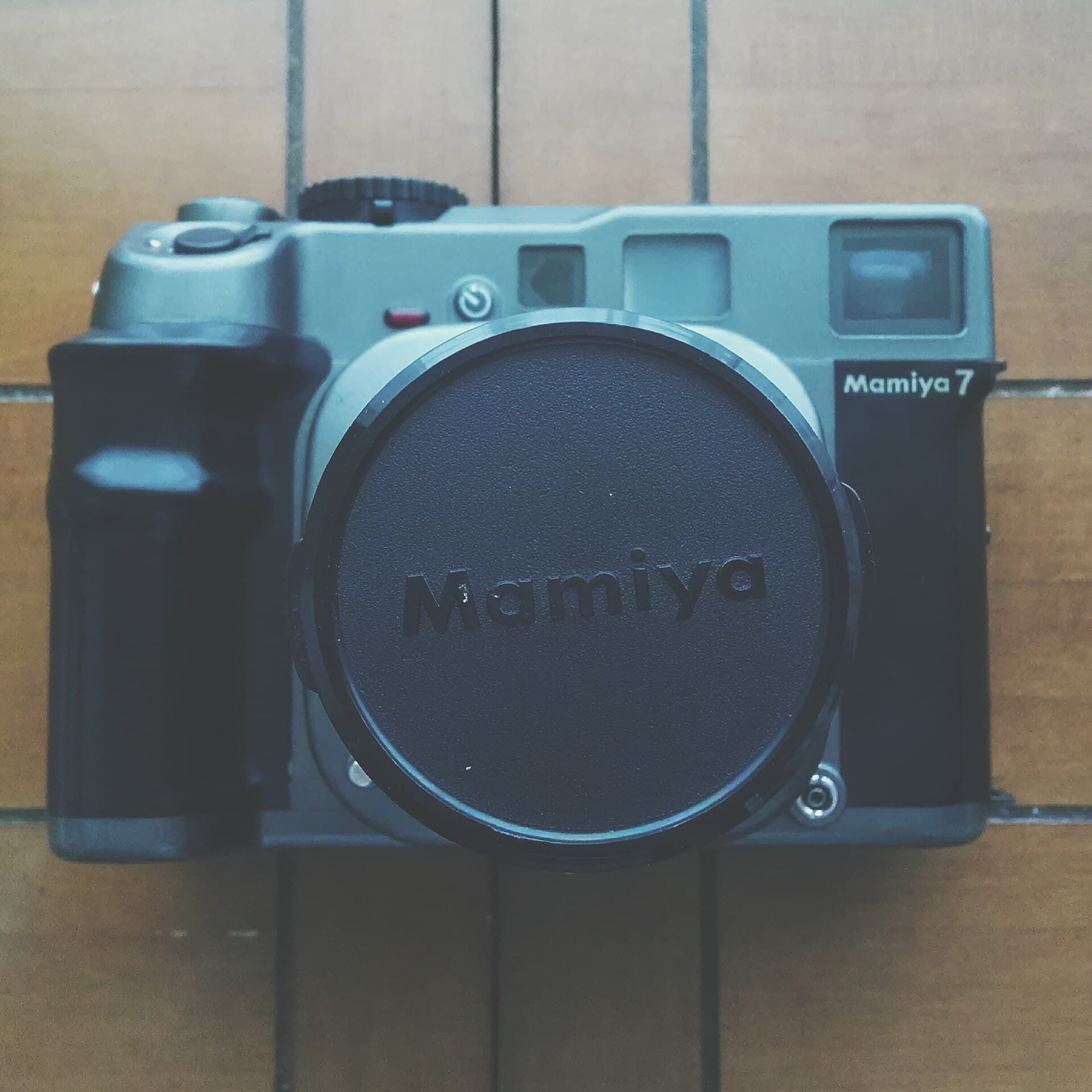
The Mamiya 7 is a 6×7 medium-format rangefinder. Lenses focus by helicoid, shutter sits in each lens (leaf, syncs flash at all speeds), and a rangefinder patch in the bright finder couples to focus. At 920 g loaded, it weighs less than a Pentax 67 lens. The trade-off: SLR users find the parallax-corrected finder limiting, and lens choice is small (six lenses total, no zooms, no macro).
Reference
Recommended film stocks for the — format your camera takes.
C41
Kodak Portra 400 is a professional C-41 color negative film known for flexible exposure latitude, natural skin tones, and fine grain.
View profileC41
Kodak Portra 160 is a professional C-41 color negative film with fine grain, soft contrast, and natural color.
View profileC41
Kodak Ektar 100 is a fine-grain C-41 color negative film with saturated color and high sharpness.
Develop — film
We're growing the lab directory near you. Browse all labs.
Before you buy used
About this camera
The lightest 6×7 ever made. Lens-shutter rangefinder for photographers who'd rather walk than set up a tripod.
| Field | Value |
|---|
| Format | 120 / 220, 6×7 cm (10 frames per 120 roll) |
| Mount | Mamiya 7 (bayonet) |
| Years | 1995–2014 (covering 7 and 7 II) |
| Shutter | 4s – 1/500s, Seiko leaf, in each lens |
| Flash sync | All speeds |
| Meter | Center-weighted silicon, AE-coupled |
| Modes | Aperture priority, manual |
| Weight | 920 g (with 80mm) |
| Battery | 1× 6V (required) |
Released 1995, succeeding the Mamiya 6 (1989, 6×6 rangefinder, retractable lens mount). The Mamiya 7 II (1999) added improved rangefinder finder, multiple-exposure capability, and a panoramic-mask 35mm adapter. Production of the 7 II ended in 2014, making it among the last new film cameras Mamiya built. No direct successor.
The Mamiya 7 is the canonical landscape film camera. Six lenses (43, 50, 65, 80, 150, 210), a meter that works, a body you can hike with, and 6×7 negatives that scan to roughly 100 megapixels of detail. The 43mm is one of the most-praised wide-angles ever made — distortion-free, edge-to-edge sharp at f/8, with a corresponding optical viewfinder that mounts to the hot shoe.
For working photographers it became the medium-format alternative to a Linhof or Toyo 4×5 — same negative ratio (close enough), faster shooting, no need for a tripod. The trade-off is no SLR through-the-lens compose: filters and close-up work require external accessories, and macro is essentially impossible.
All Mamiya 7-mount lenses are praised for sharpness:
Panoramic 35mm adapter (mask the negative for 24×65 mm wide frames). Polarizer adapter for 43mm and 50mm. No zoom, no macro, no fisheye, no faster-than-f/4 glass.
E6
Fujifilm Fujichrome Provia 100F (RDPIII) is a professional E6 reversal (slide) film in 135 and 120 formats, known for its natural, balanced color reproduction, very fine grain, and moderate saturation. It remains in production as of 2026 and is one of the last professional slide films available.
View profileBW
Kodak Tri-X 400 is a classic black-and-white film known for strong tonality, visible grain, and documentary character.
View profile