C41
Kodak Portra 400
Kodak Portra 400 is a professional C-41 color negative film known for flexible exposure latitude, natural skin tones, and fine grain.
View profileMedium Format Rangefinder
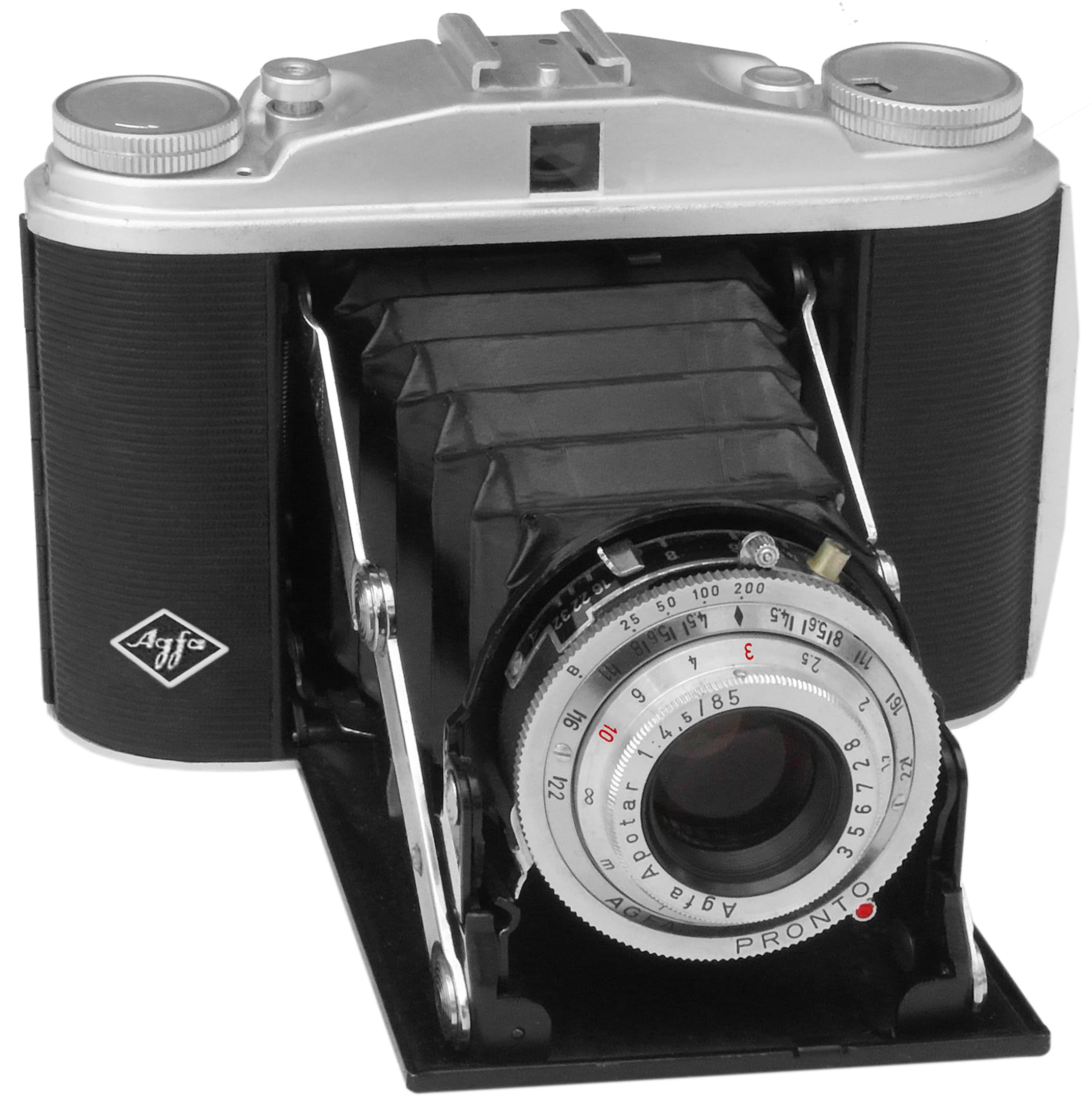
The Agfa Isolette II (1950) is the middle member of Agfa's 1950s Isolette folding 6×6 medium-format camera family, positioned between the basic Isolette I (Agnar lens, Vario shutter) and the more capable Isolette III (which added an uncoupled rangefinder). The Isolette II's distinguishing feature is the Agfa Apotar 85/4.5 — a four-element Tessar-type design that substantially outperforms the three-element Agnar in sharpness and contrast, particularly at wider apertures.
Reference
Recommended film stocks for the — format your camera takes.
C41
Kodak Portra 400 is a professional C-41 color negative film known for flexible exposure latitude, natural skin tones, and fine grain.
View profileC41
Kodak Portra 160 is a professional C-41 color negative film with fine grain, soft contrast, and natural color.
View profileC41
Kodak Ektar 100 is a fine-grain C-41 color negative film with saturated color and high sharpness.
Develop — film
We're growing the lab directory near you. Browse all labs.
Before you buy used
About this camera
The mid-tier Isolette — the Isolette II steps up from the entry-level I by fitting the superior Apotar 85/4.5 four-element lens in a Prontor-SV shutter, delivering better optical performance than the Agnar while remaining a pure scale-focus camera without rangefinder.
| Field | Value |
|---|
| Format | 6×6 cm on 120 roll film |
| Lens | Agfa Apotar 85/4.5 (or Agnar 85/4.5 on some variants) |
| Years | 1950–1958 |
| Shutter | Prontor-SV: 1s – 1/300s + B + self-timer |
| Flash sync | X sync |
| Meter | None |
| Focus | Scale focus |
| Negatives | 12 per roll (6×6) |
| Weight | ~500 g |
| Battery | None required |
The Agfa Isolette family was established in the late 1930s and expanded postwar to cover multiple specification tiers. The Isolette II appeared in 1950 as the middle-tier variant, fitting the four-element Apotar in a better shutter than the entry-level I. Agfa's postwar Munich operations were a major force in the West German camera market — Agfa film and Agfa cameras were complementary products distributed through the same channels, giving the Isolette family strong retail presence.
The Isolette II was in production through 1958, overlapping with the introduction of the Isolette III (1952 onward) and the broader market shift toward 35mm. Many examples survive in good working condition; the Prontor-SV shutter is well-documented and serviceable.
The Isolette II with a clean Apotar lens is a genuinely capable medium-format shooting camera. The Apotar 85/4.5 — a Tessar-type four-element design — produces sharp, well-corrected 6×6 negatives that reward enlargement or scanning. Zone focus at f/8 covers the majority of practical outdoor shooting situations without demanding precise rangefinder work.
For photographers new to medium format who want a step up from toy-camera quality without the cost or complexity of a coupled rangefinder, the Isolette II represents an excellent value proposition on the used market. A working example with a clean Apotar and newly replaced bellows is a legitimately good camera.
Fixed non-interchangeable lens. Standard: Agfa Apotar 85/4.5 (four-element Tessar-type) in Prontor-SV shutter. Some examples carry the Agnar 85/4.5 (three-element). Push-on filters in 29mm or 32mm; cable release; cold-shoe accessory meter.
E6
Fujifilm Fujichrome Provia 100F (RDPIII) is a professional E6 reversal (slide) film in 135 and 120 formats, known for its natural, balanced color reproduction, very fine grain, and moderate saturation. It remains in production as of 2026 and is one of the last professional slide films available.
View profileBW
Kodak Tri-X 400 is a classic black-and-white film known for strong tonality, visible grain, and documentary character.
View profile