C41
Kodak Portra 400
Kodak Portra 400 is a professional C-41 color negative film known for flexible exposure latitude, natural skin tones, and fine grain.
View profileMedium Format Rangefinder
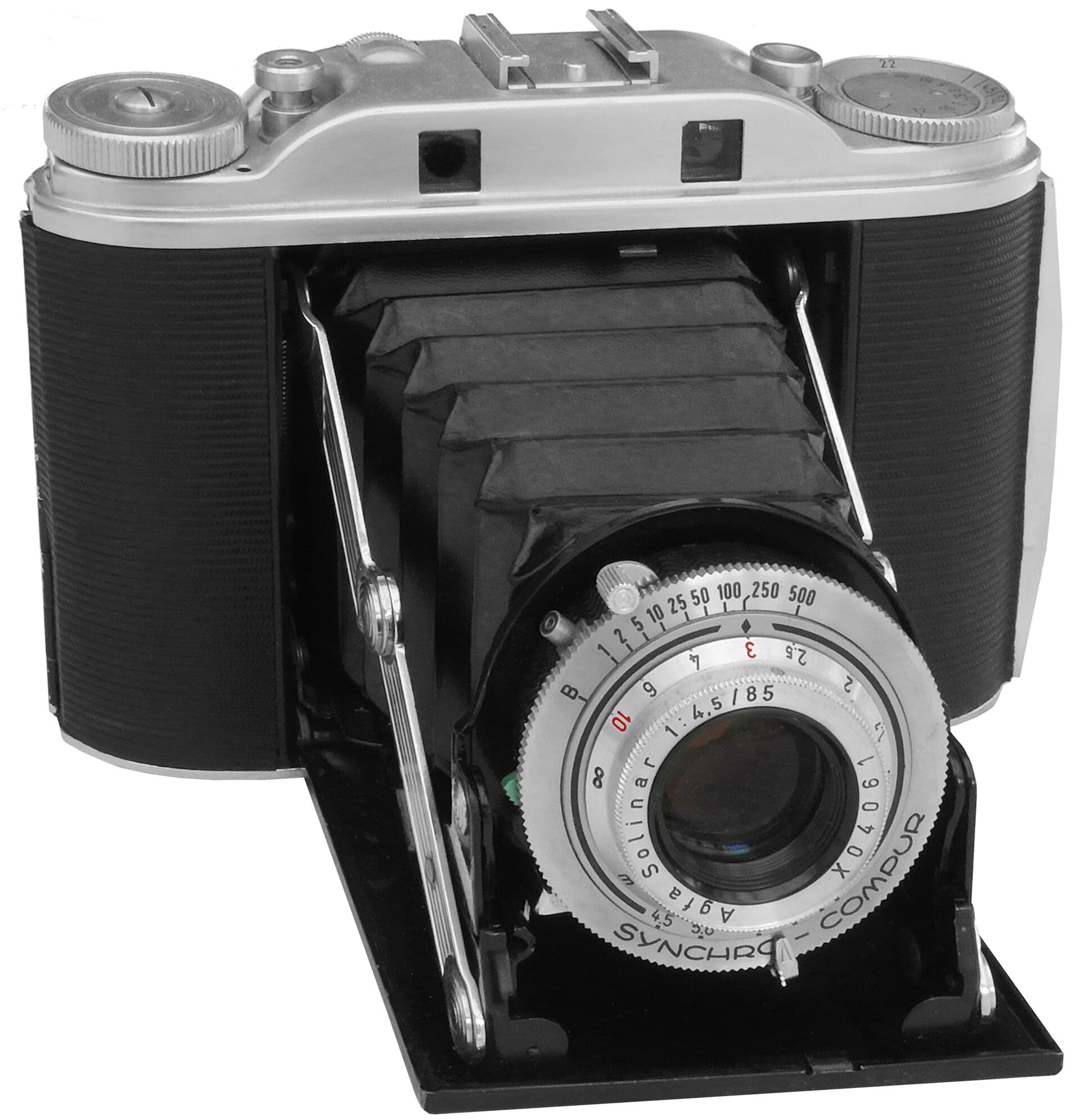
The Agfa Isolette III (1952) is a 6×6 folding medium-format camera from Agfa's Munich works, offering an **uncoupled rangefinder** — a step up from the zone-focus Isolette II. You take two readings (rangefinder reading + manual transfer to focus ring) rather than estimating distance, which improves hit rate significantly. The shutter is a **Synchro-Compur** leaf shutter (1s–1/500s), full flash sync at all speeds. Lens options were either the **Solinar 75/3.5** (four-element Tessar-type, superior) or the **Apotar 85/4.5** (three-element Cooke triplet, adequate).
Reference
Recommended film stocks for the — format your camera takes.
C41
Kodak Portra 400 is a professional C-41 color negative film known for flexible exposure latitude, natural skin tones, and fine grain.
View profileC41
Kodak Portra 160 is a professional C-41 color negative film with fine grain, soft contrast, and natural color.
View profileC41
Kodak Ektar 100 is a fine-grain C-41 color negative film with saturated color and high sharpness.
Develop — film
We're growing the lab directory near you. Browse all labs.
Before you buy used
About this camera
German 6×6 folder with uncoupled rangefinder. Solinar or Apotar 75mm, Synchro-Compur shutter, 1952–1960. One of the most common medium-format folders to find and restore.
| Field | Value |
|---|
| Format | 120 film (6×6, 12 exposures) |
| Lens | Solinar 75/3.5 or Apotar 85/4.5 (fixed) |
| Shutter | 1s – 1/500s + B, Synchro-Compur leaf |
| Flash sync | All speeds |
| Rangefinder | Uncoupled (read + transfer manually) |
| Meter | None |
| Weight | ~580 g |
| Battery | None |
Agfa produced the Isolette family from the early 1950s through the 1960s: Isolette I (zone focus), Isolette II (zone focus, Apotar), Isolette III (uncoupled RF, Apotar or Solinar), and Isolette L (with light meter). The III (1952) is generally the most desirable for practical shooting thanks to the rangefinder. Production ended around 1960 as SLR cameras began dominating the amateur market. Agfa shifted to point-and-shoot and later disposable products.
The Agfa Isolette III offers 6×6 film at an entry-level price. Solinar-equipped examples shoot surprisingly well — the Tessar-type lens design is modest but renders cleanly stopped down to f/8. The uncoupled rangefinder, while less convenient than a coupled system, eliminates the distance-guessing that ruins focus on otherwise capable zone-focus folders.
For new medium-format shooters on a budget, an Isolette III CLA'd with a Solinar lens for $80–150 is a genuine path to medium-format without the cost of a Mamiya, Bronica, or Hasselblad system. The tradeoff is slow operation (read rangefinder, dial in focus, then compose and shoot) and the absence of a meter.
Fixed Agfa Solinar 75/3.5 (preferred) or Apotar 85/4.5. No interchangeable lens capability. Accessory shoe for external flash (PC sync connector also present).
E6
Fujifilm Fujichrome Provia 100F (RDPIII) is a professional E6 reversal (slide) film in 135 and 120 formats, known for its natural, balanced color reproduction, very fine grain, and moderate saturation. It remains in production as of 2026 and is one of the last professional slide films available.
View profileBW
Kodak Tri-X 400 is a classic black-and-white film known for strong tonality, visible grain, and documentary character.
View profile