C41
Kodak Portra 400
Kodak Portra 400 is a professional C-41 color negative film known for flexible exposure latitude, natural skin tones, and fine grain.
View profile35mm Rangefinder
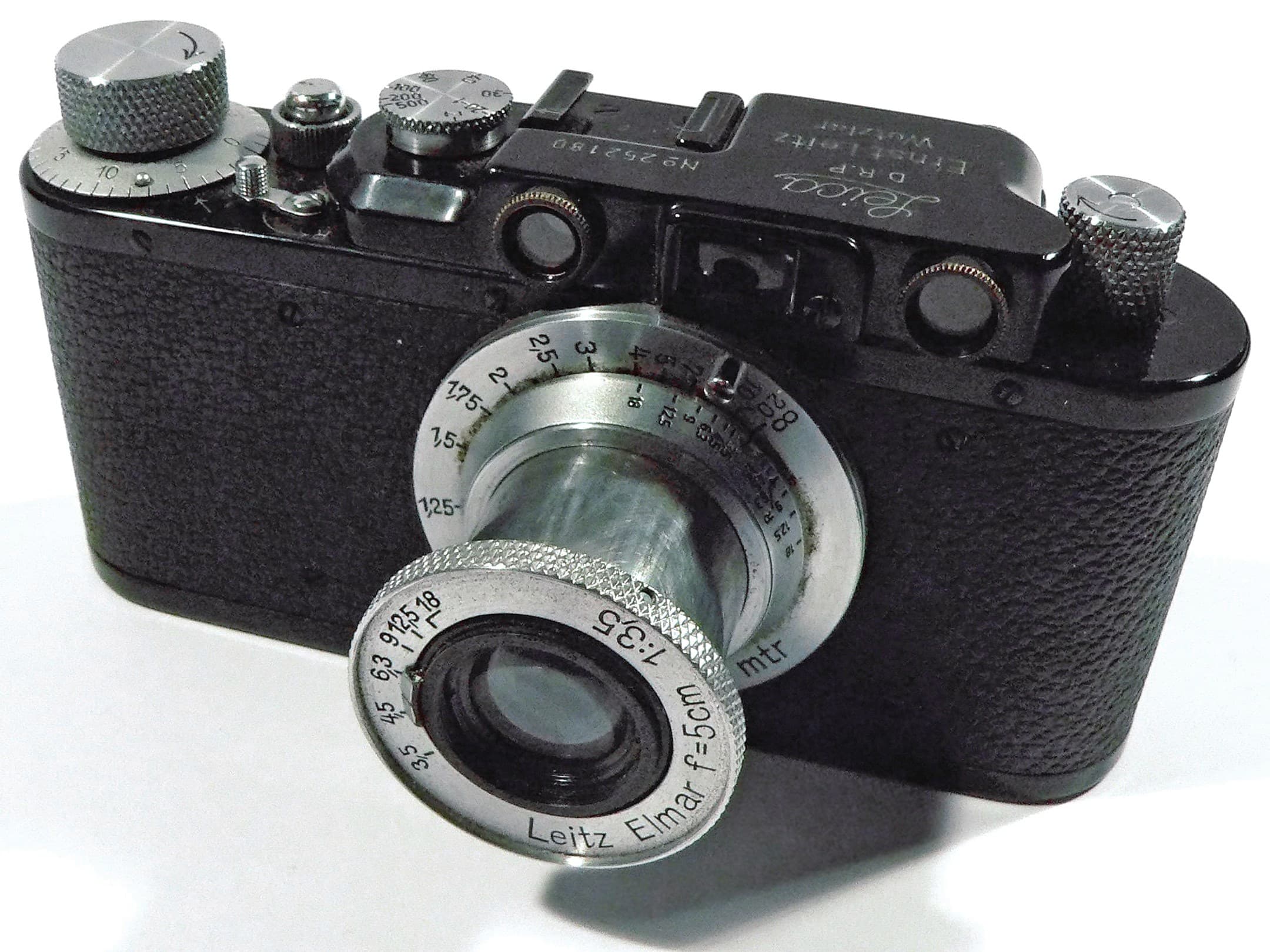
The Leica II (1932) was the first Leica with a **coupled rangefinder** — earlier Leica I bodies required external rangefinders for accurate focus. Same Barnack body design as later III-series, brass with vulcanite, mechanical horizontal-cloth shutter, Leica Screw Mount. No flash sync. Maximum shutter 1/500s; the IIIa (1935) added 1/1000s. Production ran 16 years through WWII; ~50,000 units made.
Reference
Recommended film stocks for the 35mm format your camera takes.
C41
Kodak Portra 400 is a professional C-41 color negative film known for flexible exposure latitude, natural skin tones, and fine grain.
View profileBW
Ilford HP5 Plus is a flexible ISO 400 black-and-white film with classic grain and strong push-processing tolerance.
View profileBW
Kodak Tri-X 400 is a classic black-and-white film known for strong tonality, visible grain, and documentary character.
Develop 35mm film
Labs in our directory that process 35mm film.
Before you buy used
About this camera
The first Leica with a coupled rangefinder. 1932. The body that established 35mm photography's modern workflow.
| Field | Value |
|---|
| Format | 35mm |
| Mount | Leica Screw Mount |
| Years | 1932–1948 |
| Shutter | 1/20s – 1/500s + B + Z, mechanical horizontal cloth |
| Flash sync | None |
| Meter | None |
| Modes | Manual |
| Weight | 540 g |
| Battery | None |
Released 1932 as Leica's first rangefinder camera. Earlier Leica I (1925) and Compur (1929) bodies relied on guesswork or external accessories for focus. The II's coupled rangefinder synchronized lens focus with a measured distance reading — a workflow innovation that defined 35mm photography for the next 60 years.
The Leica II is one of the most historically significant cameras ever made. Before it, 35mm photography was a 1920s amateur curiosity; after it, 35mm became the dominant photojournalism format. Combined with Oskar Barnack's Leica I (1925), the II established 35mm photography's templates — small-form-factor cameras, fast handling, candid imagery — that defined press photography until the iPhone era.
For 2026 buyers, used Leica II bodies at $500–1,200 are accessible pre-war Leica history. They're shooters' cameras as much as collectors' — the slow shutter top of 1/500s is the only meaningful limitation for film practice.
Leica Screw Mount lenses (any era). Pre-war kit: Elmar 50/3.5, Hektor 50/2.5. Post-war LTM lenses also mount. External accessory shoe-mounted finders for non-50mm framing.
BW
Fujifilm Neopan 100 Acros is an ultra-fine-grain ISO 100 black-and-white negative film celebrated for its world-class granularity, wide tonal range, and exceptional reciprocity characteristics. The original Acros was discontinued in 2018; Acros II relaunched in November 2019 with a reformulated emulsion and is the current production version.
View profileC41
Kodak Portra 160 is a professional C-41 color negative film with fine grain, soft contrast, and natural color.
View profileC41
Kodak Gold 200 is a daylight-balanced C-41 color negative film with warm color, moderate grain, and a classic consumer-film look.
View profile