C41
Kodak Portra 400
Kodak Portra 400 is a professional C-41 color negative film known for flexible exposure latitude, natural skin tones, and fine grain.
View profile35mm Rangefinder
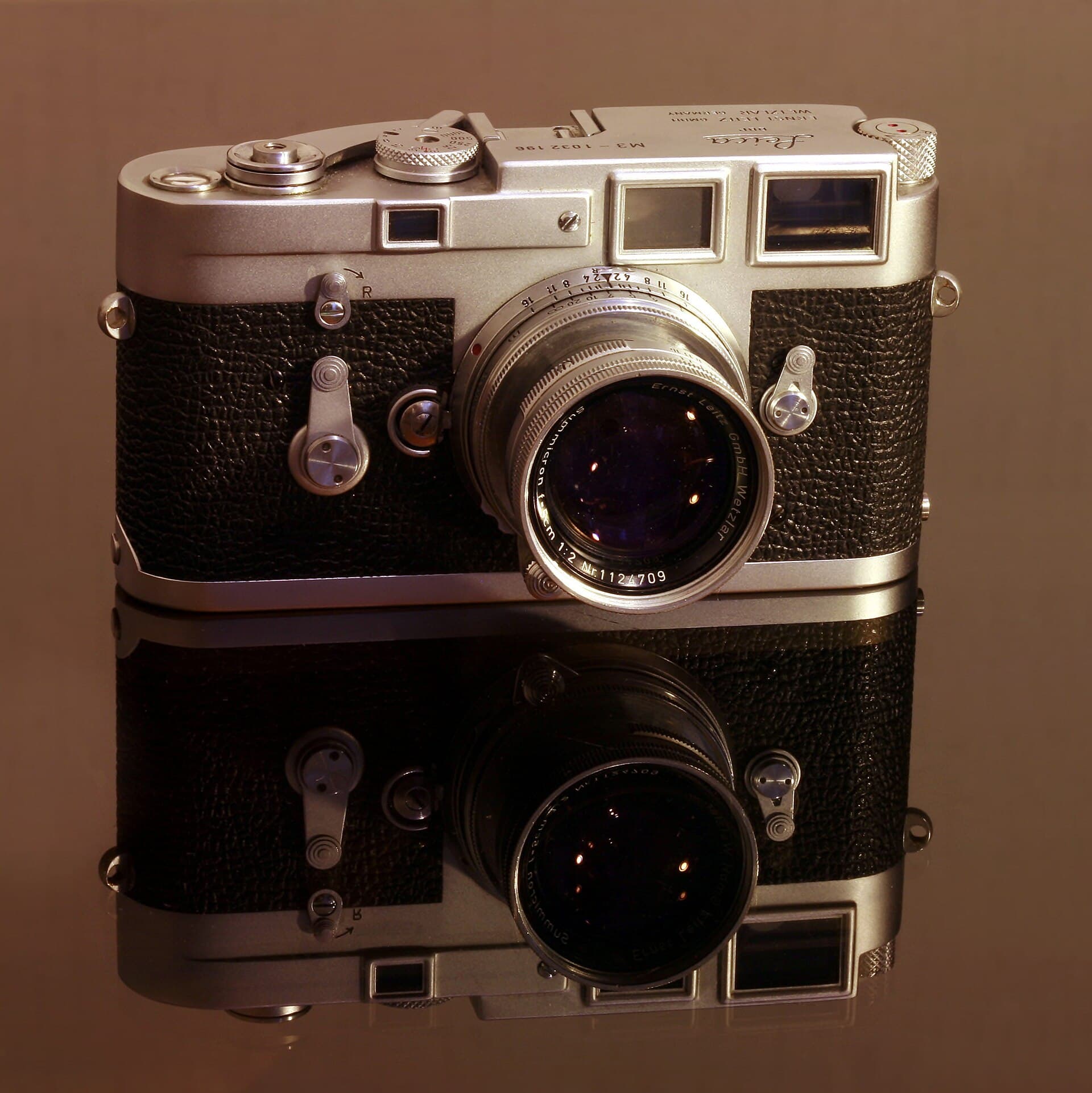
The M3 (1954) is Leica's first M-bayonet camera, replacing the screw-mount III-series. It introduces the now-standard Leica M layout: combined-image rangefinder/viewfinder with parallax-corrected projected frame lines (50, 90, 135 mm), bayonet lens mount, single-action film advance lever, hinged baseplate. The M3 has the longest rangefinder baseline (68.5 mm effective) and highest finder magnification (0.91×) of any production Leica M — qualities that make it the most accurate-focusing M for 50/90/135 mm lenses.
Reference
Recommended film stocks for the 35mm format your camera takes.
C41
Kodak Portra 400 is a professional C-41 color negative film known for flexible exposure latitude, natural skin tones, and fine grain.
View profileBW
Ilford HP5 Plus is a flexible ISO 400 black-and-white film with classic grain and strong push-processing tolerance.
View profileBW
Kodak Tri-X 400 is a classic black-and-white film known for strong tonality, visible grain, and documentary character.
Develop 35mm film
Labs in our directory that process 35mm film.
Before you buy used
About this camera
The original M. Henri Cartier-Bresson's camera. The body that ended Leica's screw-mount era and defined every M since.
| Field | Value |
|---|
| Format | 35mm |
| Mount | Leica M (introduced here) |
| Years | 1954–1966 |
| Shutter | 1s – 1/1000s, mechanical horizontal cloth |
| Flash sync | 1/50s |
| Meter | None (clip-on Leicameter optional) |
| Frame lines | 50, 90, 135 mm |
| Weight | 590 g |
| Battery | None |
Released at Photokina 1954. Early bodies are double-stroke (two strokes of the advance lever per frame, ~1954–58); later bodies switched to single-stroke (one full stroke, 1958+). 226,000 units built before the M4 superseded it in 1966 (the M2 ran in parallel as a wide-angle-friendly, lower-priced sibling). The M3 was so successful it nearly broke Leica's later sales — every working photographer already owned one and didn't need to upgrade.
The M3 is the camera that established Leica as the press/street photographer's tool of choice. Henri Cartier-Bresson used an M3 (alongside earlier IIIf bodies) for his definitive 1950s/60s output. Robert Capa carried M3 bodies in Indochina. Garry Winogrand, Inge Morath, Werner Bischof — all M3 users. The combination of small body, silent shutter, and bright accurate finder for 50mm-up lenses made it the camera that legitimized 35mm as a serious format.
For 2026 buyers, the M3 is the most affordable M body that still feels and shoots like a Leica should — chrome, brass, vulcanite, the heaviness of metal in the hand. Lack of meter is a feature for purists; clip-on Leicameter MR-4 was the period-correct accessory.
Leica M-bayonet lenses (any era). LTM lenses with M-mount adapters (Leica's official 1955 LTM-to-M adapters preserve the rangefinder coupling). Common pairings: 50mm Summicron rigid (1956), 50mm Summicron collapsible (chrome), 50mm Elmar 2.8, 90mm Tele-Elmarit, 135mm Hektor. Leicameter MR-4 (clip-on selenium meter, period-correct), Leicavit (rapid winder/grip), MD viewfinder magnifiers.
Note: The M3's frame lines are 50/90/135 only — no 35mm frame line. For 35mm lenses on an M3, Leica sold "goggle" lenses (35/2 with auxiliary optics that use the 50mm frame line).
BW
Fujifilm Neopan 100 Acros is an ultra-fine-grain ISO 100 black-and-white negative film celebrated for its world-class granularity, wide tonal range, and exceptional reciprocity characteristics. The original Acros was discontinued in 2018; Acros II relaunched in November 2019 with a reformulated emulsion and is the current production version.
View profileC41
Kodak Portra 160 is a professional C-41 color negative film with fine grain, soft contrast, and natural color.
View profileC41
Kodak Gold 200 is a daylight-balanced C-41 color negative film with warm color, moderate grain, and a classic consumer-film look.
View profile