C41
Kodak Portra 400
Kodak Portra 400 is a professional C-41 color negative film known for flexible exposure latitude, natural skin tones, and fine grain.
View profile35mm Compact
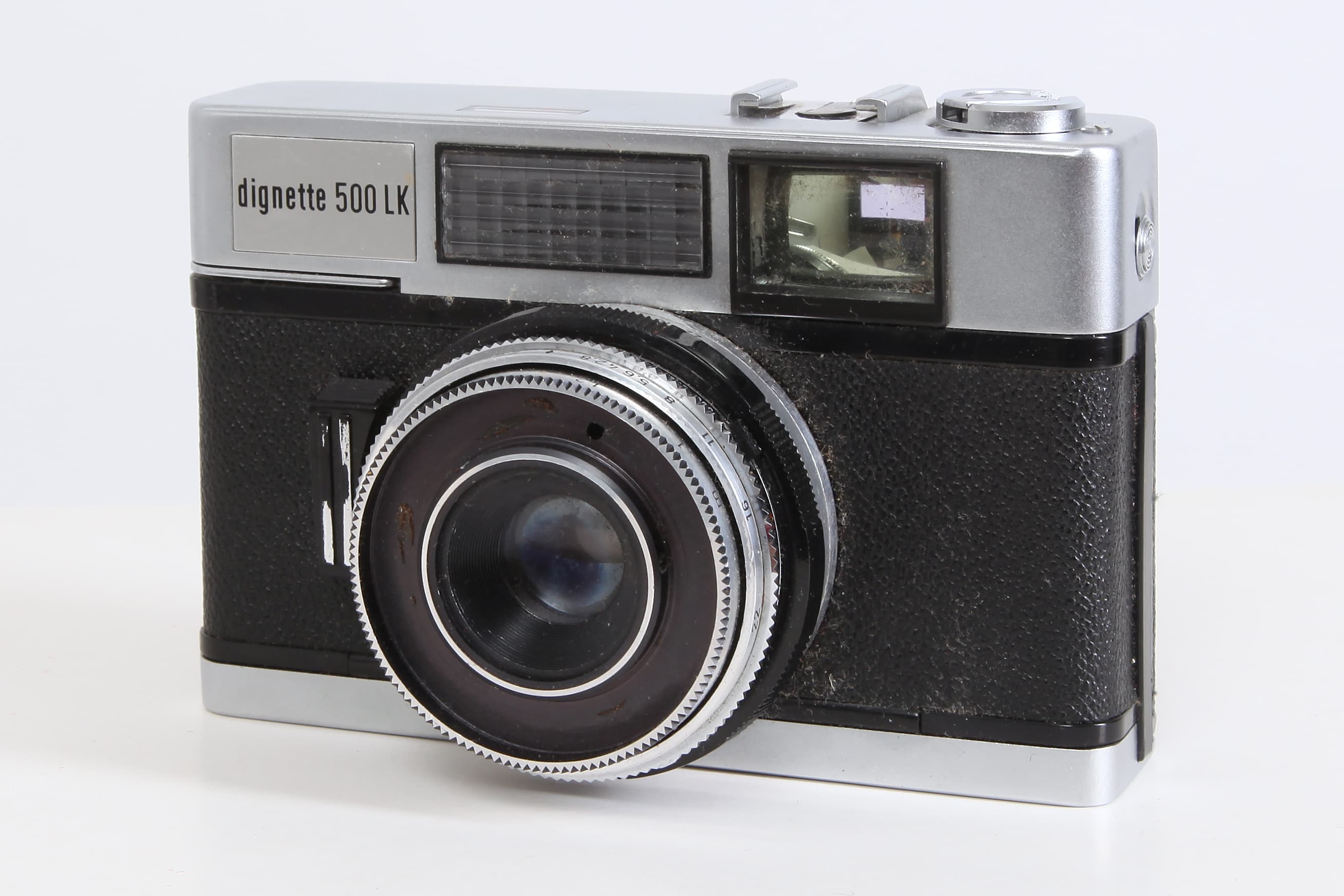
The Dacora Dignette (1956) is a 35mm fixed-lens scale-focus viewfinder camera made by Dacora-Kamerawerk in Jungingen (later Heitersheim), West Germany. It represents the entry level of the West German postwar compact camera market — a territory occupied by numerous manufacturers offering simple, affordable cameras with reputable German lenses to the growing mass of amateur photographers in Europe.
Reference
Recommended film stocks for the 35mm format your camera takes.
C41
Kodak Portra 400 is a professional C-41 color negative film known for flexible exposure latitude, natural skin tones, and fine grain.
View profileC41
Kodak Gold 200 is a daylight-balanced C-41 color negative film with warm color, moderate grain, and a classic consumer-film look.
View profileC41
Fujifilm Superia X-TRA 400 (marketed as Superia 400 in some regions) is an ISO 400 C-41 consumer color negative film in 135 format, one of Fujifilm's most popular consumer films. It delivers warm, vibrant colors with moderate grain and remains in production in some markets.
Develop 35mm film
Labs in our directory that process 35mm film.
Before you buy used
About this camera
An honest West German compact for the budget-conscious amateur — the Dacora Dignette offered scale-focus simplicity, a competent Isco-Göttingen or Cassar lens, and the reassuring quality of German manufacture at a price accessible to the postwar middle class.
| Field | Value |
|---|
| Format | 35mm (24×36 mm) |
| Mount | Fixed (non-interchangeable) |
| Years | 1956–1969 |
| Shutter | Prontor SVS leaf: 1/25s – 1/200s + B |
| Flash sync | M and X sync |
| Meter | None (basic Dignette); selenium on 300/400 variants |
| Exposure | Manual (EV scale) |
| Viewfinder | Optical frame, no rangefinder |
| Focus | Scale focus, distance symbols |
| Battery | None (selenium if metered variant) |
Dacora-Kamerawerk was established after World War II and produced cameras through the 1950s–1970s in southwest Germany. The company occupied a deliberate niche: affordable, reliable cameras for the mass market, positioned below the premium Voigtländer, Zeiss Ikon, and Agfa ranges but above the cheapest toy cameras. The Dignette was Dacora's primary product line through the late 1950s and 1960s.
The West German amateur camera market of the 1950s and 1960s was intensely competitive: Agfa offered the Silette and Optima lines, Voigtländer the Vito range, and Zeiss Ikon the Contessamat. Dacora competed on price, offering German build quality and genuine photographic lenses at the lowest possible cost. The Isco-Göttingen Isconar lens fitted to premium Dignette variants was a four-element triplet derivative with reasonably good resolution at moderate apertures.
Dacora's production wound down through the 1970s as Japanese competition undercut West German manufacturers across all market segments. The Dignette line was discontinued by the late 1960s, with the Super Dignette surviving a few years longer.
The Dacora Dignette represents the democratic end of the West German photographic industry — the camera that put German-quality lens glass into the hands of families and students who could not afford a Voigtländer Vito or Zeiss Ikon Contessamat. Its scale-focus simplicity made photography accessible without requiring the user to understand distance estimation or zone focus systems. For historians of the European camera industry, the Dignette illustrates how even budget manufacturers of the era maintained a commitment to quality optics that would be unusual in equivalent-price cameras today.
Fixed Isco-Göttingen Isconar 45/2.8 (most common), or Cassar/Westar 45/2.8 (earlier and export variants). Prontor SVS shutter with EV coupling scale. Accessories: accessory shoe (cold shoe) for flash, cable release socket, screw-mount filter ring (40.5mm or 43mm depending on variant).
C41
Kodak UltraMax 400 is a versatile consumer-grade ISO 400 daylight-balanced color negative film with T-grain emulsion, delivering warm Kodak colors, fine-for-speed grain (PGI 46), and wide exposure latitude. Currently in production and available globally as a single-roll and multi-pack.
View profileC41
Kodak ColorPlus 200 is an affordable, consumer-oriented daylight-balanced color negative film at ISO 200. Known for warm, slightly muted color rendition, fine grain, and wide exposure latitude, it is currently in production and widely available in Asia and select global markets.
View profileBW
Kodak Tri-X 400 is a classic black-and-white film known for strong tonality, visible grain, and documentary character.
View profile