C41
Kodak Portra 400
Kodak Portra 400 is a professional C-41 color negative film known for flexible exposure latitude, natural skin tones, and fine grain.
View profile35mm Compact
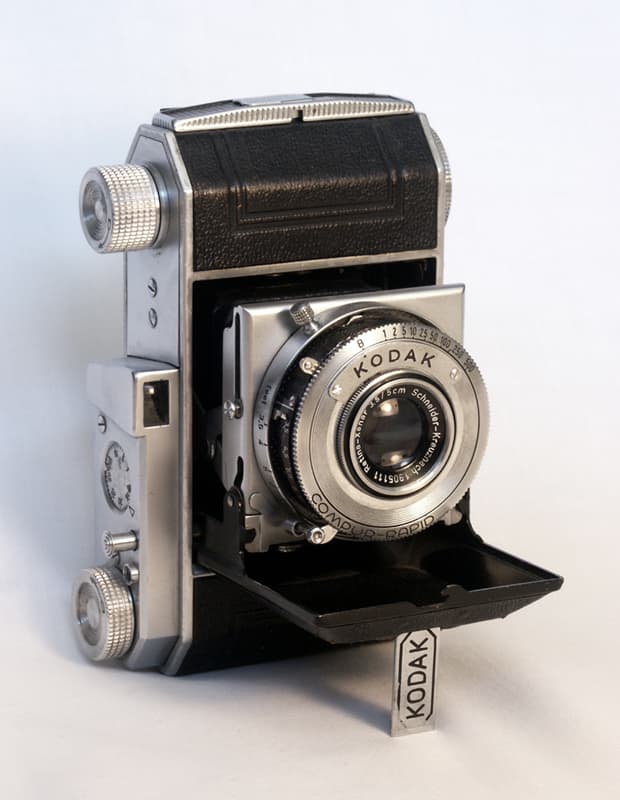
The Kodak Retina I (1934) is one of the most historically significant cameras ever made. Produced by Kodak AG in Stuttgart (the former Nagel-Werk, acquired by Eastman Kodak in 1931), it was the first camera designed to use the new 135 daylight-loading 35mm cassette — the film format that remains the universal standard for 35mm photography to this day.
Reference
Recommended film stocks for the 35mm format your camera takes.
C41
Kodak Portra 400 is a professional C-41 color negative film known for flexible exposure latitude, natural skin tones, and fine grain.
View profileC41
Kodak Gold 200 is a daylight-balanced C-41 color negative film with warm color, moderate grain, and a classic consumer-film look.
View profileC41
Fujifilm Superia X-TRA 400 (marketed as Superia 400 in some regions) is an ISO 400 C-41 consumer color negative film in 135 format, one of Fujifilm's most popular consumer films. It delivers warm, vibrant colors with moderate grain and remains in production in some markets.
Develop 35mm film
Labs in our directory that process 35mm film.
Before you buy used
About this camera
The camera that created the 135 film format — the original 1934 Kodak Retina I established the daylight-loading 35mm cassette that every camera still uses today, delivering a Schneider Xenar lens in a pocketable German-made folding body.
| Field | Value |
|---|
| Format | 35mm (24×36 mm) — the camera that created the 135 cassette |
| Lens | Schneider Xenar 50/3.5 or Kodak Ektar 50/3.5 |
| Years | 1934–1941 |
| Shutter | Compur: 1s – 1/500s + B |
| Flash sync | None (prewar) |
| Meter | None |
| Focus | Scale focus |
| Weight | ~340 g |
| Battery | None required |
The Kodak Retina I's origin lies in the 1931 Kodak acquisition of Nagel-Werk, a respected Stuttgart camera manufacturer. August Nagel, the founder, had already been working on a compact daylight-loading 35mm camera design. Under Kodak ownership, the project was developed into the Retina, with Kodak simultaneously developing the 135 cassette as the standardised film format.
The Type 117 Retina I launched in 1934, initially sold in Germany and soon exported worldwide. Kodak aggressively promoted both the camera and the cassette format; within a few years, competitors were designing cameras around the 135 cassette, and the format became a global standard. Every manufacturer of 35mm cameras — from Leica to the cheapest consumer brands — adopted the 135 cassette.
The Retina I continued in production through several type variants until World War II halted production. After the war, production resumed with the postwar Retina I and eventually the Retina Ia (1951), which updated the body with a larger viewfinder and improved specifications.
The Retina I's historical importance is difficult to overstate. The 135 daylight-loading cassette it introduced is the universal format for 35mm film photography — used today in every 35mm camera, every 35mm film roll sold at any camera shop in the world. A Kodak Retina I is the direct ancestor, in a functional sense, of every 35mm camera made since 1934.
As a photographic tool, the original Retina I is surprisingly capable. The Schneider Xenar 50/3.5 is a genuine quality lens — the same Tessar-type four-element design found in far more expensive cameras of the era. Stopped down to f/5.6 or f/8, it produces crisp negatives with good micro-contrast.
Fixed non-interchangeable lens. Standard: Schneider Xenar 50/3.5 or Kodak Ektar 50/3.5. A small number of examples carry the Schneider Anastigmat 50/3.5 or Kodak Anastigmat 50/3.5 (budget variants). Push-on or Series V drop-in filters; cable release socket.
C41
Kodak UltraMax 400 is a versatile consumer-grade ISO 400 daylight-balanced color negative film with T-grain emulsion, delivering warm Kodak colors, fine-for-speed grain (PGI 46), and wide exposure latitude. Currently in production and available globally as a single-roll and multi-pack.
View profileC41
Kodak ColorPlus 200 is an affordable, consumer-oriented daylight-balanced color negative film at ISO 200. Known for warm, slightly muted color rendition, fine grain, and wide exposure latitude, it is currently in production and widely available in Asia and select global markets.
View profileBW
Kodak Tri-X 400 is a classic black-and-white film known for strong tonality, visible grain, and documentary character.
View profile