C41
Kodak Portra 400
Kodak Portra 400 is a professional C-41 color negative film known for flexible exposure latitude, natural skin tones, and fine grain.
View profile35mm Compact
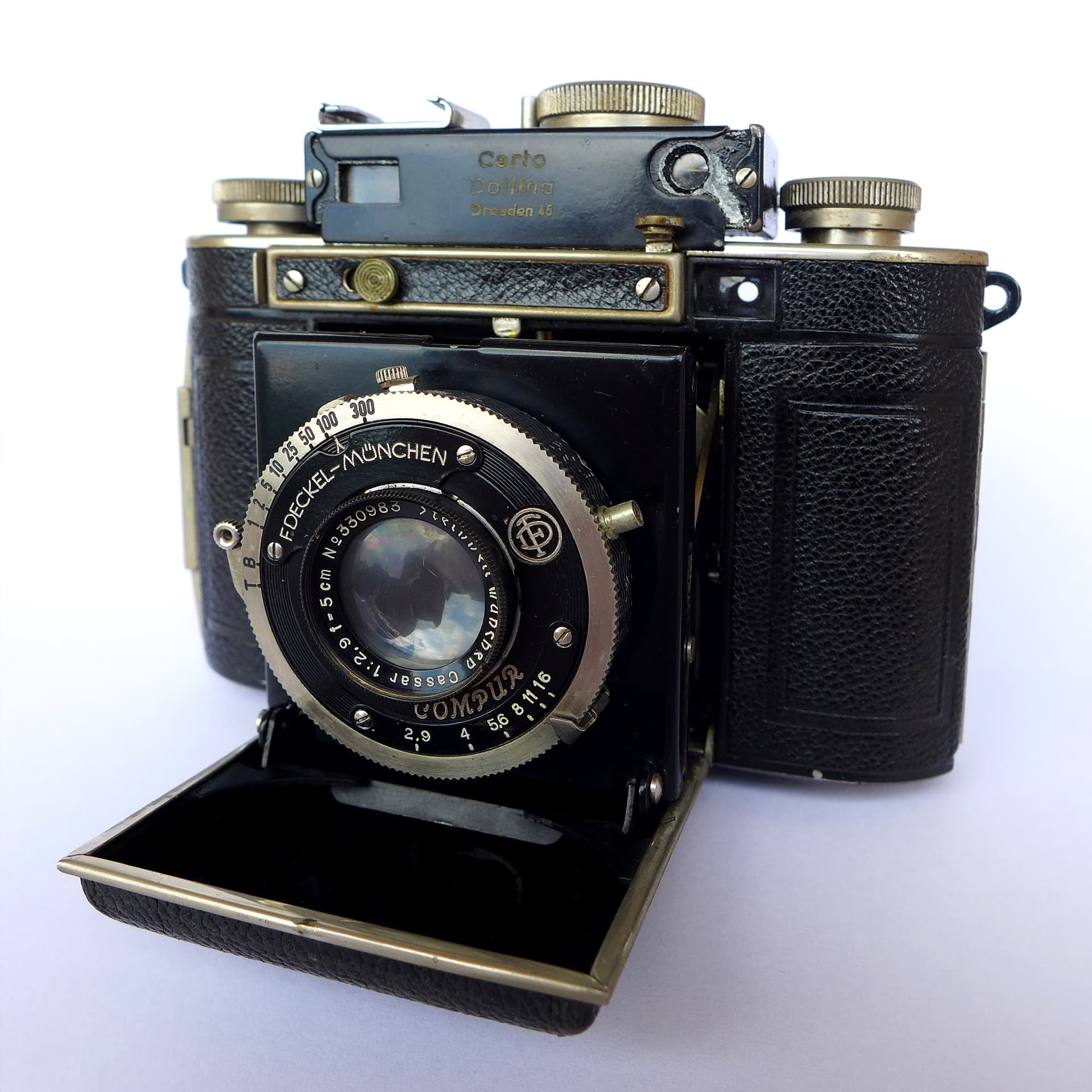
The Certo Dollina (1935) is a folding 35mm camera produced by Certo Kamerawerk in Dresden, Germany. It was produced in three main variants: the Dollina 0 (simplest, fixed-focus or scale-focus), the Dollina I (scale-focus with improved finder), and the Dollina II (coupled rangefinder). The name and description here refer principally to the Dollina I and the original scale-focus versions, which are the most commonly encountered.
Reference
Recommended film stocks for the 35mm format your camera takes.
C41
Kodak Portra 400 is a professional C-41 color negative film known for flexible exposure latitude, natural skin tones, and fine grain.
View profileC41
Kodak Gold 200 is a daylight-balanced C-41 color negative film with warm color, moderate grain, and a classic consumer-film look.
View profileC41
Fujifilm Superia X-TRA 400 (marketed as Superia 400 in some regions) is an ISO 400 C-41 consumer color negative film in 135 format, one of Fujifilm's most popular consumer films. It delivers warm, vibrant colors with moderate grain and remains in production in some markets.
Develop 35mm film
Labs in our directory that process 35mm film.
Before you buy used
About this camera
A compact prewar German 35mm folder from Certo Kamerawerk — the Dollina series offered simple scale-focus shooting with Steinheil Cassar or Schneider Xenar glass in a small, pocketable body, with the Dollina II stepping up to a coupled rangefinder.
| Field | Value |
|---|
| Format | 35mm (24×36 mm) |
| Lens | Cassar 50/2.9 (Steinheil) or Xenar 50/2.9 (Schneider) |
| Years | 1935–1941 |
| Shutter | Compur/Prontor: 1s – 1/500s + B |
| Flash sync | None (prewar) |
| Meter | None |
| Focus | Scale focus (Dollina 0/I); coupled RF (Dollina II) |
| Weight | ~350 g |
| Battery | None required |
Certo Kamerawerk, established in Dresden in the early 20th century, was one of the smaller Dresden-area camera manufacturers of the interwar period. The Dollina series launched in 1935, positioning Certo in the growing 35mm folding camera market alongside Kodak (Retina), Balda (Baldina), and the more expensive Zeiss and Voigtländer offerings.
The Cassar 50/2.9 was a three-element Cooke Triplet derivative made by Steinheil München — a competent but not exceptional lens, performing best stopped down to f/5.6–f/8. The Schneider Xenar 50/2.9, a Tessar-type four-element design, was optically superior and appeared on better-specified examples.
Production ended before the Dollina series could reach the postwar market. Unlike the Certo Six medium-format camera, which Certo revived under East German reorganisation, the Dollina 35mm line was not resumed.
The Dollina illustrates the competitive density of the prewar German 35mm camera market. Certo competed with Kodak, Balda, Welta, and a dozen other manufacturers for the affordable folding-camera customer. The series represents the entry tier of prewar German 35mm quality — above box cameras, below the rangefinder folders — and offers a historical window into the democratisation of 35mm photography before the war.
For collectors, the Dollina II with its coupled rangefinder is the most desirable variant. For photographers, a working Dollina I with a clean Xenar lens offers a functional prewar 35mm experience at minimal cost.
Fixed non-interchangeable lens. Standard: Steinheil Cassar 50/2.9 or Schneider Xenar 50/2.9. Rare: Cassar 50/2.8 on some later examples. Push-on filters; cable release socket. No built-in accessory shoe.
C41
Kodak UltraMax 400 is a versatile consumer-grade ISO 400 daylight-balanced color negative film with T-grain emulsion, delivering warm Kodak colors, fine-for-speed grain (PGI 46), and wide exposure latitude. Currently in production and available globally as a single-roll and multi-pack.
View profileC41
Kodak ColorPlus 200 is an affordable, consumer-oriented daylight-balanced color negative film at ISO 200. Known for warm, slightly muted color rendition, fine grain, and wide exposure latitude, it is currently in production and widely available in Asia and select global markets.
View profileBW
Kodak Tri-X 400 is a classic black-and-white film known for strong tonality, visible grain, and documentary character.
View profile