C41
Kodak Portra 160
Kodak Portra 160 is a professional C-41 color negative film with fine grain, soft contrast, and natural color.
View profileLarge Format & View
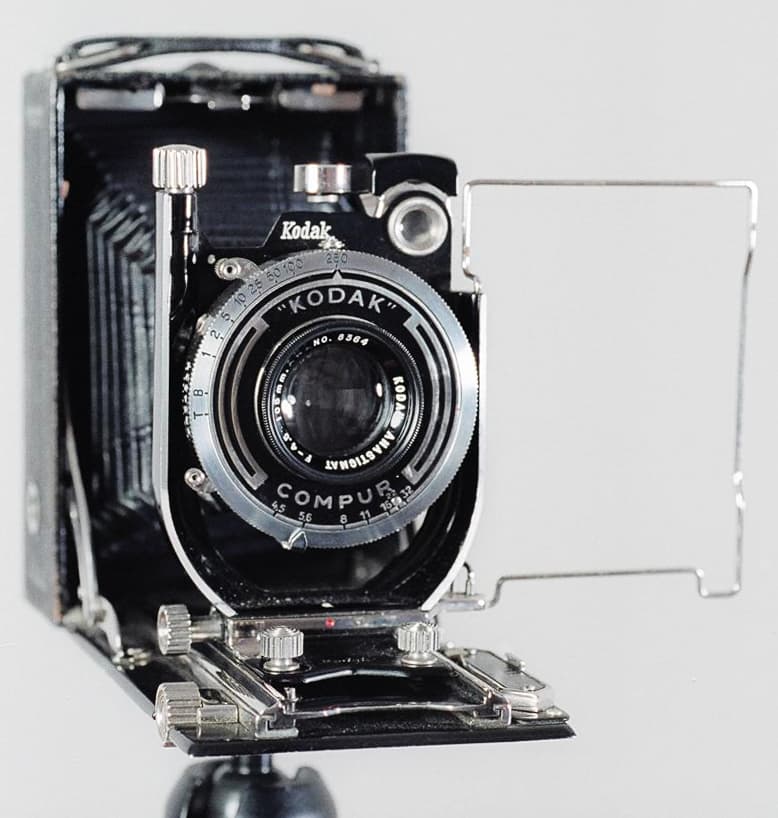
The Kodak Recomar is a folding plate camera produced from approximately 1927 by Kodak AG, the German subsidiary of Eastman Kodak headquartered in Stuttgart. The Recomar was made in two principal formats -- a 6.5x9cm model and a 9x12cm model -- and represents Kodak's entry into the European premium plate-folder market that was dominated by German firms including Voigtlander, ICA (later Zeiss Ikon), and Linhof.
Reference
Recommended film stocks for the — format your camera takes.
C41
Kodak Portra 160 is a professional C-41 color negative film with fine grain, soft contrast, and natural color.
View profileBW
Kodak T-Max 100 (TMX) is a professional ISO 100 black-and-white T-grain negative film celebrated for its extremely fine grain, high sharpness, and wide tonal range — one of the finest-grained B&W films available in 135 and 120.
View profileBW
Ilford HP5 Plus is a flexible ISO 400 black-and-white film with classic grain and strong push-processing tolerance.
Develop — film
We're growing the lab directory near you. Browse all labs.
Before you buy used
About this camera
Kodak's German-made 9x12cm plate folder from 1927 -- precision Stuttgart engineering under the American brand name.
| Field | Value |
|---|
| Format | 9x12cm glass plates (also 6.5x9cm variant); roll-film back available |
| Lens | Kodak Anastigmat, Schneider Xenar, or Zeiss Tessar (fixed, varies by variant) |
| Shutter | Compur leaf: ~1s - 1/100s + B, T |
| Meter | None |
| Battery | None |
| Viewfinder | Optical direct; no rangefinder |
| Focus | Scale / rack-and-pinion bellows extension |
| Manufacturer | Kodak AG, Stuttgart, Germany |
| Years | ~1927 - late 1930s |
Eastman Kodak established a German subsidiary -- eventually known as Kodak AG -- to serve the European market, which had strong indigenous camera and film industries and distinct product preferences from the American market. By the 1920s, Kodak AG had become a significant manufacturer in its own right, operating facilities in Stuttgart that produced cameras specifically for European tastes: primarily plate-format folders of the type that dominated serious amateur and professional photography on the Continent.
The Recomar appeared in 1927, a period of intense activity in the German camera industry. Zeiss Ikon had been formed the year before (1926) from the merger of ICA, Contessa-Nettel, Ernemann, and Goerz, creating a dominant competitor. Voigtlander continued to produce premium folders. Leica had shown its first camera in 1925 and begun commercial sales, introducing 35mm to the serious photography market for the first time.
In this competitive environment, Kodak AG positioned the Recomar as a quality instrument at a price competitive with the German majors. The Stuttgart operation had technical credibility independent of the American parent brand, and the Recomar was respected as a German camera that happened to carry the Kodak name rather than as an imported product.
After Kodak AG acquired the assets of Dr. August Nagel's firm (Nagel-Werk) in 1931 -- the same acquisition that produced the Kodak Retina -- the Stuttgart operation's camera-making capability expanded further. The Recomar continued alongside the new roll-film products. The rise of 35mm and 120 roll-film cameras through the 1930s gradually made the plate-folder format obsolete for the amateur market, and the Recomar line wound down by the late 1930s or early 1940s.
The Recomar is a useful case study in how American companies competed in the European precision-camera market of the 1920s and 1930s: not by exporting American products, but by operating German manufacturing with German engineering talent. The cameras produced by Kodak AG were genuinely German instruments -- the Recomar is not distinguishable from Voigtlander or Zeiss Ikon products by construction quality, only by label and optical specification.
The camera also represents the last generation of plate-folder designs that would be commercially viable. Within a decade of the Recomar's introduction, the combination of the Leica establishing 35mm for portable photography and the Rolleiflex establishing 120 roll film for medium-format quality work had effectively ended the plate folder's relevance for new buyers. The Recomar is therefore a camera at the twilight of its format.
For photographers working with 9x12cm sheet film today (the modern equivalent of the glass plate format), the Recomar offers a compact, lightweight option compared to conventional large-format field cameras, though sourcing sheet-film holders of the correct size is a meaningful practical obstacle.
E6
Fujifilm Fujichrome Velvia 50 (RVP 50) is the legendary professional E6 reversal slide film at ISO 50 that defined landscape and nature photography for a generation. Characterized by extreme saturation, deep contrast, and ultra-fine grain, it remains in active production as of 2026.
View profileC41
Kodak Portra 400 is a professional C-41 color negative film known for flexible exposure latitude, natural skin tones, and fine grain.
View profileBW
Kodak Tri-X 400 is a classic black-and-white film known for strong tonality, visible grain, and documentary character.
View profile