C41
Kodak Portra 160
Kodak Portra 160 is a professional C-41 color negative film with fine grain, soft contrast, and natural color.
View profileLarge Format & View
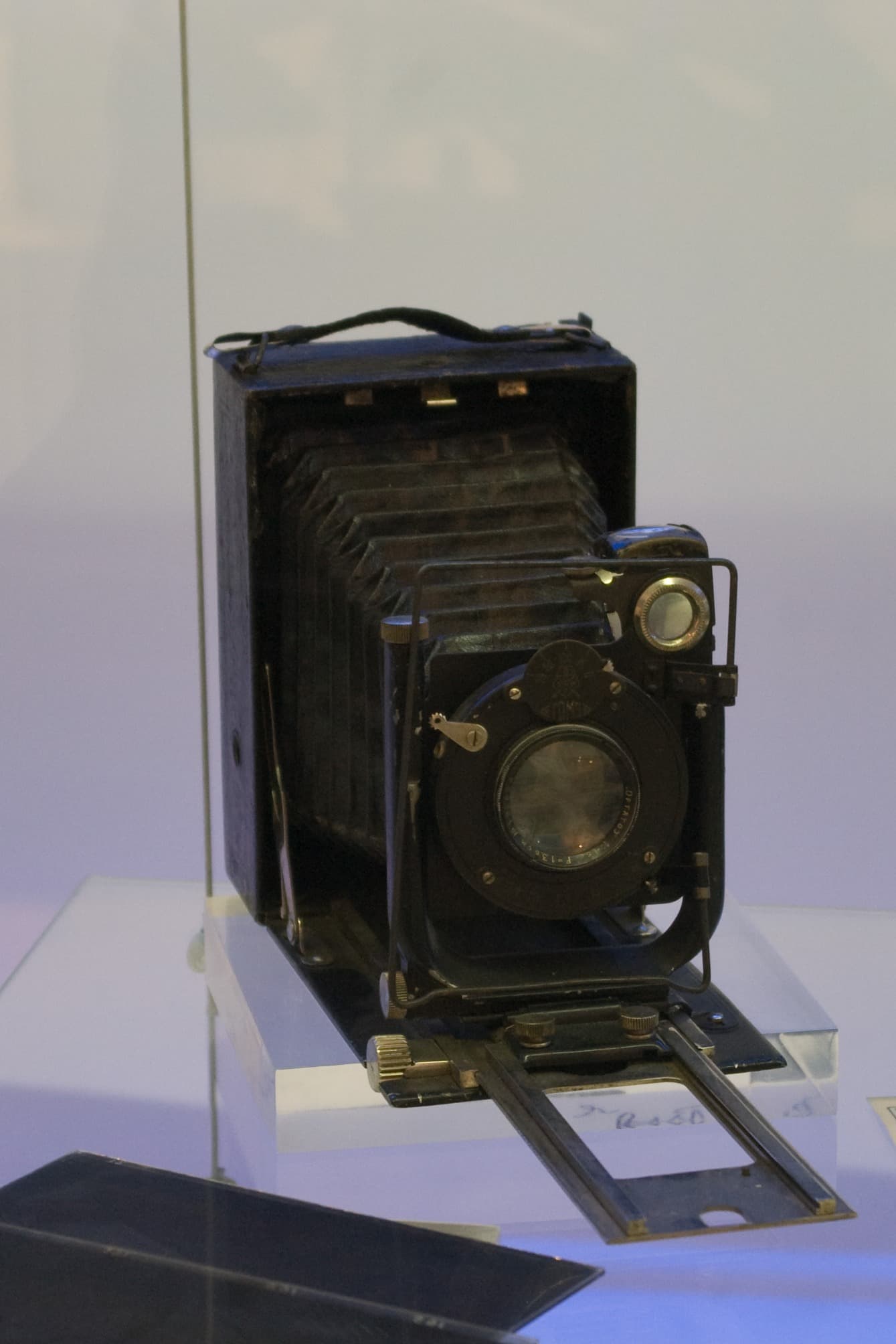
The Fotokor-1 (Фотокор-1) is a 9x12cm glass-plate folding camera manufactured by GOMZ (Gosudarstvenny Optiko-Mekhanichesky Zavod, the State Optical-Mechanical Plant) in Leningrad, beginning production in 1930. It is widely regarded as the first Soviet camera to enter genuine series production, marking the founding moment of the USSR's domestic photographic industry. The camera follows the European folding plate-camera tradition of the era, with a collapsible bellows, front-standard lens and shutter assembly, and a ground-glass focusing screen at the rear. Film backs for roll film were available as accessories but the camera was designed primarily for glass plates or cut film in standard plate holders. The Fotokor-1 was affordable by Soviet standards and became the principal camera for Soviet press photographers, amateur clubs, and scientific expeditions throughout the 1930s.
Reference
Recommended film stocks for the 9x12 format your camera takes.
C41
Kodak Portra 160 is a professional C-41 color negative film with fine grain, soft contrast, and natural color.
View profileBW
Kodak T-Max 100 (TMX) is a professional ISO 100 black-and-white T-grain negative film celebrated for its extremely fine grain, high sharpness, and wide tonal range — one of the finest-grained B&W films available in 135 and 120.
View profileBW
Ilford HP5 Plus is a flexible ISO 400 black-and-white film with classic grain and strong push-processing tolerance.
Develop 9x12 film
We're growing the lab directory near you. Browse all labs.
Before you buy used
About this camera
The first mass-produced Soviet camera: a 9x12cm plate folder from GOMZ, Leningrad, 1930.
| Field | Value |
|---|
| Format | 9x12 cm glass plate / cut film |
| Mount | Fixed (Industar-type or GOMZ lens ~135mm) |
| Years | 1930 - ~1941 |
| Shutter | ~1/25s - 1/100s + B + T, mechanical leaf |
| Flash sync | None |
| Meter | None |
| Modes | Manual |
| Weight | ~900 g |
| Battery | None required |
| Viewfinder | Ground-glass rear screen + wire frame finder |
| Focus | Bellows rack-and-pinion on ground glass |
Soviet industrial planners in the late 1920s identified camera manufacturing as a strategic gap: the USSR depended entirely on imported German cameras (Voigtlander, Zeiss) for its press, scientific, and military photography needs. The First Five-Year Plan (1928-1932) mandated domestic production of precision optical equipment, and GOMZ in Leningrad was designated as the primary facility. The Fotokor-1 design drew on the established German folding plate-camera template, likely referencing Voigtlander and Zeiss Ikon products of the period, but was engineered for Soviet manufacturing tolerances and material availability.
Series production began in 1930. The lens fitted to early examples was a Soviet-made triplet or anastigmat of approximately 135mm focal length; later production used the GOMZ-made GOMZ-4 Industar-type four-element anastigmat, which was derived from the Zeiss Tessar design.
The Fotokor-1 was sold through Soviet trade cooperatives and became the standard camera for the Osoaviakhim (Soviet civil defense and aviation society) photography sections, factory worker photography clubs, and the Soviet press. Production continued through the 1930s and was halted by the disruption of the German siege of Leningrad (1941). The factory transitioned to military production and the Fotokor-1 was never revived; postwar Soviet photography moved toward 35mm and medium-format roll-film cameras.
The Fotokor-1 is the starting point of Soviet camera history. Every subsequent Soviet camera - the FED, the Zorki, the Kiev, the Zenit - traces its institutional lineage back to the decision to build cameras at GOMZ that produced the Fotokor-1. For Soviet photographers of the 1930s, the Fotokor-1 was not a curiosity but a working tool: Soviet press agencies like TASS and magazines like Ogoniok documented a nation transforming itself using Fotokor-1 plates.
The camera also represents a deliberate act of technology transfer: Soviet engineers reverse-engineered or adapted German optical designs within the constraints of Soviet industry, establishing the pattern that would define Soviet camera production for decades. The GOMZ Industar lenses that descended from this era became standard equipment across the FED and Zorki 35mm rangefinder lines.
For collectors outside Russia, the Fotokor-1 is modestly priced relative to its historical significance, reflecting the difficulty of sourcing and using 9x12cm plate equipment and the lower collector awareness compared to Soviet 35mm cameras.
The Fotokor-1 is a fixed-lens camera. The lens and shutter assembly is mounted on the front standard and cannot be interchanged in the conventional sense, though different production runs were fitted with different GOMZ optics:
Accessories:
E6
Fujifilm Fujichrome Velvia 50 (RVP 50) is the legendary professional E6 reversal slide film at ISO 50 that defined landscape and nature photography for a generation. Characterized by extreme saturation, deep contrast, and ultra-fine grain, it remains in active production as of 2026.
View profileC41
Kodak Portra 400 is a professional C-41 color negative film known for flexible exposure latitude, natural skin tones, and fine grain.
View profileBW
Kodak Tri-X 400 is a classic black-and-white film known for strong tonality, visible grain, and documentary character.
View profile