C41
Kodak Portra 400
Kodak Portra 400 is a professional C-41 color negative film known for flexible exposure latitude, natural skin tones, and fine grain.
View profileMedium Format TLR
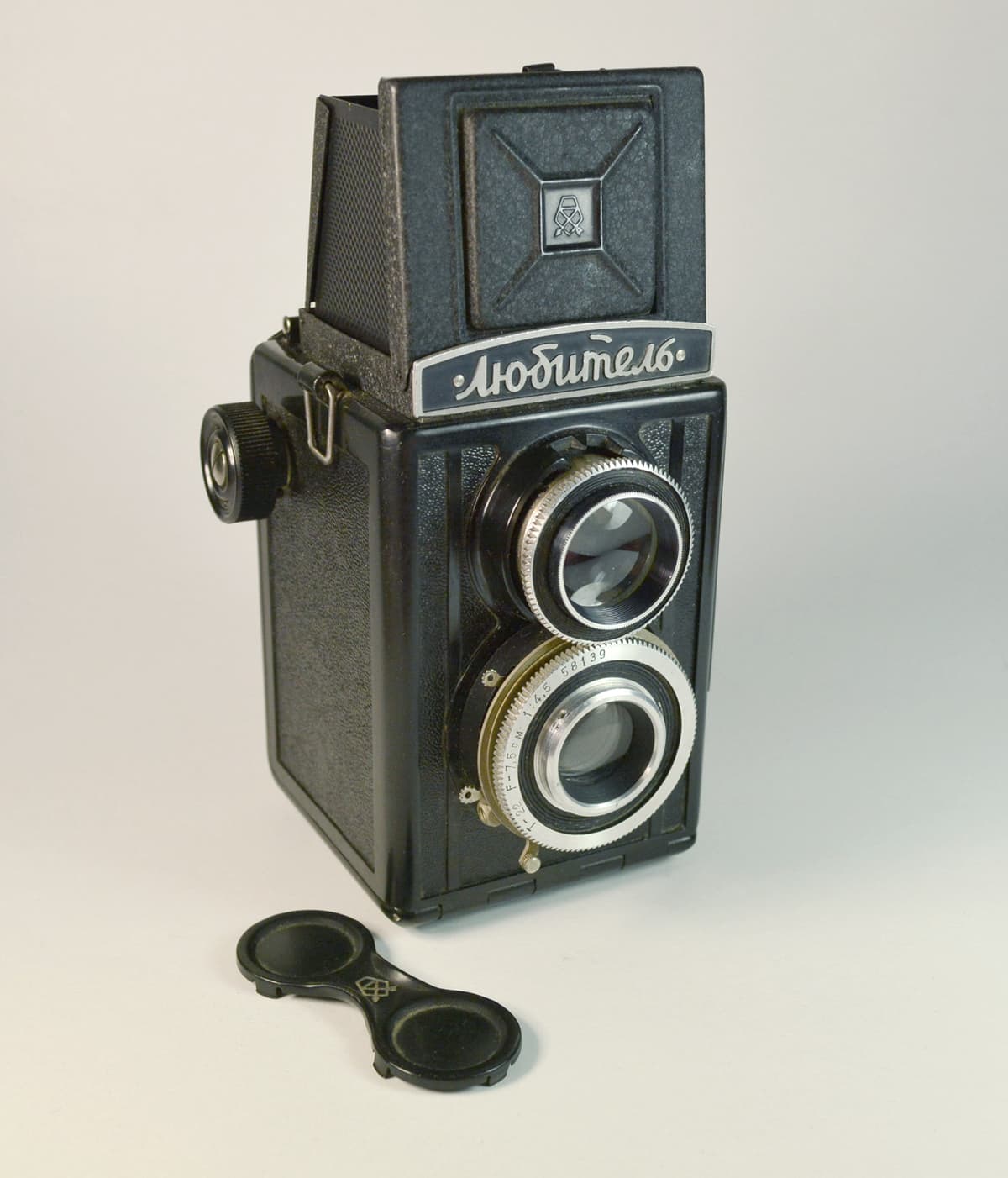
The Lubitel-D is a Soviet 120-format twin-lens reflex camera produced by GOMZ (State Optical-Mechanical Plant, Leningrad) from approximately 1956. It is a simplified variant within the Lubitel lineage, positioned between the original Lubitel and the Lubitel-2. The Lubitel-D uses a Bakelite body and a fixed taking lens - a 75mm triplet - with scale focus and a waist-level ground-glass viewfinder. There is no meter, no coupled rangefinder, and no battery required. The camera produces 6x6 cm frames on 120 roll film. The "D" designation distinguishes it from adjacent Lubitel models; the precise meaning of the suffix is not definitively documented in Western sources.
Reference
Recommended film stocks for the — format your camera takes.
C41
Kodak Portra 400 is a professional C-41 color negative film known for flexible exposure latitude, natural skin tones, and fine grain.
View profileBW
Kodak Tri-X 400 is a classic black-and-white film known for strong tonality, visible grain, and documentary character.
View profileBW
Ilford HP5 Plus is a flexible ISO 400 black-and-white film with classic grain and strong push-processing tolerance.
Develop — film
We're growing the lab directory near you. Browse all labs.
Before you buy used
About this camera
A simplified Soviet TLR that stripped the original Lubitel down to its essentials for 1956 mass production.
| Field | Value |
|---|
| Format | 120 (6x6 cm) |
| Lens | ~T-22 75mm f/4.5 triplet (fixed) |
| Focus | Scale focus |
| Shutter speeds | ~1/10s, 1/25s, 1/50s, 1/100s + B |
| Flash sync | ~ |
| Meter | None |
| Modes | Manual aperture + manual shutter |
| Body material | Bakelite |
| Weight | ~540 g |
| Battery | None required |
The Lubitel name was introduced in 1949 by GOMZ as the Soviet answer to the Voigtlander Brillant: a Bakelite TLR for the mass market, producing 6x6 cm frames on 120 film. The original Lubitel established the core formula - TLR form factor, Bakelite construction, triplet taking lens, scale focus, no meter - that the subsequent models maintained. The Lubitel-D appeared in 1956, representing a simplified iteration. It preceded the Lubitel-2, which became the more common and better-documented variant in the West. The Lubitel line continued through the Lubitel-166B and Lubitel-166 Universal, with LOMO (which absorbed GOMZ) still producing the 166 Universal into the early 2000s. The Lubitel-D occupies an early, less-documented position in this lineage.
The Lubitel-D matters as evidence of the Lubitel line's early evolution. The successive simplifications and refinements between the original Lubitel and the Lubitel-2 are documented in Soviet photographic manufacturing records but are poorly covered in English-language sources. For collectors, the Lubitel-D is among the rarer Lubitel variants; most Western Lubitel users encounter the 166B or 166 Universal, both of which are far more common. The camera shares the visual and optical character of the Lubitel line generally: the 6x6 ground-glass viewing experience, the soft-rendering triplet taking lens, and the all-manual operation that requires the photographer to manage every exposure decision. Soviet TLR results from cameras in this lineage have a distinctive quality - moderate central sharpness, soft corners, visible vignetting at wide apertures - that differs from German TLR competitors of the same period.
C41
Kodak Portra 160 is a professional C-41 color negative film with fine grain, soft contrast, and natural color.
View profileBW
Fujifilm Neopan 100 Acros is an ultra-fine-grain ISO 100 black-and-white negative film celebrated for its world-class granularity, wide tonal range, and exceptional reciprocity characteristics. The original Acros was discontinued in 2018; Acros II relaunched in November 2019 with a reformulated emulsion and is the current production version.
View profile