C41
Lomography Negative 400
Lomography Color Negative 400 is a versatile ISO 400 C-41 color negative film with vivid, saturated colors, believed to be a Kodak Alaris-manufactured emulsion, available in 35mm and 120 formats.
View profileToy & Novelty
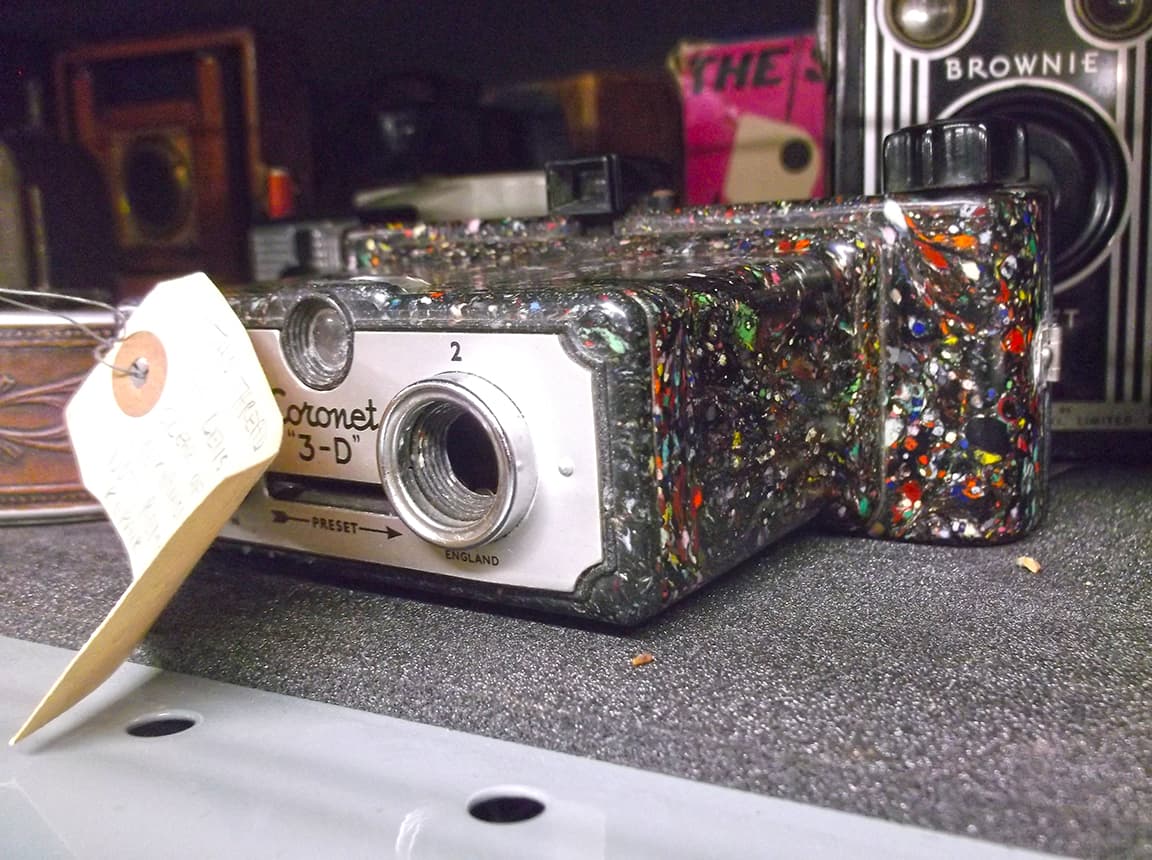
The Coronet 3D is a fixed-focus, fixed-exposure stereo box camera produced by Coronet Camera Co. of Birmingham, England, introduced in 1953 to capitalise on the stereo photography craze that swept popular culture in the early 1950s. The camera uses 127 roll film and exposes two side-by-side 16x14mm frames simultaneously through twin lenses spaced approximately 63-65mm apart -- roughly the interpupillary distance of human eyes -- to produce a stereo pair that can be viewed through a standard stereoscope viewer.
Reference
Recommended film stocks for the — format your camera takes.
C41
Lomography Color Negative 400 is a versatile ISO 400 C-41 color negative film with vivid, saturated colors, believed to be a Kodak Alaris-manufactured emulsion, available in 35mm and 120 formats.
View profileC41
Lomography Color Negative 800 is a high-speed ISO 800 C-41 color negative film widely suspected to be a Kodak-manufactured emulsion, delivering vibrant colors and adequate grain for challenging lighting conditions.
View profileC41
Develop — film
We're growing the lab directory near you. Browse all labs.
Before you buy used
About this camera
The Bakelite twin-lens stereo box camera from Birmingham that brought 3D photography to the British mass market in 1953.
| Field | Value |
|---|
| Format | 127 film, dual 16x14mm stereo pairs |
| Mount | Fixed (non-interchangeable, twin lenses) |
| Years | 1953-~ |
| Lenses | Twin meniscus elements, fixed focus |
| Shutter | Single leaf: ~1/30s |
| Flash sync | None on base model |
| Meter | None |
| Focus | Fixed (hyperfocal) |
| Battery | None |
| Stereo baseline | ~63-65mm inter-lens spacing |
Stereo photography had existed since the Victorian era -- stereoscopes were a popular parlor entertainment in the 1850s and 1860s -- but experienced a significant revival in the early 1950s, driven partly by the availability of color slide film and partly by the 3D film craze that swept Hollywood from 1952 onward with films such as "Bwana Devil" and "House of Wax." American manufacturers including the Stereo Realist (1947) and Kodak Stereo Camera (1954) served the mid-market, while the View-Master Personal Stereo Camera targeted the hobbyist.
Coronet Camera Co., a Birmingham manufacturer better known for simple box cameras and cheap novelty cameras sold through Woolworths and similar mass-market retailers, introduced the 3D in 1953 as a budget stereo option for the British market. The camera was aimed squarely at consumers attracted to the stereo craze who could not or would not spend on the Stereo Realist, which retailed at a price comparable to a professional camera.
Coronet produced the 3D in small quantities alongside its other cheap camera offerings. The company continued making simple and novelty cameras through the 1960s before eventually ceasing operations; the 3D was among the more unusual products in a lineup that included simple box cameras and novelty shapes.
127 film remained commercially available through the late twentieth century in declining quantity and is today produced by a small number of specialty suppliers, making the Coronet 3D shootable but requiring planning.
The Coronet 3D occupies a specific cultural niche: it is the British mass-market answer to a short-lived but intense popular enthusiasm for three-dimensional imagery. The early 1950s stereo craze was real and widespread -- 3D films played in cinemas, 3D picture postcards were sold at tourist sites, and consumer stereo cameras sold in significant numbers -- and the Coronet 3D represents the lowest accessible point of entry to that craze in the British market.
As a Bakelite artifact, the camera is also representative of Birmingham's postwar light manufacturing industry, which produced a range of consumer goods in Bakelite and early plastics. Coronet's cameras were sold through Woolworths at price points accessible to working-class buyers, occupying in the British market a role similar to what Argus and Ansco occupied in the American market.
For contemporary photographers, the Coronet 3D is a conversation piece and a curiosity: a camera that requires its own viewer to see the results, uses a format that demands specialty film, and produces images that are genuinely different in character from anything a conventional camera produces.
Kodak Gold 200 is a daylight-balanced C-41 color negative film with warm color, moderate grain, and a classic consumer-film look.
C41
Fujifilm Superia X-TRA 400 (marketed as Superia 400 in some regions) is an ISO 400 C-41 consumer color negative film in 135 format, one of Fujifilm's most popular consumer films. It delivers warm, vibrant colors with moderate grain and remains in production in some markets.
View profileC41
Kodak Portra 400 is a professional C-41 color negative film known for flexible exposure latitude, natural skin tones, and fine grain.
View profileBW
Kodak Tri-X 400 is a classic black-and-white film known for strong tonality, visible grain, and documentary character.
View profile