C41
Kodak Portra 400
Kodak Portra 400 is a professional C-41 color negative film known for flexible exposure latitude, natural skin tones, and fine grain.
View profileMedium Format SLR
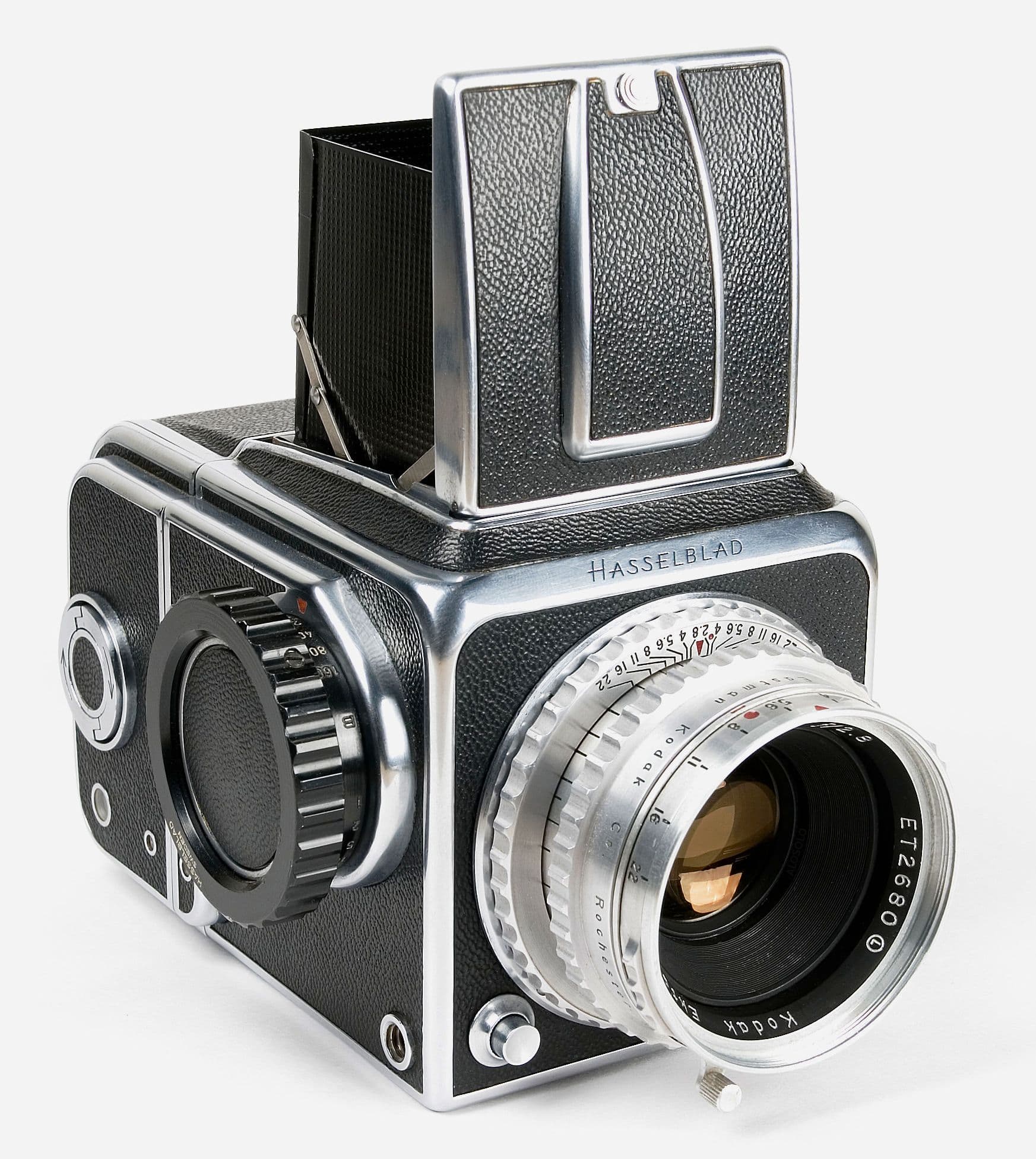
The Hasselblad 1600F (1948) holds an unchallenged place in photographic history as the first 6x6 SLR offered to the commercial market. Victor Hasselblad had developed cameras for the Swedish military during World War II, and the 1600F was his bid to translate that precision manufacturing into a professional civilian product. The camera introduced the modular architecture - interchangeable film backs, interchangeable lenses on an F-mount bayonet - that would define Hasselblad's identity for decades.
Reference
Recommended film stocks for the — format your camera takes.
C41
Kodak Portra 400 is a professional C-41 color negative film known for flexible exposure latitude, natural skin tones, and fine grain.
View profileC41
Kodak Portra 160 is a professional C-41 color negative film with fine grain, soft contrast, and natural color.
View profileC41
Kodak Ektar 100 is a fine-grain C-41 color negative film with saturated color and high sharpness.
Develop — film
We're growing the lab directory near you. Browse all labs.
Before you buy used
About this camera
The world's first commercially available 6x6 SLR, born in 1948 from post-war ambition and Swedish precision.
| Field | Value |
|---|
| Format | 120 film (6x6 cm, 12 frames) |
| Mount | Hasselblad F bayonet |
| Years | 1948-1952 |
| Shutter | Focal-plane cloth: 1s - 1/1600s + B |
| Flash sync | ~1/30s (focal-plane limit) |
| Meter | None built-in |
| Modes | Manual |
| Finder | Waist-level (standard) |
| Weight | ~ (not confirmed) |
| Battery | None required |
Victor Hasselblad began designing cameras for the Swedish Air Force during World War II to reverse-engineer and improve upon captured German aerial reconnaissance cameras. By 1948, with the war over and manufacturing infrastructure in place, Hasselblad launched the 1600F through the newly formed Victor Hasselblad AB.
The design was modular from the outset: the film magazine detached for mid-roll changes or swapping between film stocks, lenses mounted on a bayonet system that allowed quick changes in the field, and the reflex mirror gave through-the-lens composition at waist level. These principles had no real precedent in medium-format SLR cameras at the time.
The focal-plane shutter was the 1600F's primary liability. Achieving 1/1600s with a rubberized cloth curtain in a 6x6 frame required curtain slit geometry and spring tension that pushed the material to its limits. Warm temperatures, age, and heavy use all contributed to curtain failures, pinholes, and inconsistent speeds. By 1952, Hasselblad's revision produced the 1000F with a lower maximum speed and a more robust curtain mechanism. The 1600F was quietly retired.
The 1600F established the template for all Hasselblad V-system cameras that followed and, indirectly, for the broader professional medium-format SLR market. The modular magazine concept influenced Mamiya, Bronica, Rollei, and others who eventually adopted similar architectures.
For photography historians, the 1600F represents the moment when medium-format photography became genuinely flexible in the field. Before it, photographers using roll film in a studio context had few options for changing film mid-roll or swapping between colour and black-and-white without finishing a roll. The 1600F made that possible, however imperfectly.
The camera's rarity today - combined with its historical importance - gives it strong collector interest, but the mechanical fragility of surviving examples means the vast majority are display pieces.
Hasselblad F bayonet mount - not compatible with V-system lenses. The standard lens was the Carl Zeiss Tessar 80mm f/2.8; a Kodak Ektar 80mm f/2.8 was also available for the North American market. Additional F-mount options included the Sonnar 135mm f/3.5 and wider options. Film backs are interchangeable with the 1000F but not with any V-system magazine. The waist-level finder was standard equipment.
E6
Fujifilm Fujichrome Velvia 50 (RVP 50) is the legendary professional E6 reversal slide film at ISO 50 that defined landscape and nature photography for a generation. Characterized by extreme saturation, deep contrast, and ultra-fine grain, it remains in active production as of 2026.
View profileBW
Ilford HP5 Plus is a flexible ISO 400 black-and-white film with classic grain and strong push-processing tolerance.
View profileBW
Kodak Tri-X 400 is a classic black-and-white film known for strong tonality, visible grain, and documentary character.
View profile