C41
Kodak Portra 400
Kodak Portra 400 is a professional C-41 color negative film known for flexible exposure latitude, natural skin tones, and fine grain.
View profileMedium Format SLR
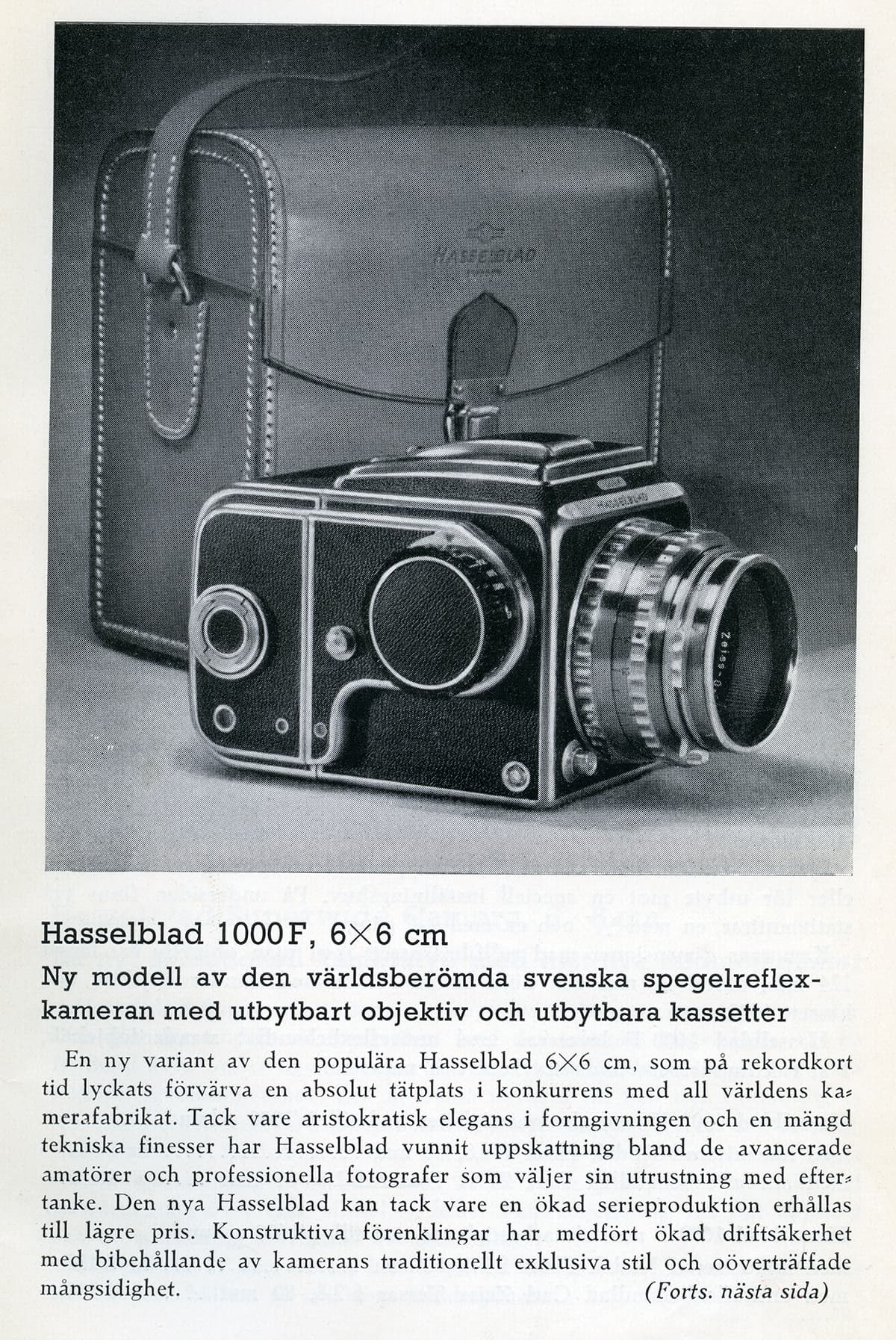
The Hasselblad 1000F (1952) is the second of the two early Hasselblad 6x6 SLR models to use a focal-plane shutter in the camera body rather than leaf shutters in the lenses. It succeeded the problematic 1600F, reducing the maximum shutter speed from an ambitious 1/1600s to a more reliable 1/1000s. The 1000F remained in production until 1957 — the same year the 500C launched and rendered the F-series obsolete by moving the shutter into each lens, an architecture that proved far more durable.
Reference
Recommended film stocks for the — format your camera takes.
C41
Kodak Portra 400 is a professional C-41 color negative film known for flexible exposure latitude, natural skin tones, and fine grain.
View profileC41
Kodak Portra 160 is a professional C-41 color negative film with fine grain, soft contrast, and natural color.
View profileC41
Kodak Ektar 100 is a fine-grain C-41 color negative film with saturated color and high sharpness.
Develop — film
We're growing the lab directory near you. Browse all labs.
Before you buy used
About this camera
The refined focal-plane Hasselblad of 1952 — predecessor of the V system and the last model before Hasselblad moved the shutter into the lens.
| Field | Value |
|---|
| Format | 120 film (6x6 cm, 12 frames) |
| Mount | Hasselblad F bayonet |
| Years | 1952-1957 |
| Shutter | Focal-plane cloth: 1s - 1/1000s + B |
| Flash sync | ~1/30s (focal-plane limit) |
| Meter | None built-in |
| Modes | Manual |
| Finder | Waist-level (standard) |
| Weight | ~ (not confirmed) |
| Battery | None required |
Victor Hasselblad introduced the 1600F in 1948 as the first commercially available 6x6 SLR. Its focal-plane shutter claimed 1/1600s - fast for the era but mechanically unreliable in practice. By 1952, Hasselblad revised the design into the 1000F, dialing the top speed back to 1/1000s and improving shutter reliability. The F-mount bayonet and modular film-back system were retained from the 1600F.
The 1000F sold in modest numbers to professional photographers and advanced amateurs who needed the versatility of a modular medium-format SLR. However, the focal-plane shutter placed an inherent limit on flash synchronisation - typically around 1/30s - which was a significant handicap for studio portrait and commercial photographers who relied on flash at all speeds.
When the 500C arrived in 1957 with its leaf-shutter-in-lens design offering full flash sync at every speed up to 1/500s, the 1000F was immediately obsolete for professional use. Hasselblad discontinued it the same year and never returned to a focal-plane design in the main V-system line until the 2000FC appeared in 1977.
The 1000F is historically significant as the bridge between Hasselblad's early ambitions and the V system that defined the company for the next five decades. It demonstrated that the modular body-plus-back architecture was viable and desirable, even if the focal-plane shutter proved to be a dead end for Hasselblad's product line.
For collectors, the 1000F represents the earliest practical Hasselblad SLR experience. It is rare, mechanically complex, and parts are nearly unobtainable - which makes it a camera for display or very careful occasional use rather than daily shooting. The F-mount lenses, particularly the Carl Zeiss Tessar 80mm f/2.8 and Sonnar 135mm f/3.5, are optically interesting but entirely incompatible with the far more common V-system ecosystem.
Hasselblad F bayonet mount - not compatible with V-system lenses. Available F-mount lenses include the Carl Zeiss Tessar 80mm f/2.8 (standard), Biotar 80mm f/2.8 (earlier variant), Distagon 60mm f/5.6, and Sonnar 135mm f/3.5. Film backs are interchangeable with the 1600F but not with V-system backs. The waist-level finder was standard; a prism finder was available as an accessory.
E6
Fujifilm Fujichrome Velvia 50 (RVP 50) is the legendary professional E6 reversal slide film at ISO 50 that defined landscape and nature photography for a generation. Characterized by extreme saturation, deep contrast, and ultra-fine grain, it remains in active production as of 2026.
View profileBW
Ilford HP5 Plus is a flexible ISO 400 black-and-white film with classic grain and strong push-processing tolerance.
View profileBW
Kodak Tri-X 400 is a classic black-and-white film known for strong tonality, visible grain, and documentary character.
View profile