C41
Kodak Portra 400
Kodak Portra 400 is a professional C-41 color negative film known for flexible exposure latitude, natural skin tones, and fine grain.
View profileMedium Format SLR
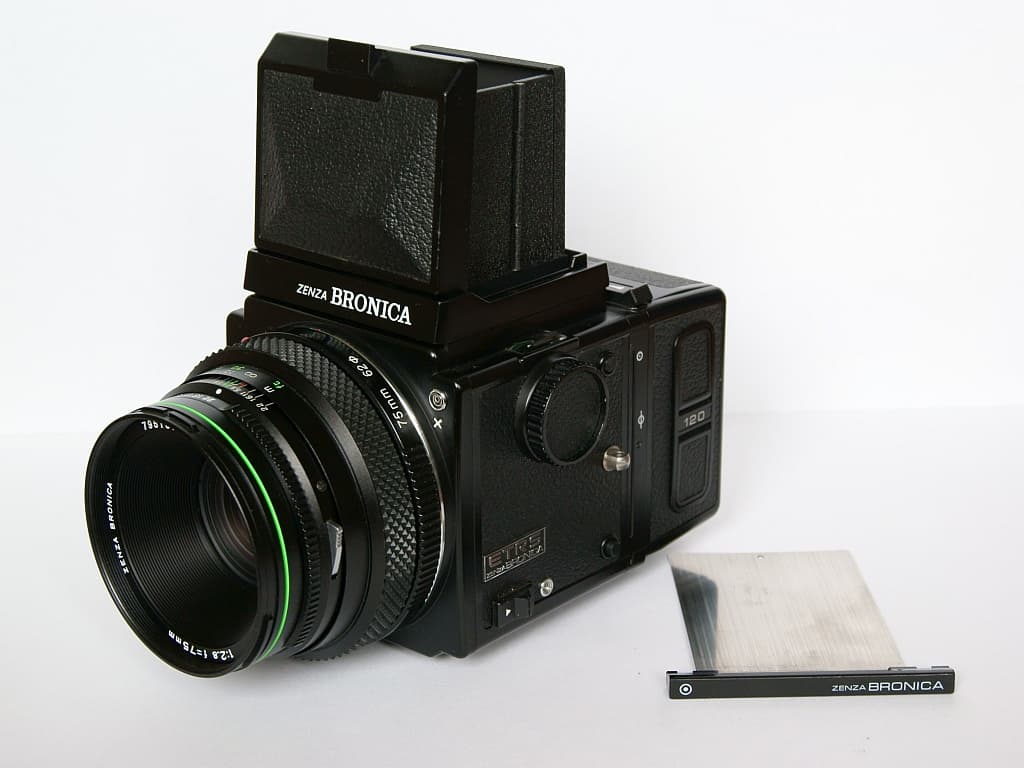
The Bronica ETR-S (1979) is the second body in Zenza Bronica's ETR system, succeeding the original 1976 ETR. It retains complete backward compatibility with the ETR's bayonet mount, leaf-shutter Zenzanon lenses, and interchangeable film backs and finders, while adding two key capabilities: a dedicated multiple-exposure mechanism and support for the new AE-III metered prism finder. When fitted with the AE-III prism and a Zenzanon-PE series lens (which carries an additional aperture-coupling ring for the AE circuit), the ETR-S delivers aperture-priority autoexposure - unusual for a 645 SLR at its price point.
Reference
Recommended film stocks for the — format your camera takes.
C41
Kodak Portra 400 is a professional C-41 color negative film known for flexible exposure latitude, natural skin tones, and fine grain.
View profileC41
Kodak Portra 160 is a professional C-41 color negative film with fine grain, soft contrast, and natural color.
View profileC41
Kodak Ektar 100 is a fine-grain C-41 color negative film with saturated color and high sharpness.
Develop — film
We're growing the lab directory near you. Browse all labs.
Before you buy used
About this camera
The ETR series' first step toward automation - the 1979 ETR-S added multiple-exposure capability and TTL metered-prism support to the original ETR system.
| Field | Value |
|---|
| Format | 120 / 220 film (6x4.5 cm, 15/30 frames) |
| Mount | Bronica ETR bayonet |
| Years | 1979-1989 |
| Shutter | Seiko leaf in lens: 8s - 1/500s + B |
| Flash sync | All speeds (leaf shutter) |
| Meter | None built-in; AE-III prism optional |
| Modes | Manual; aperture-priority (with AE-III + PE lens) |
| Finder | Waist-level (standard); multiple prism options |
| Weight | ~ (body only) |
| Battery | Not required for body; winder and AE prism require batteries |
Bronica launched the ETR in 1976 as a direct answer to photographers seeking a modular 6x4.5 system at sub-Hasselblad prices. The original ETR was fully manual and lacked a built-in meter entirely. By 1979, competing systems (notably Mamiya's 645 line) were beginning to offer metered operation, and Bronica responded with the ETR-S.
The ETR-S introduced the AE-III metered prism and a revised PE-type lens designation to signal AE coupling compatibility. The PE lens family - 75/2.8 PE, 100/2.8 PE, 150/3.5 PE, and others - retains all the leaf-shutter mechanics of the original E lenses but adds the coupling ring necessary for aperture-priority autoexposure through the AE-III finder. All E and PE lenses work in manual mode on any ETR, ETR-S, or ETRSi body.
The ETR-S also formalised multiple-exposure shooting: a dedicated ME control allows the film transport to be cocked without advancing the film, permitting deliberate double and triple exposures with repeatable results.
The ETR-S was in turn replaced by the ETRSi in 1989, which added TTL OTF (off-the-film) flash metering - the primary functional upgrade distinguishing the ETRSi from the ETR-S.
The ETR-S is the practical sweet spot of the ETR line for most photographers. It is mechanically identical to the original ETR for all basic operations, but adds the multiple-exposure capability and the option for aperture-priority shooting that many photographers find useful. Bodies are typically more affordable than ETRSi units, yet fully compatible with the entire ETR lens and accessory ecosystem.
The aperture-priority AE implementation is noteworthy: because the shutter is in each lens rather than the body, the AE-III prism reads the scene, sets the shutter speed in the lens-mounted Seiko unit via an electronic signal, and fires. The result is a technically elegant if mechanically complex workflow that Bronica refined further in the ETRSi.
For film photographers in 2026, the ETR-S represents a cost-effective way to enter the Bronica 645 system with AE capability retained as an option, without paying ETRSi premiums.
Bronica ETR bayonet mount. Compatible with all Zenzanon-E (manual) and Zenzanon-PE (AE-capable) lenses. Key optics: 40/4 E (ultra-wide), 50/2.8 E, 60/3.5 E (wide), 75/2.8 PE (standard portrait), 100/2.8 PE, 105/3.5 MC, 150/3.5 PE (short telephoto), 200/4.5 PE, 250/5.6, 500/8.
Key accessories: 120 and 220 film backs (E-series, interchangeable mid-roll); waist-level finder; 45-degree prism; AE-III metered prism (required for AE operation, paired with PE lenses); Speed Grip E; Motor Winder E (4x AA); extension tubes; bellows unit. The AE-III prism is the accessory most commonly sought with ETR-S bodies.
E6
Fujifilm Fujichrome Velvia 50 (RVP 50) is the legendary professional E6 reversal slide film at ISO 50 that defined landscape and nature photography for a generation. Characterized by extreme saturation, deep contrast, and ultra-fine grain, it remains in active production as of 2026.
View profileBW
Ilford HP5 Plus is a flexible ISO 400 black-and-white film with classic grain and strong push-processing tolerance.
View profileBW
Kodak Tri-X 400 is a classic black-and-white film known for strong tonality, visible grain, and documentary character.
View profile