C41
Kodak Portra 400
Kodak Portra 400 is a professional C-41 color negative film known for flexible exposure latitude, natural skin tones, and fine grain.
View profile35mm SLR
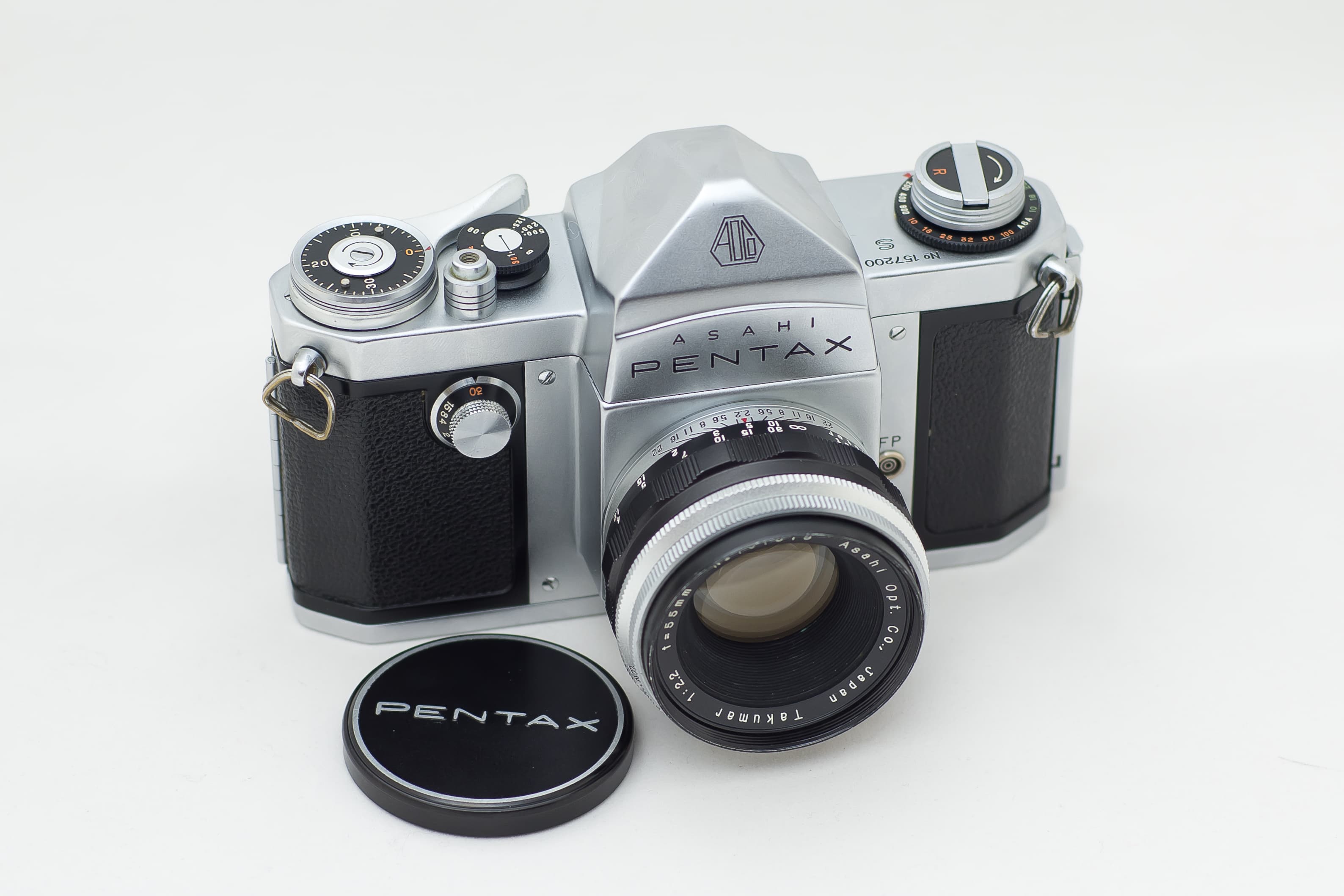
The Asahi Pentax S (1958) was the immediate successor to the original Asahi Pentax (AP) of 1957, retaining the pentaprism design and mechanical shutter of its predecessor while making one change of enormous long-term consequence: adopting the M42 42mm screw lens mount in place of the AP's proprietary M37 thread. This single decision aligned Pentax with the emerging de facto standard for manual-focus 35mm SLRs and gave the company access to the growing Contax/Praktica lens ecosystem while ensuring that Takumar lenses Asahi manufactured would be usable on cameras from other M42-compatible manufacturers. The S itself had no built-in meter and was mechanically simple, but its mount choice was foundational.
Reference
Recommended film stocks for the 35mm format your camera takes.
C41
Kodak Portra 400 is a professional C-41 color negative film known for flexible exposure latitude, natural skin tones, and fine grain.
View profileBW
Kodak Tri-X 400 is a classic black-and-white film known for strong tonality, visible grain, and documentary character.
View profileC41
Kodak Gold 200 is a daylight-balanced C-41 color negative film with warm color, moderate grain, and a classic consumer-film look.
Develop 35mm film
Labs in our directory that process 35mm film.
Before you buy used
About this camera
The refinement that locked Pentax onto M42 - the bridge between the original AP and a decade of Spotmatics.
| Field | Value |
|---|
| Format | 35mm |
| Mount | M42 (42mm screw, 45.46mm flange) |
| Years | 1958-1960 |
| Shutter | Cloth horizontal focal-plane |
| Shutter range | 1s - 1/500s + B |
| Flash sync | ~1/25s (X sync) |
| Meter | None (no built-in meter) |
| Viewfinder | Pentaprism, upright/laterally correct |
| Battery | None required |
| Focus | Manual, matte screen |
The original AP had shipped with the M37 mount in 1957, a proprietary thread that left Asahi isolated from the broader M42 ecosystem already forming around the Contax S and Praktica cameras produced in East Germany. The move to M42 for the Asahi Pentax S was a practical recognition that the market was consolidating around a single screw standard, and that lens compatibility would be a competitive factor.
The S was followed by the Asahi Pentax K (1958), which added minor refinements, and the Asahi Pentax K2 and Asahi Pentax S2 in subsequent years. The line culminated in the Spotmatic series from 1964, which introduced TTL (through-the-lens) metering to the Asahi lineup and became one of the defining cameras of the 1960s. All of these cameras shared M42 compatibility, making the S's mount decision a commitment that Asahi honored for roughly 18 years until the introduction of the K bayonet mount in 1975.
The M42 thread had originated with the Contax S of 1949 and was sometimes called the "Praktica thread" or "universal thread" in reference to the East German manufacturer that popularized it. By adopting M42, Asahi ensured that the large body of Carl Zeiss Jena, Meyer-Optik, and other European M42 lenses could be used on Pentax bodies, and vice versa.
The Asahi Pentax S matters primarily as a pivot point rather than as a camera of distinctive optical or mechanical character. The body itself broke no new technical ground over the AP - the mechanical specification was nearly identical, the viewfinder unchanged, the shutter range the same. What changed was interoperability.
By the time the Spotmatic arrived in 1964, Asahi had built a substantial Takumar lens catalog in M42: the Super-Takumar series offered primes from 17mm to 300mm and beyond, all sharing the common thread mount that began with the S. The Spotmatic's commercial success depended on this lens library; the lens library's existence depended on Asahi committing to M42 at the S stage rather than persisting with M37 or adopting a proprietary bayonet.
The M42 mount is today one of the most adaptable in vintage photography. Adapters to virtually every modern mirrorless system are cheap and widely produced, meaning that Takumar lenses manufactured for the S and all subsequent M42 Pentax bodies have found a large new audience in digital mirrorless shooters. The S is the origin point of this compatibility lineage.
M42 screw mount, 42mm thread, 45.46mm flange distance. All M42-mount lenses from any manufacturer are mechanically compatible; automatic aperture coupling may require stop-down metering depending on the lens and adapter used.
The Asahi Takumar line available during the S's production years included:
These are the "Auto-Takumar" generation, which used a semi-automatic aperture mechanism. The later Super-Takumar series (introduced 1961) replaced these with fully automatic aperture lenses and improved coating.
M42 lenses from Zeiss Jena (Tessar, Biotar, Flektogon) and Meyer-Optik (Trioplan, Domiplan, Oreston) were compatible and were used by photographers who preferred German glass.
No motor drive or dedicated flash system was marketed for the S; camera-mounted flash units of the period connected via PC sync port.
C41
Fujifilm Superia X-TRA 400 (marketed as Superia 400 in some regions) is an ISO 400 C-41 consumer color negative film in 135 format, one of Fujifilm's most popular consumer films. It delivers warm, vibrant colors with moderate grain and remains in production in some markets.
View profileBW
Ilford HP5 Plus is a flexible ISO 400 black-and-white film with classic grain and strong push-processing tolerance.
View profileC41
Kodak Ektar 100 is a fine-grain C-41 color negative film with saturated color and high sharpness.
View profile