C41
Kodak Portra 400
Kodak Portra 400 is a professional C-41 color negative film known for flexible exposure latitude, natural skin tones, and fine grain.
View profile35mm SLR
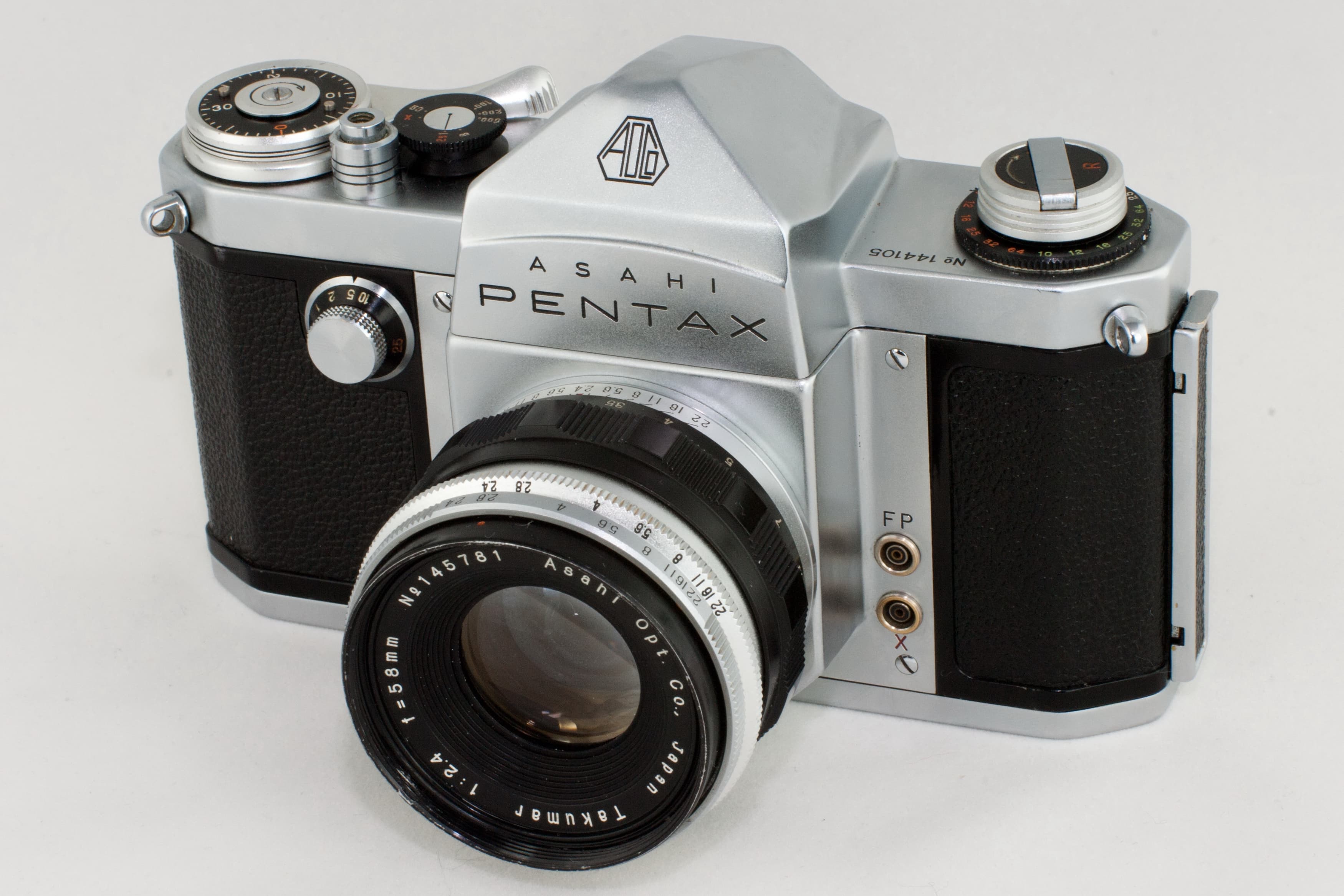
The Asahi Pentax of 1957 - commonly abbreviated AP - was the first 35mm single-lens reflex camera produced by Asahi Optical under the Pentax name, and the camera that established the brand identity the company would carry for the next seven decades. It was built around a pentaprism viewfinder giving an upright, laterally correct image, a horizontal cloth focal-plane shutter, and a proprietary M37 screw mount with a 37mm thread diameter. The AP had no built-in meter; exposure was determined by external meter or experience. It was a direct evolution of Asahi's earlier Asahiflex series, which had used a mirror-box design without a pentaprism, producing an inverted viewfinder image.
Reference
Recommended film stocks for the 35mm format your camera takes.
C41
Kodak Portra 400 is a professional C-41 color negative film known for flexible exposure latitude, natural skin tones, and fine grain.
View profileBW
Kodak Tri-X 400 is a classic black-and-white film known for strong tonality, visible grain, and documentary character.
View profileC41
Kodak Gold 200 is a daylight-balanced C-41 color negative film with warm color, moderate grain, and a classic consumer-film look.
Develop 35mm film
Labs in our directory that process 35mm film.
Before you buy used
About this camera
The camera that named a dynasty - Japan's first pentaprism SLR and the origin of the Pentax brand.
| Field | Value |
|---|
| Format | 35mm |
| Mount | M37 (37mm screw, 45.46mm flange) |
| Year | 1957-1958 |
| Shutter | Cloth horizontal focal-plane |
| Shutter range | 1s - 1/500s + B |
| Flash sync | ~1/25s (X sync) |
| Meter | None (no built-in meter) |
| Viewfinder | Pentaprism, upright/laterally correct |
| Battery | None required |
| Focus | Manual, matte screen |
Asahi Optical had entered the SLR market in 1952 with the Asahiflex I, a camera with a waist-level finder and a temporary mirror that had to be manually flipped back before the next exposure. The Asahiflex IIb of 1954 introduced an instant-return mirror, a critical improvement that made the viewfinder usable immediately after each shot.
The AP of 1957 added the pentaprism - the defining element that transformed the SLR from a specialist instrument into a practical street and portrait camera. The upright image in the eye-level finder matched how photographers saw the world, eliminating the left-right reversal of waist-level SLR finders. The Contax S of 1949 had pioneered the pentaprism in an SLR, and several European manufacturers followed; the AP was Japan's first contribution to this approach.
The M37 mount used on the AP was a transitional standard. Asahi had inherited the screw-mount convention from Exakta and Contax lineage by way of the Leica-influenced Japanese optical industry, but the 37mm thread diameter was unique to Asahi. The mount was short-lived: within a year the AP's successor, the Asahi Pentax S, migrated to the M42 42mm screw thread that would become the de facto universal standard for manual-focus SLRs through the 1970s.
The AP is historically significant on two counts. First, it established the Pentax name. Asahi Optical had previously manufactured cameras for other brands and sold its own Asahiflex cameras under the Asahi name in domestic markets while branding them Asahiflex for export. The AP introduced "Pentax" as the primary brand designation, a portmanteau of "pentaprism" and the "-ax" suffix fashionable in optical branding of the era. The name stuck for everything that followed.
Second, the AP was part of a concentrated burst of Japanese pentaprism SLR development in 1957-1958. Nikon, Topcon, Miranda, and Olympus all introduced or previewed pentaprism SLRs in this period. The competition was not merely commercial - Japanese manufacturers were demonstrating that they could match and in some respects surpass German optical engineering. The AP's quick succession by the M42-mount Asahi Pentax S shows how rapidly this learning was being absorbed and iterated.
The M37 mount is a practical dead end: lenses from no other manufacturer used this thread, and only a small number of Asahi's own lenses were produced for it before the transition to M42. This makes the AP a camera primarily of historical rather than practical photographic interest today.
The AP used the M37 screw mount, a 37mm thread with a flange distance of approximately 45.46mm.
Asahi produced a small range of Takumar lenses for M37, including a 58mm normal lens as the standard kit. The number of distinct M37 lens designs manufactured was small and all are now rare. No M37 lenses from other manufacturers are documented.
Adaptation to modern cameras is theoretically possible - the flange distance is similar to M42, and the thread could be adapted with a machined ring - but commercial M37 adapters are not widely produced. M42 lenses cannot be used on M37-mount bodies without modification.
No motor drive, databack, or dedicated flash unit was produced for the AP; these accessories did not exist in this form for consumer cameras of the period.
C41
Fujifilm Superia X-TRA 400 (marketed as Superia 400 in some regions) is an ISO 400 C-41 consumer color negative film in 135 format, one of Fujifilm's most popular consumer films. It delivers warm, vibrant colors with moderate grain and remains in production in some markets.
View profileBW
Ilford HP5 Plus is a flexible ISO 400 black-and-white film with classic grain and strong push-processing tolerance.
View profileC41
Kodak Ektar 100 is a fine-grain C-41 color negative film with saturated color and high sharpness.
View profile