C41
Kodak Portra 400
Kodak Portra 400 is a professional C-41 color negative film known for flexible exposure latitude, natural skin tones, and fine grain.
View profile35mm SLR
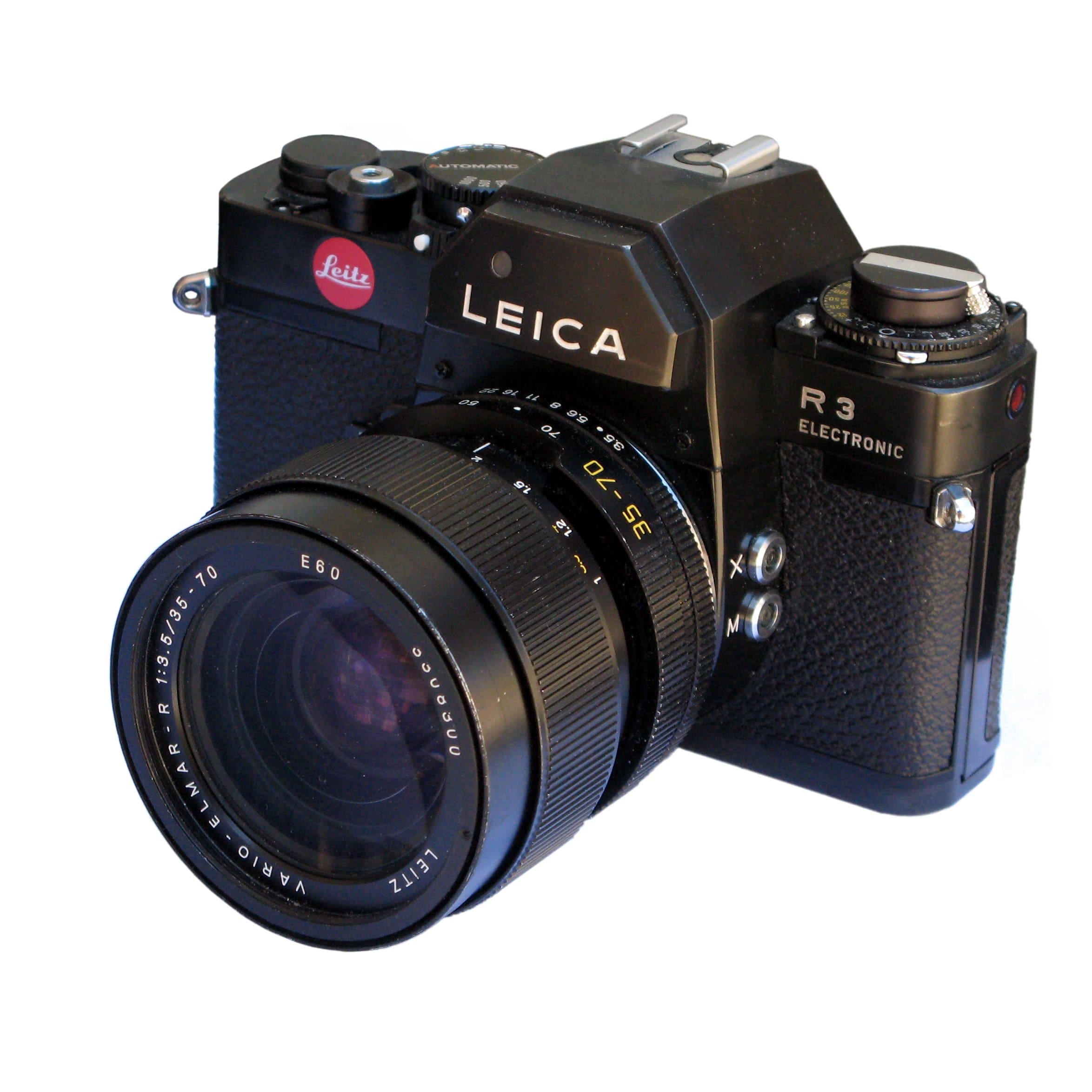
The Leica R3 (1976) is the first camera in the Leica R series and the direct successor to the Leicaflex SL2. It represents a fundamental strategic shift: rather than continuing to develop SLR bodies entirely in-house at Wetzlar (as the Leicaflex line had been), Leica entered a co-development agreement with Minolta to share body engineering and reduce manufacturing costs. The R3's internal architecture is closely derived from the Minolta XE-7 (known as the XE-1 in Europe) — a sophisticated aperture-priority camera that had established Minolta's reputation for precision engineering.
Reference
Recommended film stocks for the 35mm format your camera takes.
C41
Kodak Portra 400 is a professional C-41 color negative film known for flexible exposure latitude, natural skin tones, and fine grain.
View profileBW
Kodak Tri-X 400 is a classic black-and-white film known for strong tonality, visible grain, and documentary character.
View profileC41
Kodak Gold 200 is a daylight-balanced C-41 color negative film with warm color, moderate grain, and a classic consumer-film look.
Develop 35mm film
Labs in our directory that process 35mm film.
Before you buy used
About this camera
The R3 marked a turning point — Leica's first SLR built in partnership with Minolta, sharing its body architecture with the Minolta XE-7 while retaining Leica R-mount optics and German quality standards.
| Field | Value |
|---|
| Format | 35mm |
| Mount | Leica R bayonet (3-cam; ROM not supported) |
| Years | 1976–1979 |
| Shutter | 1s – 1/1000s + B, vertical-travel metal blades |
| Flash sync | 1/100s |
| Meter | TTL centre-weighted, EV 1–18 |
| Modes | Aperture-priority, Manual |
| Viewfinder | Pentaprism, 0.8× |
| Weight | ~600 g (body only) |
| Battery | 2× PX13 or SR44 silver oxide |
| Mechanical fallback | None |
The Leicaflex SL2 (1974) had been a refinement of the manual-metering Leicaflex concept, but by the mid-1970s Leica was under significant financial pressure. The Japanese SLR manufacturers — Nikon, Canon, Minolta, Olympus — had surpassed European rivals in both technology and production volume. Leica's solution was to partner with Minolta for SLR body engineering, freeing Leica's Wetzlar operations to focus on M-series rangefinders and R-mount lens development.
The R3 debuted at Photokina 1976. It was manufactured partly in Portugal at Leica's new facility, a further cost-reduction measure that was controversial among traditional Leica users who associated the brand exclusively with Wetzlar. The R3 MOT variant added a winder connection port for an early motor drive accessory, produced in small numbers.
The R3 was produced until 1979, when the R4 (1980) succeeded it with a substantially upgraded feature set including the full PASM mode selection and wider metering options.
The R3 is the entry point to the R-system's co-development era and the most affordable Leica SLR with a modern shutter and metering system. For photographers who want to use the Leica R lens range — particularly Summicron-R, Elmarit-R, and Summilux-R optics — on a working camera rather than a collector piece, the R3 offers aperture-priority automation and a reliable vertical-travel shutter at prices that significantly undercut the SL2 and later R bodies.
Its limitations relative to later R bodies are real: no shutter-priority or programme mode, 1/1000s maximum speed (vs. 1/2000s on the R4 and later), and no ROM lens compatibility. But as a lens-testing and occasional-use body, the R3 is entirely capable.
The Minolta XE-7 heritage also means that certain spare parts and service knowledge overlap with a very common Japanese camera, which is practically useful for repair technicians.
Leica R bayonet mount (3-cam for open-aperture metering; 2-cam lenses work in stop-down mode; 1-cam Leicaflex lenses stop-down only). Compatible lenses: Summicron-R 50/2, Summilux-R 50/1.4, Elmarit-R 28/2.8, Summicron-R 90/2, Elmarit-R 90/2.8, Elmarit-R 135/2.8, Vario-Elmar-R 35–70/3.5. Accessories: Motor R (winder for R3 MOT variant); cable release; interchangeable focusing screens.
C41
Fujifilm Superia X-TRA 400 (marketed as Superia 400 in some regions) is an ISO 400 C-41 consumer color negative film in 135 format, one of Fujifilm's most popular consumer films. It delivers warm, vibrant colors with moderate grain and remains in production in some markets.
View profileBW
Ilford HP5 Plus is a flexible ISO 400 black-and-white film with classic grain and strong push-processing tolerance.
View profileC41
Kodak Ektar 100 is a fine-grain C-41 color negative film with saturated color and high sharpness.
View profile