C41
Kodak Portra 400
Kodak Portra 400 is a professional C-41 color negative film known for flexible exposure latitude, natural skin tones, and fine grain.
View profile35mm SLR
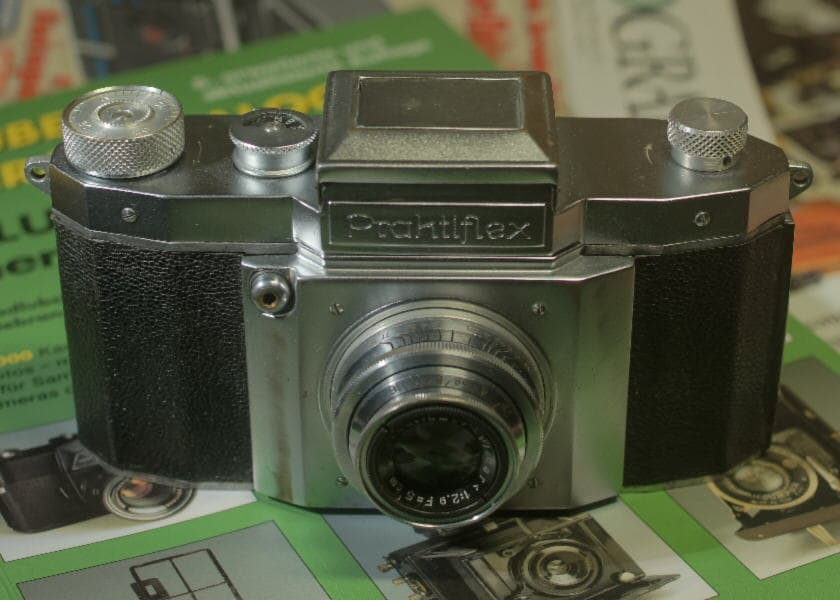
The KW Praktiflex II is a 35mm single-lens reflex camera produced by Kamera-Werkstätten (KW) in Dresden, East Germany, introduced around 1948 in the immediate postwar period. It is a refined and updated version of the 1938 KW Praktiflex -- the original M42-mount SLR -- incorporating improvements developed during and after World War II, most notably a coupled film-advance and shutter-cocking mechanism that eliminated the two-step operation required on the earliest Praktiflex bodies.
Reference
Recommended film stocks for the 35mm format your camera takes.
C41
Kodak Portra 400 is a professional C-41 color negative film known for flexible exposure latitude, natural skin tones, and fine grain.
View profileBW
Kodak Tri-X 400 is a classic black-and-white film known for strong tonality, visible grain, and documentary character.
View profileC41
Kodak Gold 200 is a daylight-balanced C-41 color negative film with warm color, moderate grain, and a classic consumer-film look.
Develop 35mm film
Labs in our directory that process 35mm film.
Before you buy used
About this camera
The postwar refinement that locked M42 in place as a mount standard -- the 1948 Praktiflex II added a coupled film advance and cemented the screw-thread mount that the world would adopt.
| Field | Value |
|---|
| Format | 35mm (24x36 mm) |
| Mount | M42 (42x1mm screw thread) |
| Introduced | ~1948 |
| Shutter | Horizontal cloth focal-plane: 1/20s - 1/500s + B |
| Flash sync | None (~ on early examples) |
| Meter | None |
| Exposure | Manual |
| Viewfinder | Waist-level ground glass |
| Focus | Manual, ground glass |
| Battery | None |
Kamera-Werkstätten survived World War II with its Dresden factory partially intact, though the city suffered heavy bombing in February 1945. Production resumed under Soviet occupation and subsequently under the East German Democratic Republic. The postwar Praktiflex -- referred to retroactively by collectors as the Praktiflex II or Praktiflex FX, though KW's own designations were not always consistent -- incorporated the technical improvements that wartime production interruptions had delayed.
The most significant mechanical advance on the postwar Praktiflex was the coupling of the film advance knob to the shutter cocking mechanism. On the original 1938 Praktiflex, the photographer had to wind the film and cock the shutter as two separate operations -- a source of missed frames and double exposures. The postwar refinement linked these actions, making the camera safer and faster to operate.
The M42 mount, carried over unchanged from 1938, was also refined in the postwar period. Carl Zeiss Jena and Meyer-Optik Görlitz, both also operating as East German state enterprises, produced lenses for the M42 standard throughout this period. When Asahi Optical in Japan adopted essentially the same thread specification for the Asahiflex (1952) and subsequently for the entire Pentax line, the mount's fate as a global standard was sealed.
By 1949, KW had begun marketing the successor line under the Praktica name, and by the early 1950s the Praktiflex designation was being phased out. The Praktiflex II sits in a narrow historical window: postwar, pre-Praktica, and technically significant.
The Praktiflex II is the camera that established the M42 mount in its stable, production form. While the 1938 Praktiflex introduced the M42 concept, it was the postwar refinement that produced the mount in the form that would be adopted internationally. The lens-mount standardisation that the Praktiflex II represents had consequences far beyond KW or East Germany: by the time Asahi, Fujinon, Mamiya, and scores of independent lens makers had adopted M42, it had become the de facto universal 35mm SLR mount -- a position it held until Pentax's switch to the K bayonet in 1975.
For the Dresden camera industry specifically, the Praktiflex II also represents the successful reconstitution of precision optical-mechanical manufacturing in a devastated postwar city -- a technological continuity that made East Germany a significant camera-exporting nation for the following three decades.
The Praktiflex II accepts any M42 lens. Lenses available in the postwar period from KW's associated manufacturers included the Carl Zeiss Jena Tessar 50/3.5, Meyer-Optik Primotar 50/3.5, and Meyer-Optik Trioplan 50/2.9. The Biotar 58/2 from Carl Zeiss Jena, one of the most sought-after M42 lenses by modern collectors, was also produced during this era. The M42 mount's universal legacy means modern adapters allow these and thousands of other M42 lenses to be fitted to mirrorless digital cameras.
C41
Fujifilm Superia X-TRA 400 (marketed as Superia 400 in some regions) is an ISO 400 C-41 consumer color negative film in 135 format, one of Fujifilm's most popular consumer films. It delivers warm, vibrant colors with moderate grain and remains in production in some markets.
View profileBW
Ilford HP5 Plus is a flexible ISO 400 black-and-white film with classic grain and strong push-processing tolerance.
View profileC41
Kodak Ektar 100 is a fine-grain C-41 color negative film with saturated color and high sharpness.
View profile