C41
Kodak Portra 400
Kodak Portra 400 is a professional C-41 color negative film known for flexible exposure latitude, natural skin tones, and fine grain.
View profile35mm SLR
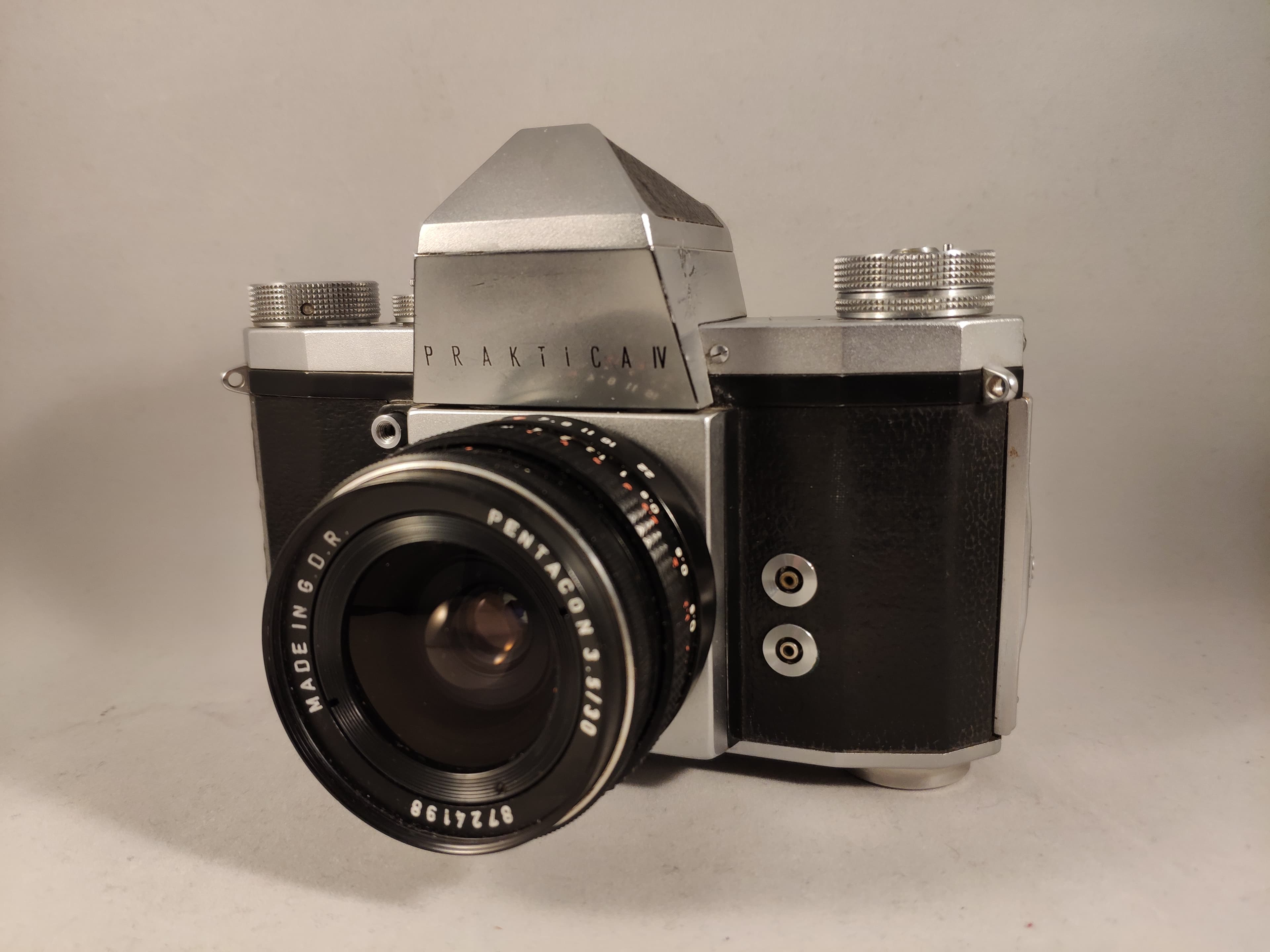
The KW Praktica IV is a 35mm single-lens reflex camera produced by Kamera-Werkstätten (KW) in Dresden, East Germany, introduced in 1959. It is notable within the Praktica line as one of the earliest models to incorporate a fixed eye-level pentaprism viewfinder, replacing the waist-level ground-glass arrangement that had characterised the Praktiflex and early Praktica FX bodies. The Praktica IV retains the M42 screw-thread lens mount and all-mechanical horizontal cloth focal-plane shutter of its predecessors, but the addition of the pentaprism brought it in line with the ergonomic direction being set by Western competitors such as the Asahi Spotmatic and Voigtländer Bessamatic.
Reference
Recommended film stocks for the 35mm format your camera takes.
C41
Kodak Portra 400 is a professional C-41 color negative film known for flexible exposure latitude, natural skin tones, and fine grain.
View profileBW
Kodak Tri-X 400 is a classic black-and-white film known for strong tonality, visible grain, and documentary character.
View profileC41
Kodak Gold 200 is a daylight-balanced C-41 color negative film with warm color, moderate grain, and a classic consumer-film look.
Develop 35mm film
Labs in our directory that process 35mm film.
Before you buy used
About this camera
The first Praktica with an eye-level pentaprism -- the 1959 step that brought the Dresden SLR out of waist-level obscurity.
| Field | Value |
|---|
| Format | 35mm (24x36 mm) |
| Mount | M42 (42x1mm screw thread) |
| Introduced | 1959 |
| Shutter | Horizontal cloth focal-plane: 1s - 1/500s + B |
| Flash sync | ~1/25s (PC socket) |
| Meter | None |
| Exposure | Manual |
| Viewfinder | Eye-level pentaprism |
| Focus | Manual, ground glass |
| Battery | None required |
The Praktica name was adopted by KW around 1949 as it phased out the Praktiflex designation and began producing a more refined, commercially oriented SLR. The early Praktica FX models of the early-to-mid 1950s maintained a waist-level viewfinder inherited from the Praktiflex lineage. By the late 1950s, the eye-level pentaprism had become the expected configuration for a serious SLR -- the Asahi Pentax (1957) and Minolta SR-2 (1958) had established the standard.
The Praktica IV, introduced in 1959, was KW's response: a body that brought the core Praktica mechanical system -- M42 mount, cloth focal-plane shutter, all-mechanical operation -- into an eye-level pentaprism configuration. The model designation "IV" reflected the iterative numbering convention KW used in this period; the Praktica line was not strictly sequential in naming and several model numbers were applied to bodies with varying feature sets across the same years.
Production continued for several years, with the IV eventually succeeded by models with self-timers, improved shutter mechanisms, and, eventually, the TTL metering introduced on the VLC in the late 1960s.
The Praktica IV marks the point at which the Dresden SLR line committed fully to eye-level viewing. Before it, the Praktica brand was associated in the minds of many photographers -- particularly in Western Europe where these cameras were exported -- with an older, more awkward waist-level workflow. The pentaprism model brought the Praktica into direct competition with mid-range SLRs from Japan and West Germany.
For the East German photographic industry, the Praktica IV also represented a successful domestically produced response to Cold War-era competition: it was manufactured, exported, and sold in Western markets under various rebadged names, contributing foreign currency to the GDR economy.
The Praktica IV accepts all M42-mount lenses. Lenses produced contemporaneously by East German manufacturers included:
Any M42 lens produced by any manufacturer, including later Asahi Super-Takumar and Pentax lenses, also fits.
C41
Fujifilm Superia X-TRA 400 (marketed as Superia 400 in some regions) is an ISO 400 C-41 consumer color negative film in 135 format, one of Fujifilm's most popular consumer films. It delivers warm, vibrant colors with moderate grain and remains in production in some markets.
View profileBW
Ilford HP5 Plus is a flexible ISO 400 black-and-white film with classic grain and strong push-processing tolerance.
View profileC41
Kodak Ektar 100 is a fine-grain C-41 color negative film with saturated color and high sharpness.
View profile