C41
Kodak Portra 400
Kodak Portra 400 is a professional C-41 color negative film known for flexible exposure latitude, natural skin tones, and fine grain.
View profile35mm SLR
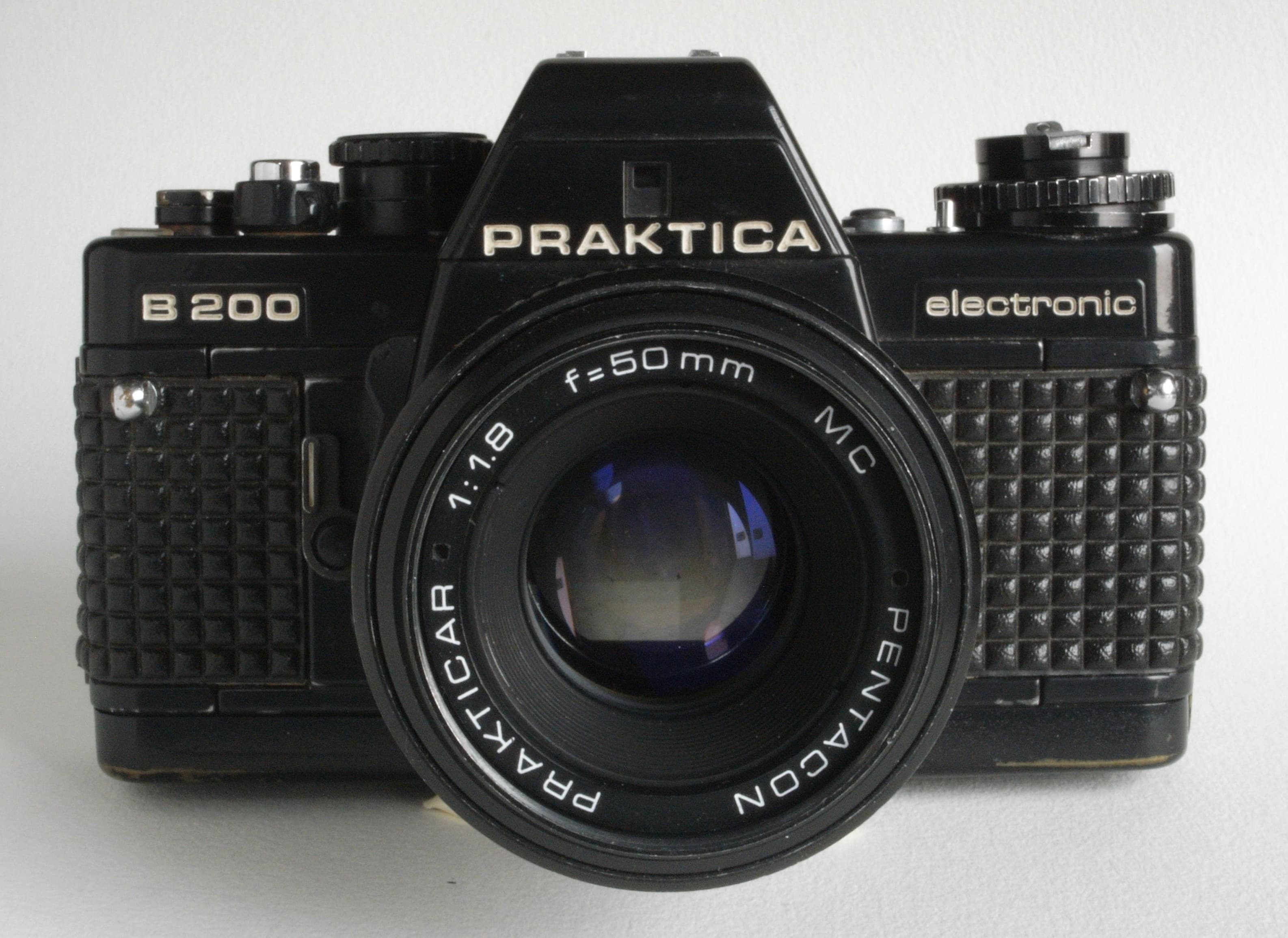
The Praktica B200 (1979) is the founding model of VEB Pentacon's Praktica B series - the first camera to use the Praktica B electronic bayonet mount that would define Dresden's SLR output through the 1980s and into the early 1990s. With the B200, Pentacon abandoned the M42 screwmount that had been synonymous with the Praktica name since the early 1950s, replacing it with a dedicated electronic bayonet capable of transmitting aperture data from lens to body for open-aperture TTL metering.
Reference
Recommended film stocks for the 35mm format your camera takes.
C41
Kodak Portra 400 is a professional C-41 color negative film known for flexible exposure latitude, natural skin tones, and fine grain.
View profileBW
Kodak Tri-X 400 is a classic black-and-white film known for strong tonality, visible grain, and documentary character.
View profileC41
Kodak Gold 200 is a daylight-balanced C-41 color negative film with warm color, moderate grain, and a classic consumer-film look.
Develop 35mm film
Labs in our directory that process 35mm film.
Before you buy used
About this camera
The camera that launched the Praktica B-mount: East Germany's electronic bayonet SLR at its debut in 1979.
| Field | Value |
|---|
| Format | 35mm (24x36 mm) |
| Mount | Praktica B bayonet (electronic) |
| Introduced | 1979 |
| Shutter | Electronic focal-plane: 1s - 1/1000s + B (stepless in Av) |
| Flash sync | 1/100s (X-sync) |
| Meter | Silicon blue cell TTL, open-aperture |
| Exposure | Aperture-priority auto + manual |
| Viewfinder | Pentaprism, split-prism + microprism ring |
| Focus | Manual |
| Battery | 4x AA (LR6) |
| Mechanical fallback | None |
VEB Pentacon in Dresden had manufactured M42-mount cameras under the Praktica name since the early 1950s, building on the universal screwmount that Zeiss Ikon had popularised and that Pentax had carried to global dominance. By the late 1970s, the Japanese manufacturers had moved to electronic bayonet mounts - Canon's FD, Pentax's K-mount, Olympus OM - enabling open-aperture metering and more sophisticated automation. M42, as a passive mechanical mount, could not support these advances without stop-down metering.
Pentacon's answer was the B mount, introduced with the B200 in 1979. The B mount is a bayonet with electrical contacts that transmit the selected aperture value electronically from lens to body, permitting open-aperture metering. The lens aperture is controlled by a lever actuated by the camera body at the moment of exposure. This allowed the B200 to offer a genuinely modern autoexposure experience comparable to Western cameras of the period - without requiring the photographer to stop down the aperture ring before each shot.
The B200 was produced through the early 1980s and gave way to a series of successors including the B100 (a simpler, lower-cost variant), the BC1 (1985), and the BX20 (1986). The B mount itself outlasted the B200 by well over a decade, remaining the standard for Praktica SLRs until camera production in Dresden effectively ceased in the mid-1990s.
The B200 is historically significant as the camera that initiated East Germany's most ambitious attempt to keep pace with the West in SLR design. The Praktica B mount represented a genuine engineering commitment - designing and manufacturing a new electronic bayonet system under the resource and information constraints of the GDR in the late 1970s was no small achievement.
For contemporary film photographers, the B200's significance is primarily as the entry point to the Praktica B lens ecosystem. The Carl Zeiss Jena B-mount lenses - particularly the Pancolar 50mm f/1.8 MC, Flektogon 35mm f/2.4 MC, and Sonnar 135mm f/2.8 MC - are optically excellent and considerably undervalued relative to equivalent Contax or Leica R glass. The B200 provides access to these lenses in their native automatic mount configuration.
The B200 also occupies a specific place in the history of electronic SLR design: it arrived the same year as the Olympus OM-2n and predates the Canon A-1's aperture-priority mode by only two years, placing Pentacon in reasonable synchrony with Japanese development timelines despite operating under very different industrial conditions.
Praktica B-mount electronic bayonet. Key native lenses:
M42 lenses can be adapted via B-mount to M42 adaptor but lose automatic aperture coupling, reverting to stop-down metering. This is a functional workaround that makes the B200 compatible with the enormous M42 lens library.
TTL flash via the B-mount hotshoe. Compatible with Metz 45 series with appropriate SCA adaptor, and Pentacon/Praktica-branded TTL units.
C41
Fujifilm Superia X-TRA 400 (marketed as Superia 400 in some regions) is an ISO 400 C-41 consumer color negative film in 135 format, one of Fujifilm's most popular consumer films. It delivers warm, vibrant colors with moderate grain and remains in production in some markets.
View profileBW
Ilford HP5 Plus is a flexible ISO 400 black-and-white film with classic grain and strong push-processing tolerance.
View profileC41
Kodak Ektar 100 is a fine-grain C-41 color negative film with saturated color and high sharpness.
View profile