C41
Kodak Portra 400
Kodak Portra 400 is a professional C-41 color negative film known for flexible exposure latitude, natural skin tones, and fine grain.
View profile35mm SLR
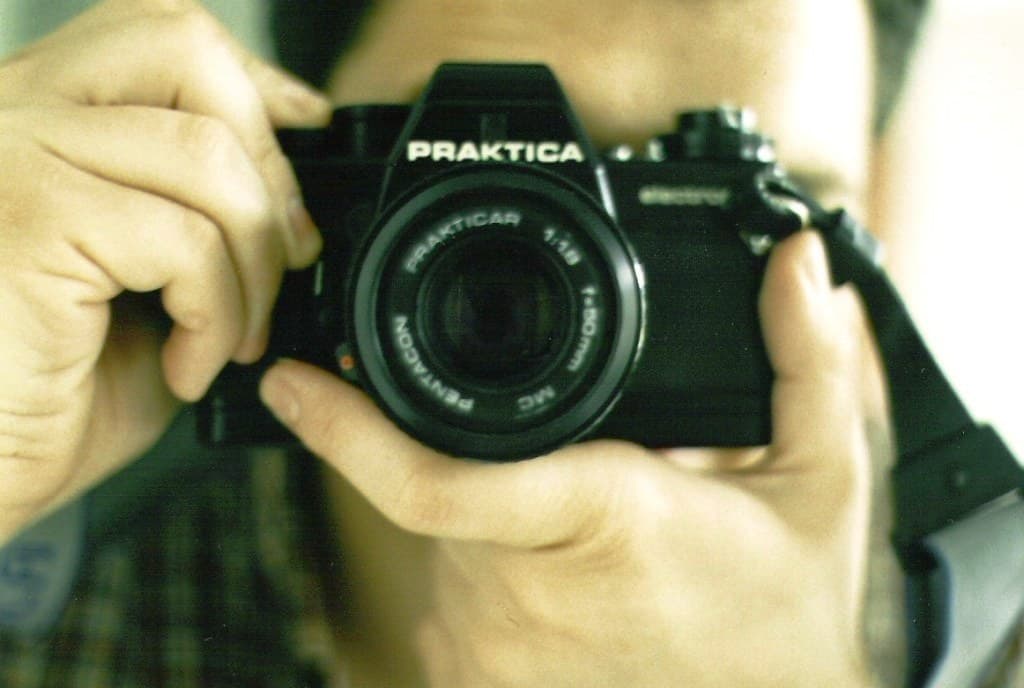
The Praktica BC1 (1985) is a 35mm single-lens reflex camera produced by VEB Pentacon in Dresden, East Germany, and represents an important step in the Praktica B series — the electronic-mount successor to the long-running M42 Praktika. The BC1 uses the Praktica B bayonet mount introduced in 1979, an electronic mount that enables automatic aperture coupling and TTL flash metering without the stop-down penalty of the earlier M42 system.
Reference
Recommended film stocks for the 35mm format your camera takes.
C41
Kodak Portra 400 is a professional C-41 color negative film known for flexible exposure latitude, natural skin tones, and fine grain.
View profileBW
Kodak Tri-X 400 is a classic black-and-white film known for strong tonality, visible grain, and documentary character.
View profileC41
Kodak Gold 200 is a daylight-balanced C-41 color negative film with warm color, moderate grain, and a classic consumer-film look.
Develop 35mm film
Labs in our directory that process 35mm film.
Before you buy used
About this camera
The Praktica B-mount comes of age: the BC1 brought electronic aperture-priority automation and TTL flash to East Germany's most popular SLR line in a plastic-bodied package aimed squarely at the amateur market.
| Field | Value |
|---|
| Format | 35mm (24x36 mm) |
| Mount | Praktica B bayonet (electronic) |
| Introduced | ~1985 |
| Shutter | Electronic focal-plane: 1s - 1/1000s + B (stepless in Av) |
| Flash sync | 1/100s (X-sync) |
| Meter | Silicon blue cell TTL, open-aperture |
| Exposure | Aperture-priority auto + manual |
| Viewfinder | Pentaprism |
| Focus | Manual, split-prism + microprism ring |
| Battery | 4x AA (LR6) |
| Mechanical fallback | None |
VEB Pentacon introduced the Praktica B mount in 1979, marking the Praktica line's transition from the M42 screwmount that had defined the brand since the 1950s. The B mount was a full electronic bayonet with contacts for aperture value transmission from lens to body, enabling open-aperture metering and automatic aperture control in the same manner as Pentax K or Canon FD. This was a significant upgrade: M42 cameras required stop-down metering, which dimmed the viewfinder during exposure measurement and slowed the shooting process.
The BC1 arrived in 1985 as part of the second generation of B-mount bodies. It sat above the more basic B100 in Pentacon's lineup and below the BX20 (1986), which added additional refinements including an improved metering system. The BC1, B100, and BX20 together represent the mature Praktica B system — a coherent lineup with a range of capable lenses from Carl Zeiss Jena and Meyer-Optik.
Production continued through German reunification in 1990 under the successor organisation Pentacon GmbH. By the mid-1990s, competition from Japanese manufacturers had made the Praktica range commercially unviable in Western markets, and production of B-mount cameras wound down. The BC1's successor, the BX20, was among the last significant Praktica models before the Dresden camera industry effectively ended.
The BC1 is significant as part of the Praktica B system's contribution to the history of East German camera manufacturing. The B mount and its electronic coupling represented a genuine technical achievement from VEB Pentacon, allowing a state-owned enterprise under significant resource constraints to produce a competitive SLR system with features comparable to Western Japanese cameras of the mid-1980s.
For contemporary film photographers, the BC1's primary value is as an affordable entry point into the Praktica B lens catalogue. Carl Zeiss Jena's Pancolar 50/1.8 MC, Flektogon 35/2.4 MC, and Sonnar 135/2.8 MC are all excellent lenses with strong rendering character, and they can be used on the BC1 at full automatic aperture. These lenses are significantly cheaper than equivalent Contax Zeiss or Leica R glass while offering comparable optical quality in many applications.
Praktica B-mount electronic bayonet. Key lenses:
Third-party B-mount lenses from Sigma and Tamron were produced in small quantities. M42 lenses can be adapted to B-mount but lose automatic aperture coupling, reverting to stop-down metering.
TTL flash: Metz 45 series with Praktica SCA adaptor, Cullmann flashguns, and Pentacon-branded units with the appropriate hotshoe protocol.
The BC1 was sold in East Germany and exported to Western Europe and the UK through cut-price channels. It was used primarily by amateur photographers and students seeking an affordable system camera. Its reputation is as a workhorse budget SLR rather than as a tool associated with specific photographers or notable projects.
C41
Fujifilm Superia X-TRA 400 (marketed as Superia 400 in some regions) is an ISO 400 C-41 consumer color negative film in 135 format, one of Fujifilm's most popular consumer films. It delivers warm, vibrant colors with moderate grain and remains in production in some markets.
View profileBW
Ilford HP5 Plus is a flexible ISO 400 black-and-white film with classic grain and strong push-processing tolerance.
View profileC41
Kodak Ektar 100 is a fine-grain C-41 color negative film with saturated color and high sharpness.
View profile