C41
Kodak Portra 400
Kodak Portra 400 is a professional C-41 color negative film known for flexible exposure latitude, natural skin tones, and fine grain.
View profile35mm SLR
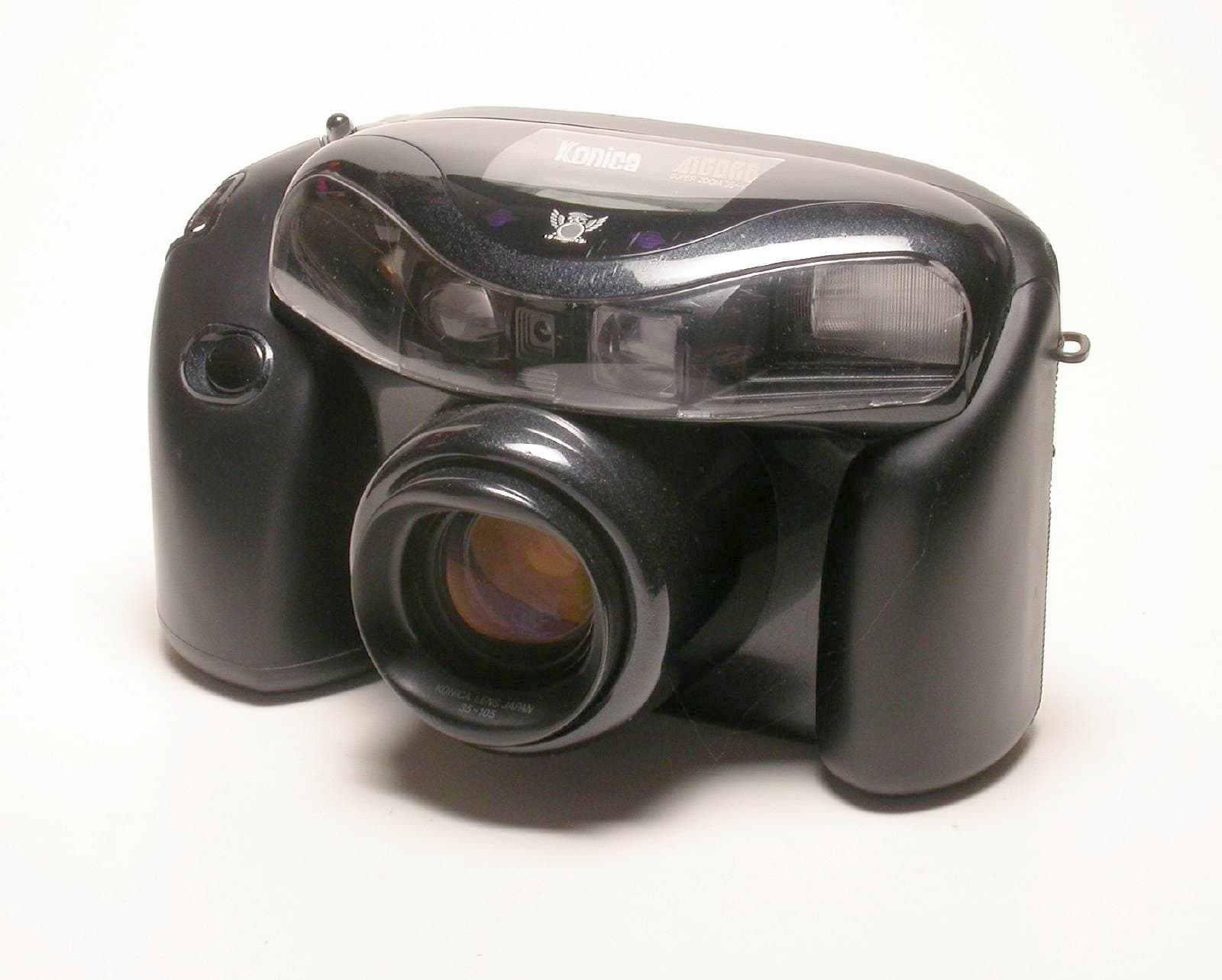
The Konica Aiborg (1991) is a bridge camera - occupying the space between a compact point-and-shoot and a true interchangeable-lens SLR - distinguished by a dramatically sculpted body that appears to owe more to science fiction prop design than conventional camera ergonomics. The name combines "AI" (a reference to autofocus intelligence) with "Borg," evoking the assimilating cybernetic antagonists of Star Trek: The Next Generation, then at peak cultural saturation. Whether the naming was deliberate or coincidental is unverified.
Reference
Recommended film stocks for the 35mm format your camera takes.
C41
Kodak Portra 400 is a professional C-41 color negative film known for flexible exposure latitude, natural skin tones, and fine grain.
View profileBW
Kodak Tri-X 400 is a classic black-and-white film known for strong tonality, visible grain, and documentary character.
View profileC41
Kodak Gold 200 is a daylight-balanced C-41 color negative film with warm color, moderate grain, and a classic consumer-film look.
Develop 35mm film
Labs in our directory that process 35mm film.
Before you buy used
About this camera
Aggressively styled 1991 bridge SLR with binocular-style grip, fixed zoom, and SLR through-the-lens viewing.
| Field | Value |
|---|
| Format | 35mm |
| Lens | ~Hexanon AF 38-140mm f/4.5-6.7 (fixed) |
| Year | 1991 |
| Shutter | ~1/2s - 1/500s, electronic |
| Meter | Multi-segment, programmed auto |
| Modes | Program only |
| Focus | Phase-detection AF |
| Battery | ~4x AA |
| Flash | Built-in |
| Viewfinder | SLR pentamirror |
Konica entered the 1990s with a diverse compact lineup anchored by the popular Big Mini family and the Z-up zoom compacts. The Aiborg represents a distinct experiment: a bridge-format camera designed to compete with similar offerings from Nikon (Pronea) and Olympus in the pseudo-SLR segment, but with a far more aggressive visual identity.
Released in 1991, the Aiborg arrived at a moment when Japanese camera manufacturers were willing to explore genuinely unusual form factors for consumer products. The early 1990s produced a wave of biomorphic, overtly futuristic industrial design across the consumer electronics sector in Japan, and the Aiborg fits squarely within that moment. Its dual-grip front panel and overall silhouette read as intentionally alien against conventional camera design.
Commercial performance is undocumented; the camera did not spawn an obvious direct successor within Konica's lineup, which suggests it was a limited experiment rather than a platform. By the time Konica-Minolta formed in 2003, bridge-format cameras of this type had largely given way to early digital bridge cameras.
The Aiborg is significant primarily as a design artifact. For camera historians and collectors interested in 1990s Japanese industrial design, it represents a brief moment when manufacturers believed consumers wanted cameras that looked like they had been salvaged from a near-future film set. The futuristic binocular grip is both a genuine ergonomic attempt at two-handed stability and a theatrical statement.
Photographically, the fixed Hexanon zoom delivers competent results across its range, and the SLR finder - even via pentamirror rather than pentaprism - gives a shooting experience absent from true point-and-shoot compacts. For a user who wants something unusual and fully functional, the Aiborg fills that role at modest used prices.
Its scarcity on international markets (primarily Japan-domestic) and the absence of a large collector community keep prices low relative to the novelty it offers.
C41
Fujifilm Superia X-TRA 400 (marketed as Superia 400 in some regions) is an ISO 400 C-41 consumer color negative film in 135 format, one of Fujifilm's most popular consumer films. It delivers warm, vibrant colors with moderate grain and remains in production in some markets.
View profileBW
Ilford HP5 Plus is a flexible ISO 400 black-and-white film with classic grain and strong push-processing tolerance.
View profileC41
Kodak Ektar 100 is a fine-grain C-41 color negative film with saturated color and high sharpness.
View profile