C41
Kodak Portra 400
Kodak Portra 400 is a professional C-41 color negative film known for flexible exposure latitude, natural skin tones, and fine grain.
View profile35mm SLR
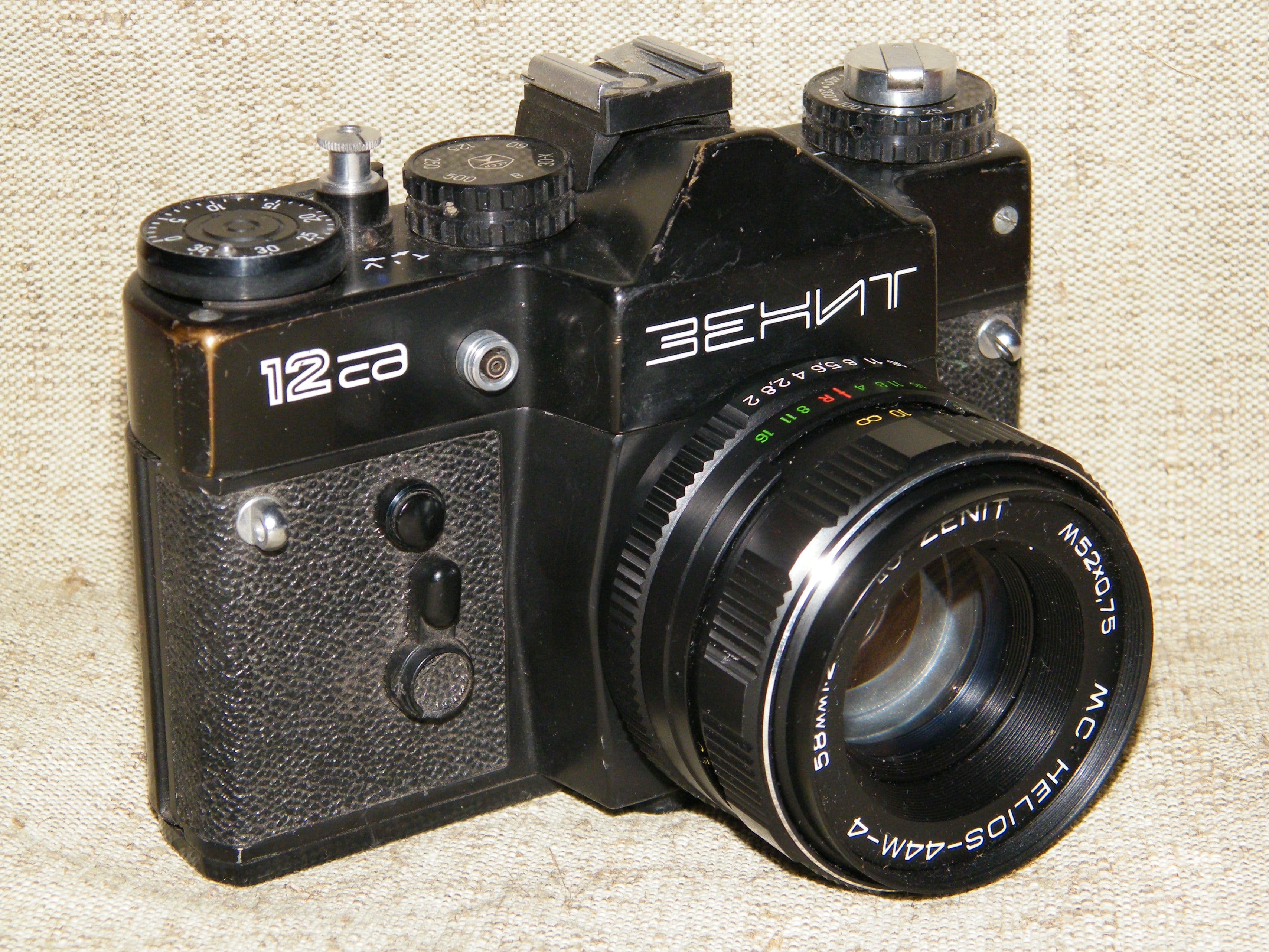
The KMZ Zenit-12CD is a 35mm SLR produced at KMZ (Krasnogorsky Mekhanichesky Zavod) in Krasnogorsk from approximately 1985. It is a member of the Zenit-12 family, which succeeded the Zenit E as KMZ's volume production SLR, and represents the most fully specified variant in that family. The key distinction from the earlier Zenit E is the metering system: where the Zenit E used an uncoupled selenium cell mounted externally on the camera front, the Zenit-12CD uses a through-the-lens (TTL) CdS meter coupled to the shutter-speed dial, with the meter needle visible in the viewfinder. This makes exposure setting considerably more practical than with the external selenium cell, particularly when using stopped-down adapted lenses. The shutter and mechanical architecture follow the Zenit E pattern: a horizontal-travelling cloth focal-plane shutter with a minimum speed of 1/30s (no slow speeds), M42 screw mount, and a pentaprism viewfinder with microprism focusing aid. Manual exposure throughout; the camera requires batteries for the meter but operates mechanically without them.
Reference
Recommended film stocks for the 35mm format your camera takes.
C41
Kodak Portra 400 is a professional C-41 color negative film known for flexible exposure latitude, natural skin tones, and fine grain.
View profileBW
Kodak Tri-X 400 is a classic black-and-white film known for strong tonality, visible grain, and documentary character.
View profileC41
Kodak Gold 200 is a daylight-balanced C-41 color negative film with warm color, moderate grain, and a classic consumer-film look.
Develop 35mm film
Labs in our directory that process 35mm film.
Before you buy used
About this camera
A refined Zenit-12 with TTL CdS metering - the Krasnogorsk SLR line's most competent standard variant.
| Field | Value |
|---|
| Format | 35mm |
| Mount | M42 universal |
| Years | ~1985 - ~1994 |
| Shutter | 1/30s - 1/500s + B, horizontal cloth |
| Flash sync | 1/30s |
| Meter | TTL CdS, needle-match in viewfinder |
| Modes | Manual |
| ISO range | 25 - 400 |
| Battery | ~2x AA (meter only) |
| Mechanical fallback | Yes |
| Weight | ~930 g |
The Zenit E (1965) was KMZ's dominant volume production SLR for two decades, accumulating approximately 8 million units manufactured before its discontinuation in 1986. Its external uncoupled selenium meter was already technically outdated by the mid-1970s - TTL metering had become standard in Japanese SLRs by the early 1970s - but the Zenit E's simplicity and low production cost made it commercially viable for Soviet domestic and export markets. The Zenit-12 family was developed as the response to this obsolescence gap, bringing TTL CdS metering into a body that retained the fundamental Zenit E mechanical architecture.
Several Zenit-12 variants were produced through the 1980s, differing primarily in metering system specification and minor cosmetic details. The Zenit-12XP preceded the 12CD with a similar TTL approach; the 12CD designation ('CD' likely from the Russian Цветной Диапозитив, 'colour slide', suggesting optimisation for reversal film, though this is not confirmed) represents the most refined standard specification in the family. Production continued into the early 1990s under the economic disruption that followed the Soviet Union's dissolution; KMZ continued manufacturing into the post-Soviet period under changed commercial conditions.
The Zenit-12CD is the practical answer to a common complaint about the Zenit E: that the external selenium meter makes TTL metering with adapted lenses impossible. Stopped-down TTL metering through the lens directly reads the light reaching the film plane regardless of which M42 lens is mounted, making the 12CD useful for the full range of M42 glass - Helios, Industar, Mir, Jupiter, and adapted Carl Zeiss Jena, Pentax Takumar, and other M42 lenses - without requiring external meter compensation for filter factors or non-standard apertures.
The underlying shutter mechanism and body architecture are unchanged from the Zenit E family: no slow speeds (the 1/30s minimum is the same limitation), the same horizontal cloth travel, the same M42 mount geometry, and the same substantial weight. These are known quantities for anyone familiar with the Zenit line. The 12CD adds TTL metering in the viewfinder as the substantive improvement over the E, making exposure setting faster and more accurate in practice. For Soviet SLR collectors the 12CD occupies the pragmatically useful position: the best metering implementation in the classic Zenit body before the line moved toward more elaborate designs.
M42 universal screw mount. Native Soviet lenses: Helios-44 series 58mm f/2 (standard kit; Biotar-formula "swirly bokeh"), Industar-50 50mm f/3.5, Industar-61 L/Z 55mm f/2.8, Mir-1B 37mm f/2.8 (wide), Jupiter-9 85mm f/2, Tair-11A 135mm f/2.8. Full compatibility with Carl Zeiss Jena M42 lenses (Flektogon, Tessar, Biotar), Pentax Super-Takumar and SMC Takumar lenses, and Praktica/Pentacon M42 glass. Stopped-down TTL metering functions with all M42 lenses regardless of aperture coupling.
Accessories: standard M42 extension tubes for macro work; no dedicated winder or motor drive documented for the Zenit-12 family.
C41
Fujifilm Superia X-TRA 400 (marketed as Superia 400 in some regions) is an ISO 400 C-41 consumer color negative film in 135 format, one of Fujifilm's most popular consumer films. It delivers warm, vibrant colors with moderate grain and remains in production in some markets.
View profileBW
Ilford HP5 Plus is a flexible ISO 400 black-and-white film with classic grain and strong push-processing tolerance.
View profileC41
Kodak Ektar 100 is a fine-grain C-41 color negative film with saturated color and high sharpness.
View profile