C41
Kodak Portra 400
Kodak Portra 400 is a professional C-41 color negative film known for flexible exposure latitude, natural skin tones, and fine grain.
View profile35mm SLR
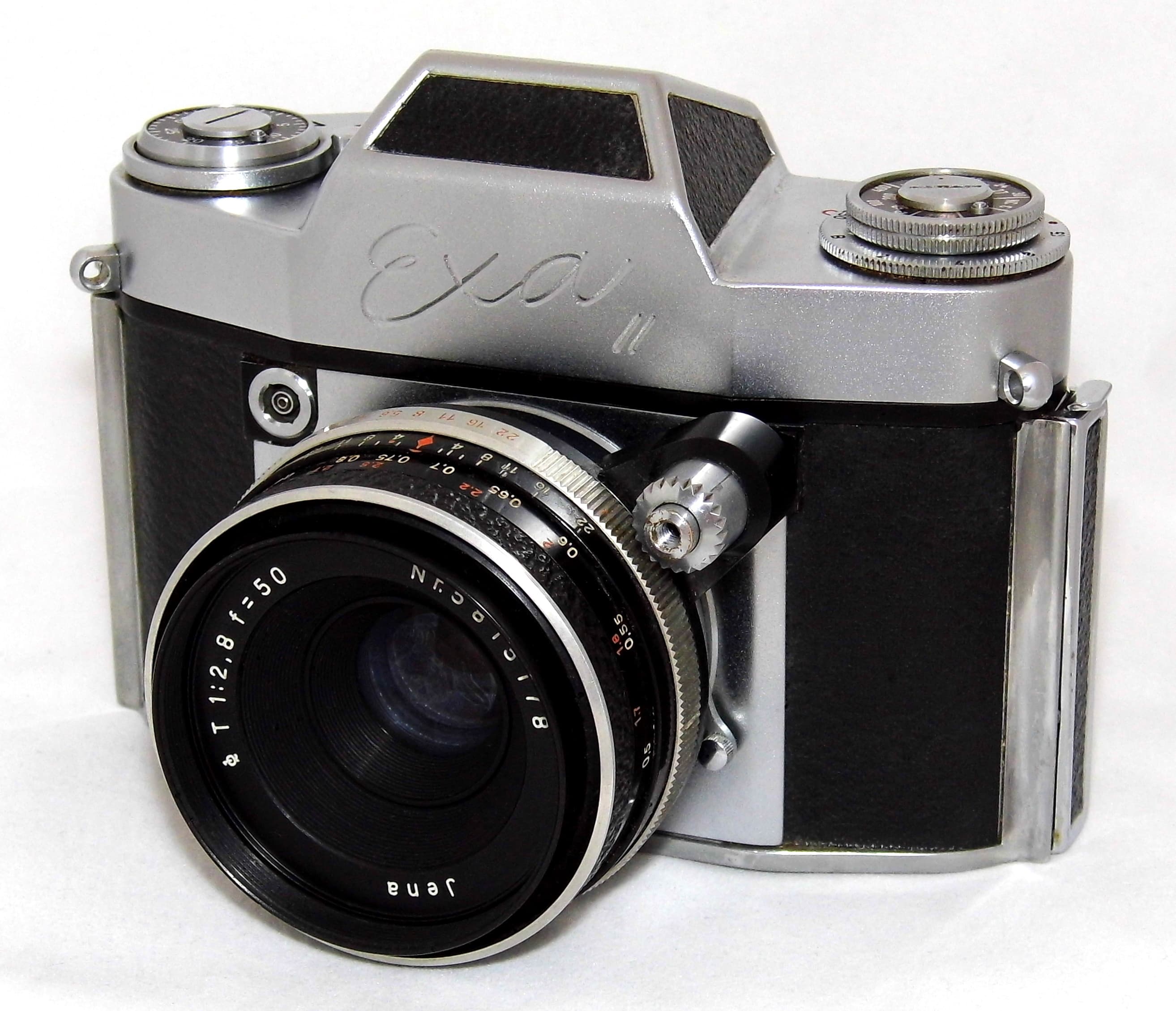
The Ihagee Exa II (1959) is a 35mm single-lens reflex camera made in Dresden, East Germany, occupying a distinct position in the Exa product line: unlike the simpler Exa 1 with its rotary sector shutter, the Exa II uses a cloth focal-plane shutter providing a broader speed range. More significantly, it inherits the interchangeable viewfinder system of the Exakta Varex — a feature absent from the Exa 1 series — allowing both a standard waist-level hood and an eye-level pentaprism to be swapped in.
Reference
Recommended film stocks for the 35mm format your camera takes.
C41
Kodak Portra 400 is a professional C-41 color negative film known for flexible exposure latitude, natural skin tones, and fine grain.
View profileBW
Kodak Tri-X 400 is a classic black-and-white film known for strong tonality, visible grain, and documentary character.
View profileC41
Kodak Gold 200 is a daylight-balanced C-41 color negative film with warm color, moderate grain, and a classic consumer-film look.
Develop 35mm film
Labs in our directory that process 35mm film.
Before you buy used
About this camera
An Exa with a proper focal-plane shutter and interchangeable finders — the Exa II bridged the gap between the simplified Exa 1 and the full Exakta Varex, offering genuine versatility in a compact body.
| Field | Value |
|---|
| Format | 35mm (24×36 mm) |
| Mount | Exakta bayonet |
| Years | 1959–1962 |
| Shutter | Horizontal cloth focal-plane: 1/25s – 1/500s + B |
| Flash sync | X-sync; 1/25s |
| Meter | None |
| Exposure | Manual |
| Viewfinder | Interchangeable (waist-level or pentaprism) |
| Focus | Manual, ground glass |
| Battery | None |
Ihagee launched the Exa II in 1959, the same year the full Exakta Varex IIb was updated, as an attempt to offer an intermediate product. The Exa 1 (introduced 1959 with fixed pentaprism) addressed the lowest price tier; the Exa II was positioned above it with a real focal-plane shutter and interchangeable finders, but below the Varex's full slow-speed escapement and 12s–1/1000s range.
The brief production run of only three years suggests that buyers either opted up to the full Varex or down to the simpler Exa 1 rather than choosing the intermediate model. By 1962 the Exa II had been withdrawn. Ihagee itself faced the broader challenge of East German camera-industry reorganisation under VEB Pentacon, and the Exakta brand's position in the market weakened through the 1960s as M42-mount cameras gained dominance.
The Exa II is now a relatively uncommon collector's piece — rarer than either the Exa 1 series or the full Varex, due to its short production run.
The Exa II is historically interesting as an attempt to create a modular, finder-interchangeable SLR at a mid-range price point. Its brief existence illustrates the commercial difficulty of the middle tier in camera product ranges — a challenge faced by many manufacturers. For collectors today it represents an unusual variant in the Exa family, combining the finder flexibility of the Varex with a simpler, lighter body and standard right-hand shutter release.
Accepts all Exakta-mount lenses: Carl Zeiss Jena Tessar 50/3.5, Biotar 58/2, Flektogon 35/2.8, Pancolar 50/2; Meyer-Optik Primotar 50/3.5, Oreston 50/1.8; Schneider Curtagon 35/2.8. Viewfinder accessories: waist-level hood (standard), optional pentaprism finder compatible with Exakta Varex prisms of the era.
C41
Fujifilm Superia X-TRA 400 (marketed as Superia 400 in some regions) is an ISO 400 C-41 consumer color negative film in 135 format, one of Fujifilm's most popular consumer films. It delivers warm, vibrant colors with moderate grain and remains in production in some markets.
View profileBW
Ilford HP5 Plus is a flexible ISO 400 black-and-white film with classic grain and strong push-processing tolerance.
View profileC41
Kodak Ektar 100 is a fine-grain C-41 color negative film with saturated color and high sharpness.
View profile