C41
Kodak Portra 400
Kodak Portra 400 is a professional C-41 color negative film known for flexible exposure latitude, natural skin tones, and fine grain.
View profile35mm SLR
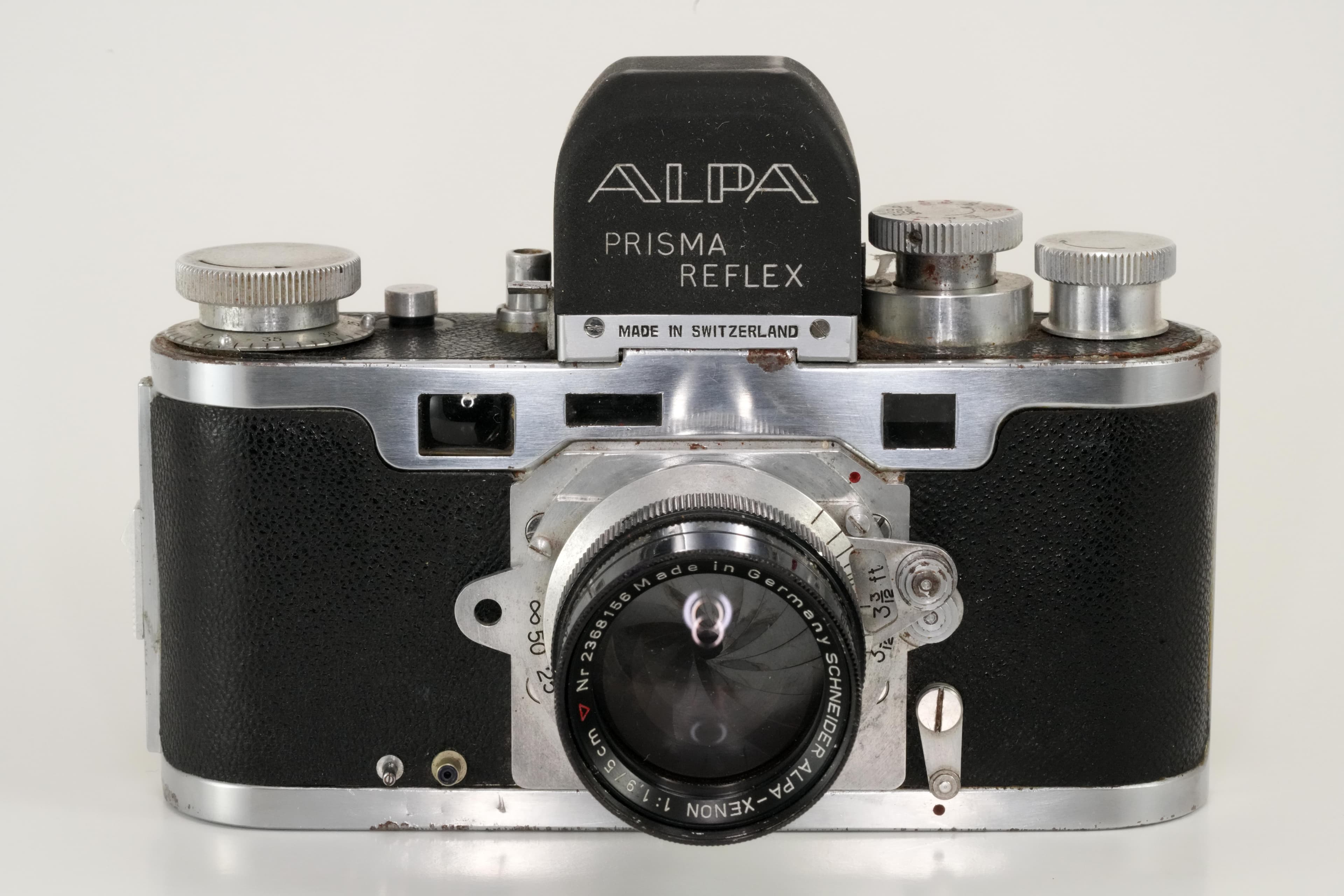
The Alpa Reflex III (c. 1946) is a 35mm single-lens reflex camera produced by Pignons S.A. of Ballaigues, Switzerland, representing the earliest commercially distributed iteration of the Alpa camera line. It is the direct commercial successor to the wartime Bolca SP development work and the model from which all subsequent Alpa numbering derives. The camera is entirely mechanical - no exposure meter, no battery dependency - with a focal-plane shutter spanning approximately 1 second to 1/1000s plus B.
Reference
Recommended film stocks for the 35mm format your camera takes.
C41
Kodak Portra 400 is a professional C-41 color negative film known for flexible exposure latitude, natural skin tones, and fine grain.
View profileBW
Kodak Tri-X 400 is a classic black-and-white film known for strong tonality, visible grain, and documentary character.
View profileC41
Kodak Gold 200 is a daylight-balanced C-41 color negative film with warm color, moderate grain, and a classic consumer-film look.
Develop 35mm film
Labs in our directory that process 35mm film.
Before you buy used
Finding a Alpa Reflex III for sale is itself uncommon; it is more likely to surface at auction or through specialist dealers in vintage European cameras than on general camera marketplaces.
About this camera
The founding instrument of the Alpa system - the Swiss precision SLR that established the Alpa mount and the Kern optic partnership in the postwar years.
| Field | Value |
|---|
| Format | 35mm |
| Mount | Alpa bayonet |
| Years | c. 1946 – ~ |
| Metering | None |
| Battery | None required |
| Shutter | Focal-plane: ~1s - 1/1000s + B |
| Flash sync | |
| Viewfinder | Pentaprism / eye-level |
| Focus aids | Ground glass |
| Mirror lockup | Yes |
Pignons S.A. began the commercial Alpa camera programme in the mid-1940s as an evolution of the wartime Bolca SP development. The earliest commercially designated Alpa models used Roman numeral designations rather than the Arabic numeral system that became standard from the Alpa 4 onward; the Reflex III is among these early Roman-numeral designations. Naming conventions in this period were inconsistent and some sources treat the Roman-numeral and early Arabic-numeral bodies as overlapping or synonymous product families.
The defining engineering decision made at this early stage - the asymmetric Alpa bayonet mount - had lasting consequences. The asymmetry of the mount (a lug arrangement that prevents rotation to a symmetric lock position) gave it a distinctive feel and made it immediately identifiable among collectors, but more importantly it provided a rigid, repeatable register that suited precision Kern optics. The flange distance established for the Alpa mount was maintained without change across all Pignons-era Alpa production, enabling lens compatibility across nearly five decades.
Kern-Aarau, the Swiss optical manufacturer, supplied the principal lenses for the Alpa system from these early days. The Switar name - derived from Swiss and star - appeared on the fastest and most celebrated Kern designs. The Reflex III and its immediate successors defined the Alpa/Kern pairing that would become the system's identity.
Production quantities for the Alpa Reflex III are not established in available sources. Total Alpa production by Pignons across all variants is estimated at fewer than 30,000 cameras over the entire production period; the Reflex III as an early, transitional model would represent a small fraction of this.
The Alpa Reflex III matters as the founding instrument of a camera system whose significance is disproportionate to its production numbers. By establishing the Alpa mount and the Kern-Switar optic partnership at this early stage, Pignons created a system with unusual coherence: a photographer who bought into the Alpa ecosystem in the late 1940s was acquiring lenses fully compatible with the last Pignons-era Alpa body made in 1990, the Alpa 11si.
The camera also represents the Swiss precision manufacturing tradition applied to the SLR form at a moment when most SLR development was happening in Germany (Ihagee, Zeiss) and the Soviet Union (Arsenal, KMZ). Alpa's market was narrow - professional scientific, technical, and editorial photographers willing to pay a significant premium for Swiss build quality - but in that niche the Reflex III and its successors were considered the finest available instruments by those who used them.
For camera historians, the Reflex III also documents the direct continuity between the wartime Bolca SP and the mature Alpa commercial product. The pentaprism commitment, the mechanical precision, and the Ballaigues manufacturing origin are unchanged from the Bolca era.
The Alpa bayonet mount established on the Reflex III accepts the full range of Kern and third-party Alpa-mount optics produced throughout the system's history:
Early Alpa bodies had a narrower native accessories programme than later models. Motor drives and system accessories emerged as the line matured; the Reflex III was supported by the fundamental Kern optic range only.
C41
Fujifilm Superia X-TRA 400 (marketed as Superia 400 in some regions) is an ISO 400 C-41 consumer color negative film in 135 format, one of Fujifilm's most popular consumer films. It delivers warm, vibrant colors with moderate grain and remains in production in some markets.
View profileBW
Ilford HP5 Plus is a flexible ISO 400 black-and-white film with classic grain and strong push-processing tolerance.
View profileC41
Kodak Ektar 100 is a fine-grain C-41 color negative film with saturated color and high sharpness.
View profile