C41
Kodak Portra 400
Kodak Portra 400 is a professional C-41 color negative film known for flexible exposure latitude, natural skin tones, and fine grain.
View profile35mm SLR
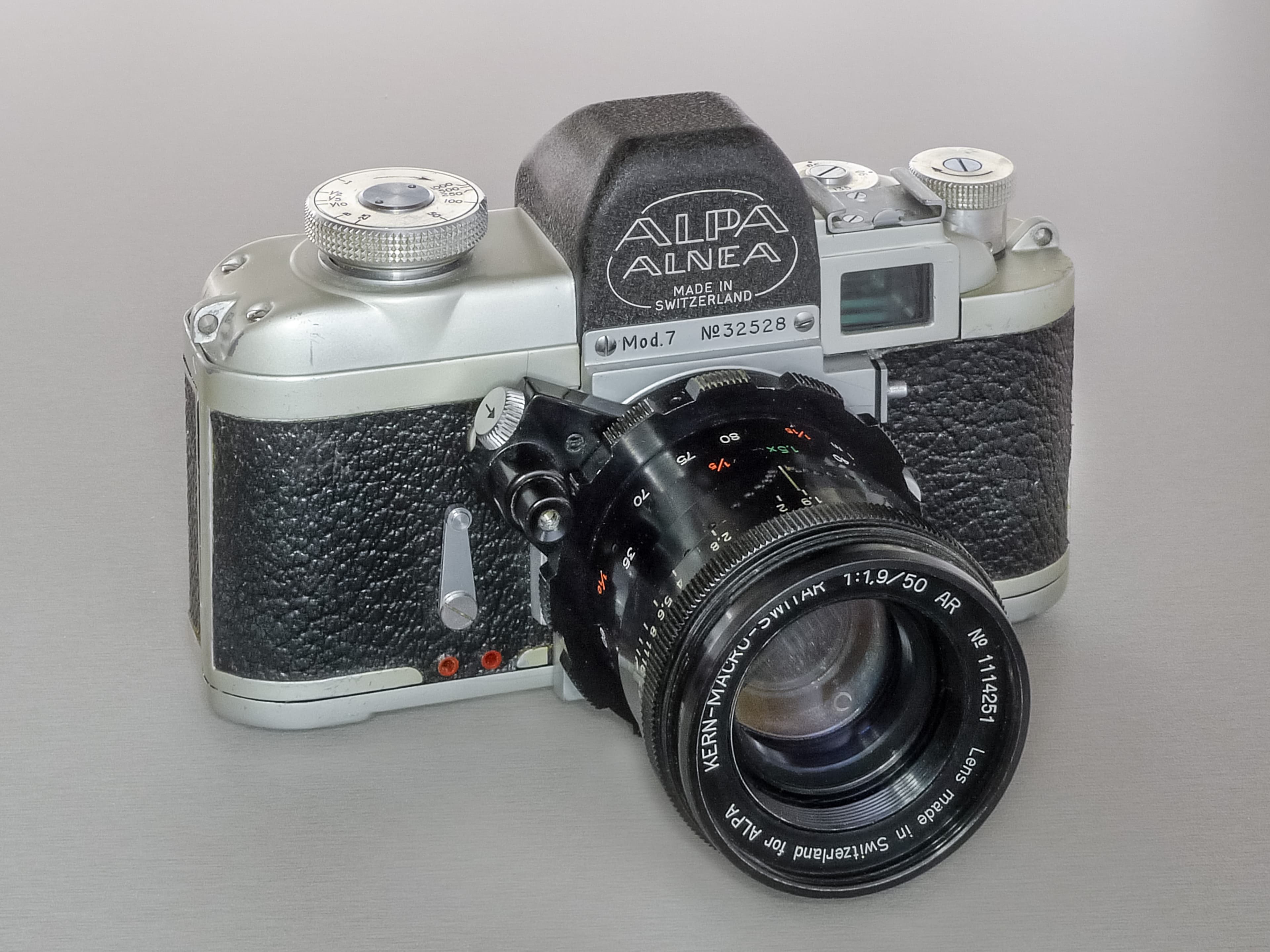
The Alpa 7 (1952) is a 35mm single-lens reflex camera produced by Pignons S.A. of Ballaigues, Switzerland. Sitting above the entry-level Alpa 6 in the product line, it was Pignons' principal mid-tier offering for the first half of the 1950s. The camera is entirely mechanical — no exposure meter, no battery dependency — and relies on the photographer's judgement or a separate hand-held meter to set exposure. The focal-plane shutter covers 1 second to 1/1000s plus B.
Reference
Recommended film stocks for the 35mm format your camera takes.
C41
Kodak Portra 400 is a professional C-41 color negative film known for flexible exposure latitude, natural skin tones, and fine grain.
View profileBW
Kodak Tri-X 400 is a classic black-and-white film known for strong tonality, visible grain, and documentary character.
View profileC41
Kodak Gold 200 is a daylight-balanced C-41 color negative film with warm color, moderate grain, and a classic consumer-film look.
Develop 35mm film
Labs in our directory that process 35mm film.
Before you buy used
About this camera
The fully mechanical, no-meter Swiss SLR that defined the Pignons mid-range line in the early 1950s.
| Field | Value |
|---|
| Format | 35mm |
| Mount | Alpa bayonet |
| Years | 1952–1957 |
| Metering | None (unmetered) |
| Battery | None required |
| Shutter | Focal-plane: 1s – 1/1000s + B |
| Flash sync | |
| Viewfinder | Pentaprism, eye-level |
| Focus aids | Ground glass |
| Mirror lockup | Yes |
Pignons S.A. began producing Alpa cameras in 1944 under the direction of Jacques Bolsky. The Alpa numbering sequence stepped through successively refined models: the Alpa 4 and 5 in the mid-1940s, the Alpa 6 by 1950, and the Alpa 7 in 1952. Each step brought incremental refinement — improved fit and finish, revised film transport, updated finder optics — rather than wholesale redesign. The fundamental architecture of a pentaprism SLR body with the Alpa bayonet mount was established early and retained throughout the Pignons era.
The Alpa 7 occupied the line for five years, a relatively long tenure for a mid-tier Pignons offering. Its successor, the Alpa 7s (1957), was a direct mechanical twin fitted with a selenium exposure meter integrated into the body, allowing the two models to coexist briefly in the catalogue for buyers who preferred a lower price point without metering.
Alpa cameras were never high-volume products. Swiss precision manufacturing and the cost of Kern optics kept retail prices well above mass-market competitors from Germany and Japan. Production quantities for individual Alpa models are not publicly established; total Pignons production across all Alpa variants through 1990 is generally estimated at fewer than 30,000 cameras.
The Alpa 7 matters less as an individual model than as the anchor of the mid-tier Alpa system at a pivotal moment in SLR history. In 1952, the pentaprism SLR was still a novelty: the Contax S (1949) had introduced the eye-level pentaprism to the mass market, and most manufacturers were still shipping waist-level or non-reflex alternatives. Alpa's commitment to the pentaprism SLR form from the beginning positioned the line as technically progressive even before metering was incorporated.
The Alpa bayonet mount, shared across all models from the Alpa 4 through the Alpa 11si (1990), means that Kern Switar lenses bought for an Alpa 7 in 1954 can be used on any later Alpa body. This mount continuity across nearly five decades of production is unusual in camera history and gives the Alpa system unusual coherence as a collectible ecosystem.
The Alpa mount accepts the full range of Kern and third-party Alpa-mount optics:
Accessories were limited relative to later professional systems. No motor drive was available for the Alpa 7. The camera's chief accessory was the right lens.
C41
Fujifilm Superia X-TRA 400 (marketed as Superia 400 in some regions) is an ISO 400 C-41 consumer color negative film in 135 format, one of Fujifilm's most popular consumer films. It delivers warm, vibrant colors with moderate grain and remains in production in some markets.
View profileBW
Ilford HP5 Plus is a flexible ISO 400 black-and-white film with classic grain and strong push-processing tolerance.
View profileC41
Kodak Ektar 100 is a fine-grain C-41 color negative film with saturated color and high sharpness.
View profile