C41
Kodak Portra 400
Kodak Portra 400 is a professional C-41 color negative film known for flexible exposure latitude, natural skin tones, and fine grain.
View profile35mm SLR
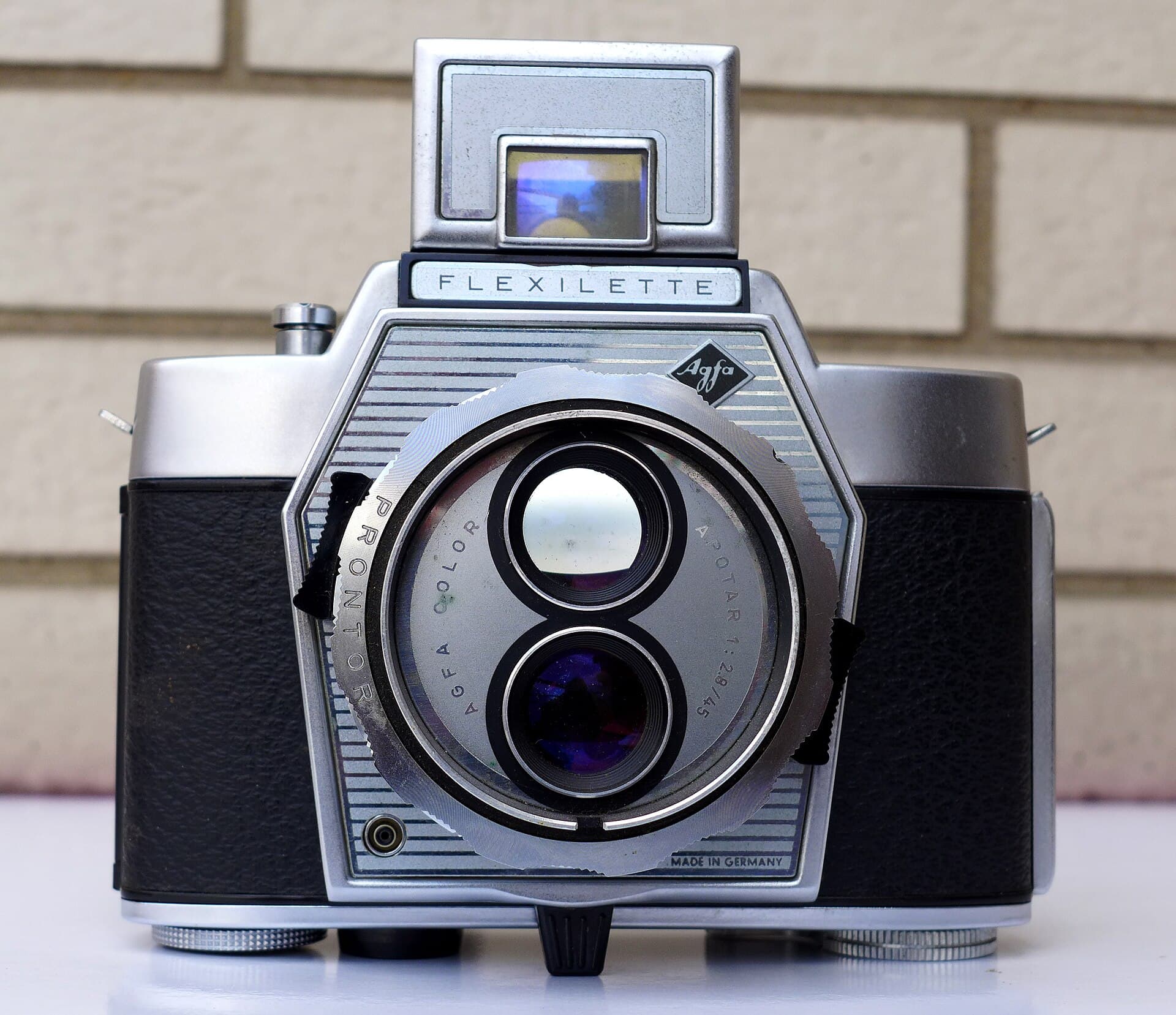
The Agfa Flexilette (1960) is a 35mm camera made in Munich, West Germany, that defies easy categorisation. It applies the twin-lens reflex (TLR) viewing principle — separate upper viewing lens and lower taking lens — to 35mm film rather than medium format, resulting in a camera that looks like a miniature TLR but shoots standard 24×36mm 35mm frames.
Reference
Recommended film stocks for the 35mm format your camera takes.
C41
Kodak Portra 400 is a professional C-41 color negative film known for flexible exposure latitude, natural skin tones, and fine grain.
View profileBW
Kodak Tri-X 400 is a classic black-and-white film known for strong tonality, visible grain, and documentary character.
View profileC41
Kodak Gold 200 is a daylight-balanced C-41 color negative film with warm color, moderate grain, and a classic consumer-film look.
Develop 35mm film
Labs in our directory that process 35mm film.
Before you buy used
About this camera
Neither TLR nor true SLR — the Agfa Flexilette applied the twin-lens reflex concept to 35mm film, producing one of photography's most unusual and visually striking cameras: a TLR-style waist-level reflex viewer in a 35mm compact body.
| Field | Value |
|---|
| Format | 35mm (24×36 mm) |
| Mount | Fixed twin-lens (taking: Color-Apotar 45/2.8; viewing: Color-Apotar 45/2.8) |
| Years | 1960–1964 |
| Shutter | Prontor-S leaf: 1/25s – 1/300s + B |
| Flash sync | M and X sync |
| Meter | Selenium, match-needle |
| Exposure | Manual (meter-guided) |
| Viewfinder | Waist-level ground glass (TLR style) |
| Focus | Scale |
| Battery | None (selenium) |
Agfa launched the Flexilette in 1960 as a curiosity product — a 35mm camera offering the TLR viewing experience at a fraction of the cost and size of a medium-format TLR. The late 1950s and early 1960s saw several unusual hybrid camera designs from European makers as the market explored different ways to differentiate compact cameras. The Flexilette is among the most distinctive of these experiments.
The camera was produced until approximately 1964. Sales were modest — the waist-level viewing required an adjustment in technique for photographers accustomed to eye-level 35mm cameras, and the shutter speed range (maximum 1/300s) was limited compared to contemporary eye-level alternatives. Agfa did not develop the concept further.
The Flexilette appeared at a time when Agfa was exploring various camera formats and designs across its product range. The contemporaneous Agfa Silette line and Agfa folding cameras reflected different approaches to the 35mm market.
The Agfa Flexilette is one of the most unusual production cameras of the postwar era — a genuine TLR for 35mm film. It demonstrates a road not taken: the application of reflex viewing to the compact 35mm format. For collectors, it is a striking and conversation-starting piece; for photographers, it offers the distinctive waist-level street-photography perspective in a format that uses readily available 35mm film rather than scarce 120 roll film.
Fixed Color-Apotar 45mm f/2.8 triplet (taking), matched Color-Apotar 45/2.8 (viewing) — non-interchangeable. Accessories: push-on lens filters, ever-ready case, M and X sync flash leads. The waist-level hood folds flat against the camera body when not in use.
C41
Fujifilm Superia X-TRA 400 (marketed as Superia 400 in some regions) is an ISO 400 C-41 consumer color negative film in 135 format, one of Fujifilm's most popular consumer films. It delivers warm, vibrant colors with moderate grain and remains in production in some markets.
View profileBW
Ilford HP5 Plus is a flexible ISO 400 black-and-white film with classic grain and strong push-processing tolerance.
View profileC41
Kodak Ektar 100 is a fine-grain C-41 color negative film with saturated color and high sharpness.
View profile