C41
Kodak Portra 400
Kodak Portra 400 is a professional C-41 color negative film known for flexible exposure latitude, natural skin tones, and fine grain.
View profileMedium Format Rangefinder
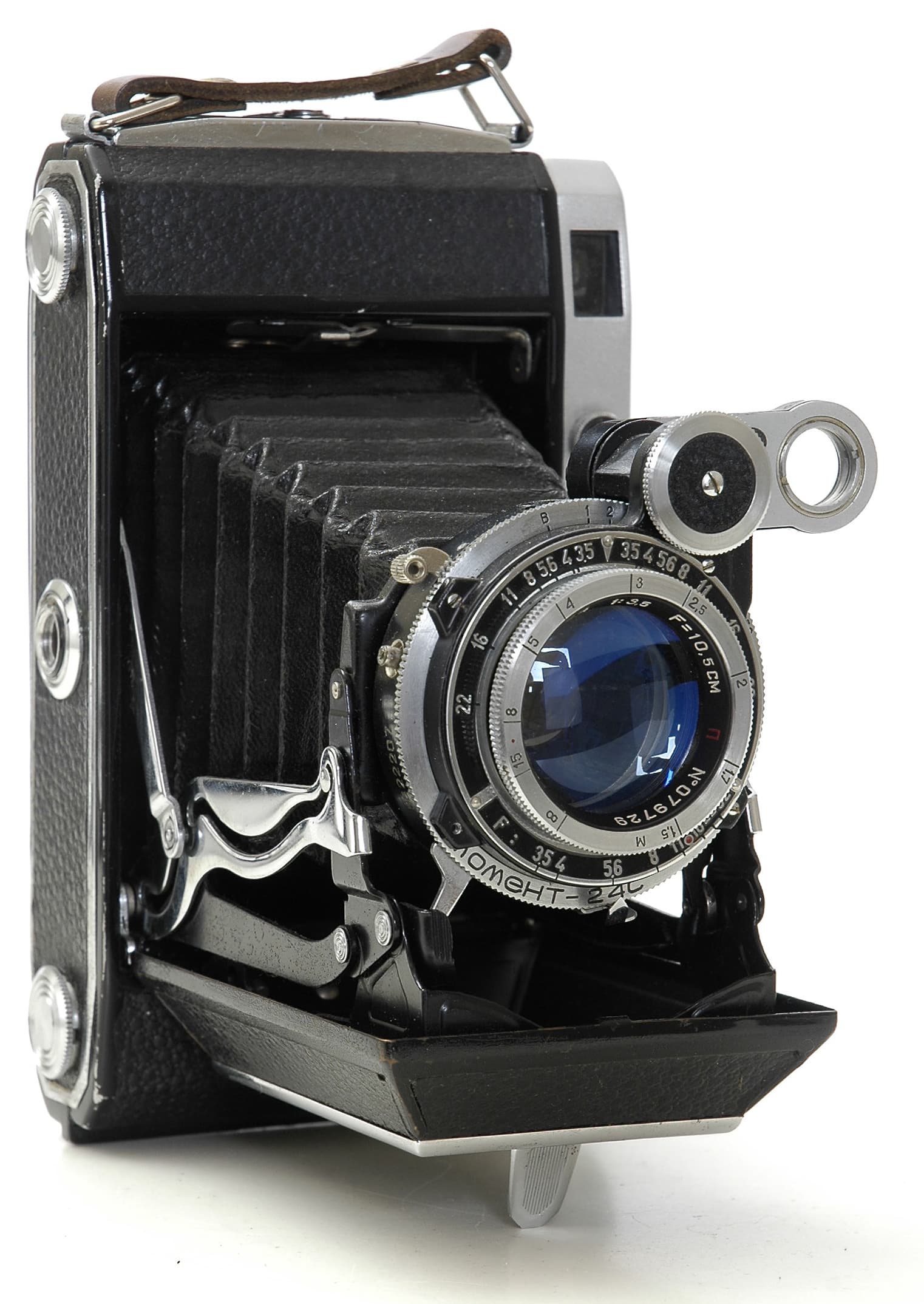
The Moskva-5 (Russian: Москва-5, "Moscow-5") is a 6×9 format folding medium-format camera produced by KMZ (Krasnogorsk Mechanical Plant) from 1956 to approximately 1960. It is the final and most refined model in the Moskva series, which KMZ developed through the late 1940s and 1950s as a Soviet adaptation of the Zeiss Ikon Super Ikonta C. The Moskva-5 shoots 6×9 frames on 120 film (8 exposures per roll) and features a coupled rangefinder, a leaf shutter running from 1s to 1/250s, and the Industar-24 105mm f/3.5 Tessar-type lens. It folds to a comparatively slim profile for a 6×9 camera, making it a practical field instrument.
Reference
Recommended film stocks for the — format your camera takes.
C41
Kodak Portra 400 is a professional C-41 color negative film known for flexible exposure latitude, natural skin tones, and fine grain.
View profileC41
Kodak Portra 160 is a professional C-41 color negative film with fine grain, soft contrast, and natural color.
View profileC41
Kodak Ektar 100 is a fine-grain C-41 color negative film with saturated color and high sharpness.
Develop — film
We're growing the lab directory near you. Browse all labs.
Before you buy used
About this camera
Soviet 6×9 folder with coupled rangefinder - KMZ's final and most refined Moskva, a close copy of the Zeiss Super Ikonta C.
| Field | Value |
|---|
| Format | 120 (6×9, 8 exposures; or 6×6 with mask) |
| Lens | Industar-24 105mm f/3.5 (Tessar copy) |
| Shutter | 1s – 1/250s + B, leaf shutter |
| Flash sync | 1/250s (leaf shutter) |
| Rangefinder | Coupled |
| Meter | None |
| Weight | ~850 g |
| Battery | None |
KMZ introduced the Moskva series in 1946-47 with the Moskva-1, a close mechanical copy of the Zeiss Super Ikonta C 530/16. Successive variants - Moskva-2, Moskva-3, Moskva-4 - refined the build quality, shutter, and rangefinder coupling through the early 1950s. The Moskva-5, introduced in 1956, is the culmination of this line: tighter tolerances, an improved shutter (Synchro-Compur derivative), and a cleaner external design compared to earlier versions. Production ended around 1960 when KMZ shifted medium-format resources toward the Iskra 6×6 project. No Moskva-6 was produced. The Moskva-5 is the most commonly encountered Moskva model today due to its later production date and better survival rates.
The 6×9 negative is the largest format conveniently available from a folding roll-film camera. At 56×84mm, a 6×9 frame is roughly 3.5x the area of a 35mm frame, delivering a contact-printable negative of genuinely large format quality from a pocketable body. The Moskva-5 made this format accessible to Soviet photographers at a time when equivalent German cameras (Super Ikonta C, Voigtlander Bessa II) were unobtainable imports. The Industar-24 lens is a solid Tessar formula performer - sharp in the center at f/5.6 and f/8, with expected Tessar softness toward the corners wide open. For contemporary film photographers, the Moskva-5 offers 6×9 shooting at a fraction of the price of functional German 6×9 folders, at the cost of less refined mechanics and rangefinder precision.
Fixed Industar-24 105/3.5. No interchangeable lens system. Filter thread size is ~40.5mm . Some bodies have a 6×6 format mask available, reducing the frame count to 12 exposures per roll. PC sync socket for flash. No hot shoe.
E6
Fujifilm Fujichrome Provia 100F (RDPIII) is a professional E6 reversal (slide) film in 135 and 120 formats, known for its natural, balanced color reproduction, very fine grain, and moderate saturation. It remains in production as of 2026 and is one of the last professional slide films available.
View profileBW
Kodak Tri-X 400 is a classic black-and-white film known for strong tonality, visible grain, and documentary character.
View profile