C41
Kodak Portra 400
Kodak Portra 400 is a professional C-41 color negative film known for flexible exposure latitude, natural skin tones, and fine grain.
View profileMedium Format Rangefinder
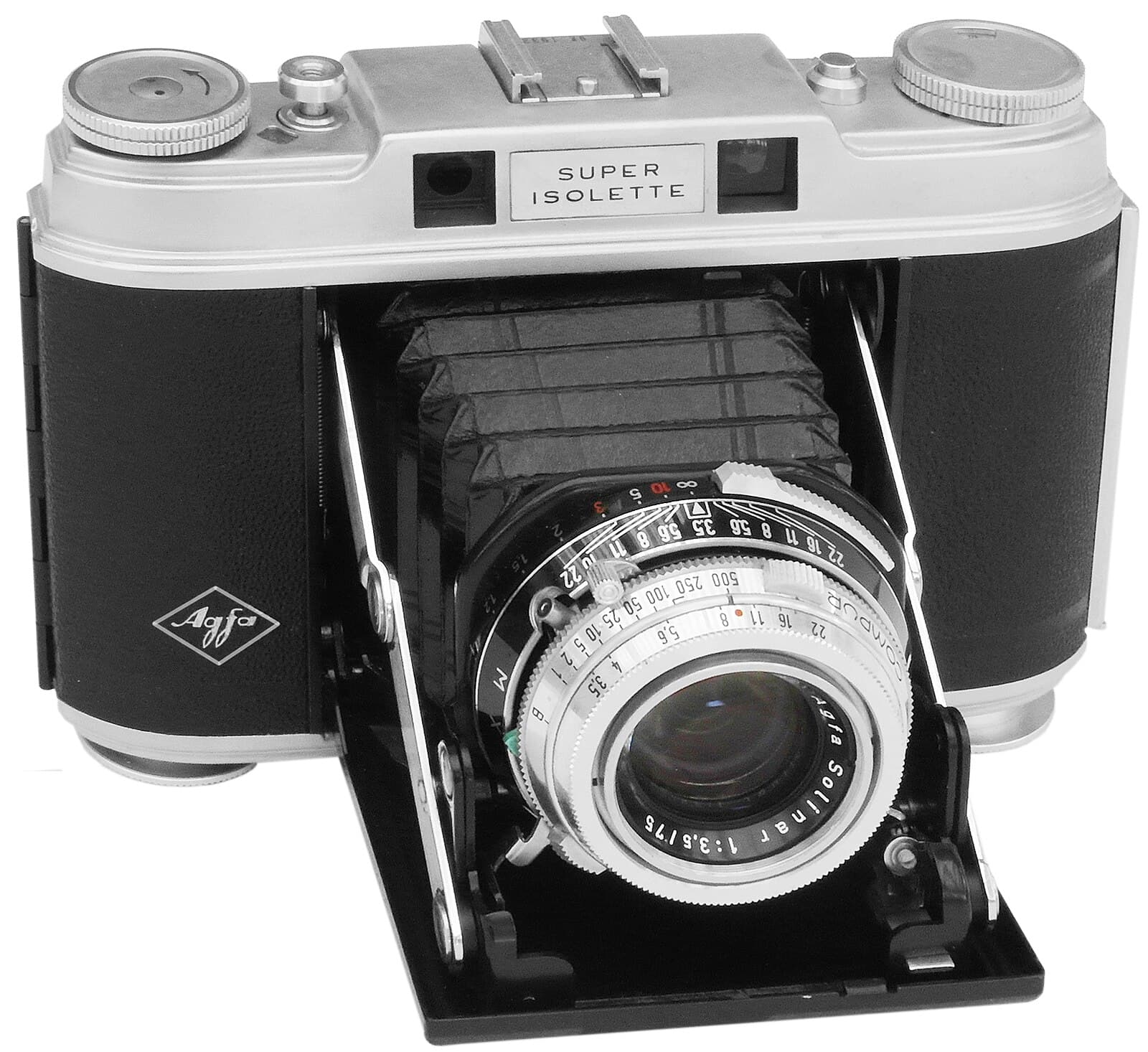
The Agfa Super Isolette (1954) is the flagship of Agfa's Isolette folder family, distinguished from its siblings by a **coupled rangefinder** - turning what had been a two-step read-and-transfer operation on the Isolette III into a single combined focus-and-compose workflow. The lens is the **Solinar 75mm f/3.5**, a four-element Tessar-type design shared with the better-specified Isolette III variants. Shutter is the **Synchro-Compur** leaf shutter running 1s to 1/500s with full flash sync at all speeds.
Reference
Recommended film stocks for the — format your camera takes.
C41
Kodak Portra 400 is a professional C-41 color negative film known for flexible exposure latitude, natural skin tones, and fine grain.
View profileC41
Kodak Portra 160 is a professional C-41 color negative film with fine grain, soft contrast, and natural color.
View profileC41
Kodak Ektar 100 is a fine-grain C-41 color negative film with saturated color and high sharpness.
Develop — film
We're growing the lab directory near you. Browse all labs.
Before you buy used
About this camera
The premium Isolette: 6x6 folder with a true coupled rangefinder and four-element Solinar glass, 1954.
| Field | Value |
|---|
| Format | 120 film (6x6, 12 exposures) |
| Lens | Solinar 75mm f/3.5 (fixed) |
| Shutter | 1s - 1/500s + B, Synchro-Compur leaf |
| Flash sync | All speeds (leaf shutter) |
| Rangefinder | Coupled |
| Meter | None |
| Battery | None |
Agfa's Isolette line began with the Isolette I (zone focus) and progressed through Isolette II, Isolette III (uncoupled RF), and the Isolette L (uncoupled RF with built-in selenium meter). The Super Isolette sat above all of these, offering the coupled rangefinder that users of the Zeiss Ikon Super Ikonta B expected. Agfa was competing against Zeiss and Voigtlander for the serious-amateur German folder market in the mid-1950s. By 1960, the rising dominance of SLRs - and Agfa's own shift toward simpler consumer cameras - ended the Isolette line entirely.
Within the Isolette family the Super Isolette is the most capable for handheld shooting: the coupled rangefinder eliminates the fumble of transferring a separate reading to the lens, making the camera genuinely usable in variable-light situations where you need to refocus quickly. The Solinar lens - shared with the better Isolette III variants - produces clean results especially stopped down to f/8.
The Super Isolette occupies an unusual position in the used market: it is more capable than the Isolette III, but it commands a meaningfully higher price and the coupled rangefinder mechanism is an additional point of potential failure that requires CLA. Buyers who want the best Isolette experience and are willing to pay for it (and have it serviced) find the Super Isolette the most rewarding of the line.
E6
Fujifilm Fujichrome Provia 100F (RDPIII) is a professional E6 reversal (slide) film in 135 and 120 formats, known for its natural, balanced color reproduction, very fine grain, and moderate saturation. It remains in production as of 2026 and is one of the last professional slide films available.
View profileBW
Kodak Tri-X 400 is a classic black-and-white film known for strong tonality, visible grain, and documentary character.
View profile