C41
Kodak Portra 400
Kodak Portra 400 is a professional C-41 color negative film known for flexible exposure latitude, natural skin tones, and fine grain.
View profile35mm Rangefinder
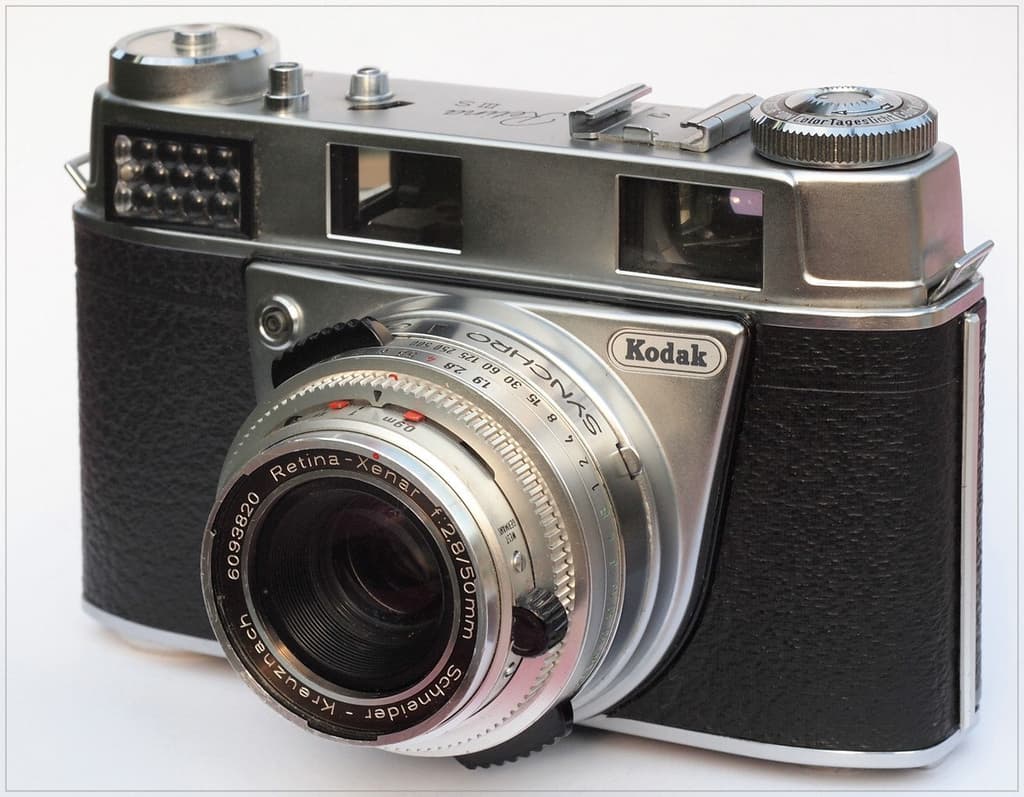
The Kodak Retina IIIs (1958) represents the mature apex of the Retina folding camera concept. It builds on the IIa and IIc series by adding two features absent from earlier Retinas: an integrated selenium exposure meter (uncoupled, requiring manual transfer of EV values) and compatibility with Retina interchangeable front elements — auxiliary lens modules that screw into the front of the fixed 50mm standard lens to provide wide-angle (28mm equivalent) or telephoto (80mm equivalent) coverage.
Reference
Recommended film stocks for the 35mm format your camera takes.
C41
Kodak Portra 400 is a professional C-41 color negative film known for flexible exposure latitude, natural skin tones, and fine grain.
View profileBW
Ilford HP5 Plus is a flexible ISO 400 black-and-white film with classic grain and strong push-processing tolerance.
View profileBW
Kodak Tri-X 400 is a classic black-and-white film known for strong tonality, visible grain, and documentary character.
Develop 35mm film
Labs in our directory that process 35mm film.
Before you buy used
About this camera
The IIIs is the most capable Retina of its generation — a folding German rangefinder with a built-in selenium meter and interchangeable front optical elements that provide the equivalent of three different focal lengths from a single camera.
| Field | Value |
|---|
| Format | 35mm (36×24mm) |
| Lens | Schneider Retina-Xenon C 50/2 or Rodenstock Retina-Heligon C 50/2 |
| Auxiliary lenses | Retina-Curtar-Xenon 35mm equiv. wide; Retina-Tele-Xenar 80mm equiv. tele |
| Years | 1958–1960 |
| Shutter | Synchro-Compur leaf: 1s – 1/500s + B |
| Flash sync | All speeds (leaf shutter) |
| Meter | Selenium external (uncoupled), EV 5–18 |
| Modes | Manual |
| Finder | Optical with coupled rangefinder; parallax-corrected for 50mm |
| Weight | ~570 g |
| Battery | None (selenium meter is self-powered) |
The Retina IIIs (Type 027) arrived at the end of the folding rangefinder era — by 1958, rigid-body 35mm cameras from Leica, Nikon, and Canon were firmly established as professional tools, and the folding camera's portability advantage was less compelling than it had been in the late 1940s. Kodak's Nagel Werk responded by adding the features that made the Retina line as technically capable as any rigid compact: a built-in meter and a form of optical versatility through the interchangeable front element system.
The IIIs was produced only until 1960, making it one of the shorter-lived Retina variants. It was superseded in the early 1960s by the Retina Reflex series, which offered genuine SLR through-the-lens viewing. The IIIs therefore represents the final generation of the pure rangefinder Retina before the SLR transition.
The selenium meter is a significant convenience over the entirely unmetered IIa — no battery required, always ready, and accurate enough for slide film with a stop-down correction factor understood.
The Retina IIIs is the Swiss Army knife of the Retina line: meter, interchangeable optics, and rangefinder focusing in a folding body that closes smaller than a wallet. For photographers interested in the full Retina system — including the wide and tele auxiliary elements — the IIIs is the correct body to seek.
The interchangeable front element system is optically legitimate: the Retina-Curtar-Xenon and Retina-Tele-Xenar are purpose-designed for this conversion function by Schneider and produce acceptable (if not exceptional) results. Wide-angle conversion gives approximately 35mm equivalent coverage; telephoto conversion gives approximately 80mm. Neither matches the quality of a dedicated prime, but both are adequate for available-light documentary and travel work.
The selenium meter's battery-free operation is a genuine practical advantage over cameras requiring mercury or silver oxide cells — the IIIs is usable with its meter indefinitely, assuming the selenium cell has not degraded.
Standard lens: Schneider-Kreuznach Retina-Xenon C 50mm f/2 (most production) or Rodenstock Retina-Heligon C 50mm f/2. Interchangeable front elements: Retina-Curtar-Xenon 35mm equivalent (wide conversion); Retina-Tele-Xenar 80mm equivalent (telephoto conversion). Each auxiliary element includes its own dedicated viewfinder mask or accessory shoe-mount viewfinder frame for accurate composition. Filter thread: 32mm (primary lens). Accessories: Retina flash shoe adapter; case; close-up supplementary lenses.
BW
Fujifilm Neopan 100 Acros is an ultra-fine-grain ISO 100 black-and-white negative film celebrated for its world-class granularity, wide tonal range, and exceptional reciprocity characteristics. The original Acros was discontinued in 2018; Acros II relaunched in November 2019 with a reformulated emulsion and is the current production version.
View profileC41
Kodak Portra 160 is a professional C-41 color negative film with fine grain, soft contrast, and natural color.
View profileC41
Kodak Gold 200 is a daylight-balanced C-41 color negative film with warm color, moderate grain, and a classic consumer-film look.
View profile