C41
Kodak Portra 400
Kodak Portra 400 is a professional C-41 color negative film known for flexible exposure latitude, natural skin tones, and fine grain.
View profile35mm Rangefinder
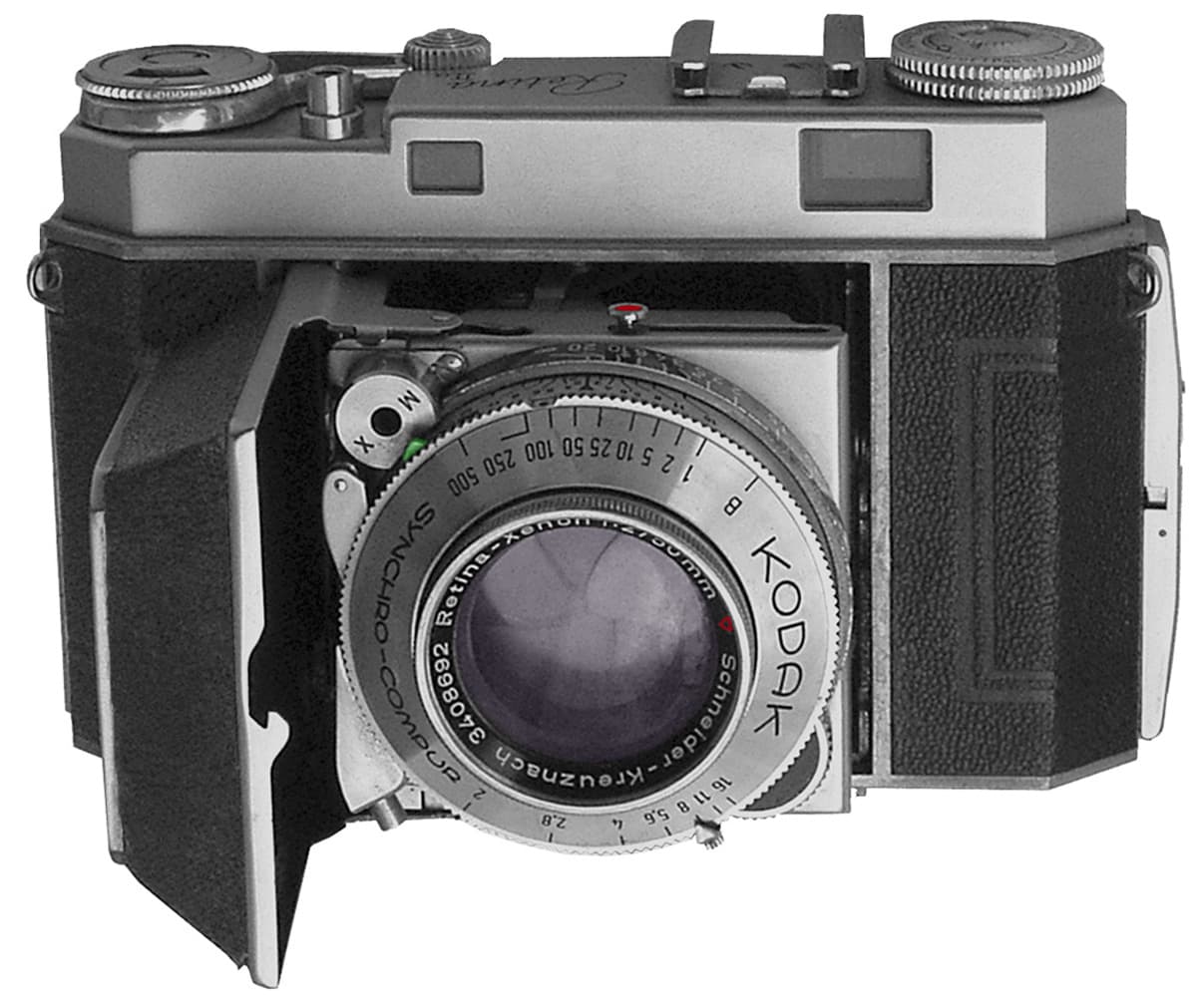
The Kodak Retina IIa (1951) is a precision German 35mm folding camera that marries a coupled rangefinder viewfinder to the Retina's established folding bellows design. It is manufactured at Kodak's Nagel Werk factory in Stuttgart — the same facility that had produced the original Kodak Retina in 1934 and which brought rigorous German optical and mechanical standards to Kodak's product line throughout the 1940s and 1950s.
Reference
Recommended film stocks for the 35mm format your camera takes.
C41
Kodak Portra 400 is a professional C-41 color negative film known for flexible exposure latitude, natural skin tones, and fine grain.
View profileBW
Ilford HP5 Plus is a flexible ISO 400 black-and-white film with classic grain and strong push-processing tolerance.
View profileBW
Kodak Tri-X 400 is a classic black-and-white film known for strong tonality, visible grain, and documentary character.
Develop 35mm film
Labs in our directory that process 35mm film.
Before you buy used
About this camera
A folding coupled-rangefinder 35mm camera built by Kodak's German Nagel Werk in Stuttgart — the Retina IIa combines Schneider or Rodenstock optics with a Compur leaf shutter in a body that folds flat enough to slip into a coat pocket.
| Field | Value |
|---|
| Format | 35mm (36×24mm) |
| Lens | Schneider Retina-Xenon C 50/2 or Rodenstock Retina-Heligon C 50/2 |
| Years | 1951–1954 |
| Shutter | Synchro-Compur leaf: 1s – 1/500s + B |
| Flash sync | All speeds (leaf shutter) |
| Meter | None |
| Modes | Manual |
| Finder | Optical viewfinder with coupled rangefinder |
| Weight | ~440 g (closed body) |
| Focus | Coupled rangefinder (manual) |
| Battery | None required |
The Retina lineage began in 1934 when Kodak acquired Nagel-Werk and introduced the original Retina — one of the first cameras to use the 35mm cartridge film format that would become universal. The Retina II of 1936 added a rangefinder. Post-war production resumed in 1946 with the IIa designation applied to successive refinements through the early 1950s.
The 1951 Retina IIa (Type 016) represented the mature expression of this evolution: a camera precise enough for professional use, compact enough for travel, and reliable enough to remain in production essentially unchanged until 1954. Kodak sold it through both its own distribution network and through camera dealers across Europe and the United States, positioning it as a premium portable for the discerning amateur.
The Retina line continued to evolve: the Retina IIc (1954) introduced a larger finder with combined viewfinder/rangefinder eyepiece, and the IIIc added an integrated light meter. The IIa represents the pinnacle of the pre-Ic design philosophy — clean, uncluttered, and entirely mechanical.
The Kodak Retina IIa offers an entry point into German-manufactured coupled-rangefinder photography at prices substantially below Leica M or Contax equipment. The Schneider Xenon and Rodenstock Heligon 50/2 lenses are genuinely excellent: sharp from corner to corner at f/2.8 and beyond, with smooth tonal rendering that complements both black-and-white and colour film beautifully.
The folding design makes the Retina IIa one of the most pocketable coupled-rangefinder cameras available — significantly more compact than a Leica M or Voigtländer Bessa when closed. This portability made it a popular travel camera in the 1950s and gives it continuing relevance for film photographers who want German glass in a compact package.
The absence of a built-in meter is not a handicap with a sunny-16 approach or a separate hand-held meter, and many photographers find the entirely mechanical, battery-free operation appealing.
Fixed-lens camera: Schneider-Kreuznach Retina-Xenon C 50mm f/2 or Rodenstock Heligon C 50mm f/2 (production variant dependent). Lens apertures: f/2–f/16. Synchro-Compur shutter with M and X flash sync sockets. Accessories: 39mm filter thread; lens hood; close-up supplementary lenses (Retina Closeup Lenses, purpose-built); flash gun with M or X sync cable; ever-ready leather case.
BW
Fujifilm Neopan 100 Acros is an ultra-fine-grain ISO 100 black-and-white negative film celebrated for its world-class granularity, wide tonal range, and exceptional reciprocity characteristics. The original Acros was discontinued in 2018; Acros II relaunched in November 2019 with a reformulated emulsion and is the current production version.
View profileC41
Kodak Portra 160 is a professional C-41 color negative film with fine grain, soft contrast, and natural color.
View profileC41
Kodak Gold 200 is a daylight-balanced C-41 color negative film with warm color, moderate grain, and a classic consumer-film look.
View profile