C41
Kodak Gold 200
Kodak Gold 200 is a daylight-balanced C-41 color negative film with warm color, moderate grain, and a classic consumer-film look.
View profileHalf-Frame
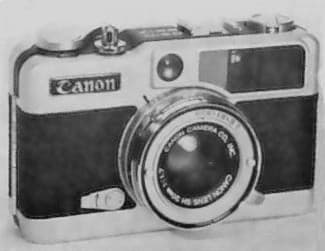
The Canon Demi EE17 (1966) is the top-specification model in Canon's Demi half-frame family, distinguished by its exceptionally fast 28mm f/1.7 lens (equivalent to approximately 40mm on full 35mm frame due to the smaller half-frame negative). The "17" in the name refers to the f/1.7 maximum aperture. It shoots 18×24mm half-frame negatives on standard 35mm film, doubling the frame count (72 shots on a 36-exposure roll). Aperture-priority auto-exposure with a CdS behind-lens cell; manual aperture control as override. The Copal SV shutter runs 1/30s–1/250s with X-sync at 1/60s.
Reference
Recommended film stocks for the half-frame-35mm format your camera takes.
C41
Kodak Gold 200 is a daylight-balanced C-41 color negative film with warm color, moderate grain, and a classic consumer-film look.
View profileC41
Fujifilm Superia X-TRA 400 (marketed as Superia 400 in some regions) is an ISO 400 C-41 consumer color negative film in 135 format, one of Fujifilm's most popular consumer films. It delivers warm, vibrant colors with moderate grain and remains in production in some markets.
View profileC41
Develop half-frame-35mm film
We're growing the lab directory near you. Browse all labs.
Before you buy used
About this camera
The fastest half-frame. 28mm f/1.7 SE Lens (28mm equivalent in half-frame = normal-ish), aperture-priority auto-exposure, 72 exposures on a 36-exposure roll, and Canon's 1960s build quality.
| Field | Value |
|---|
| Format | Half-frame 35mm (18×24mm) |
| Lens | 28mm f/1.7 SE Lens (≈ 40mm full-frame equivalent) |
| Years | 1966–1972 |
| Shutter | 1/30s – 1/250s, Copal SV leaf, B |
| Flash sync | 1/60s |
| Meter | CdS behind-lens, aperture-priority AE |
| Focus | Zone (3 zones: 0.9 m / 1.5 m / 3 m / ∞) |
| Weight | 430 g |
| Battery | PX625 / 1.35V mercury |
Canon launched the original Demi in 1963 as a compact half-frame aimed at the amateur market, competing with the Olympus Pen series. The EE17 arrived in 1966 as the premium variant with a faster f/1.7 lens and improved AE system. "EE" stood for "Electric Eye" — Canon's marketing term for automatic exposure. Canon produced the Demi series through the early 1970s, when compact full-frame cameras began to displace half-frame in consumer preference. The EE17 is the most desirable Demi because of its lens speed; clean examples are harder to find than the standard Demi or EE models.
Half-frame cameras offer a peculiar trade-off: half the resolution of standard 35mm per frame, but twice the shots and a naturally vertical default orientation (the camera shoots landscape but the negative is portrait). The EE17's f/1.7 lens is remarkably fast for a half-frame — the Yashica Half 17 was the first with this aperture (also f/1.7), but the Canon EE17 matched it. In practical terms, f/1.7 on a half-frame is approximately the same as f/2.4 on full frame for depth-of-field purposes, so the background blur is limited but the low-light performance is genuine.
Canon's build quality on the Demi EE17 is a step above most half-frame cameras. The finder is clean, the zone-focus ring is positive, and the AE system is well-calibrated on working examples. Used prices have risen with the film revival: expect $40–150 for a working body.
Lens is fixed. Standard accessory shoe (no hot shoe — sync via PC socket). Close-up supplementary lens available as accessory. Self-timer built in. No interchangeable lens option.
Kodak UltraMax 400 is a versatile consumer-grade ISO 400 daylight-balanced color negative film with T-grain emulsion, delivering warm Kodak colors, fine-for-speed grain (PGI 46), and wide exposure latitude. Currently in production and available globally as a single-roll and multi-pack.
BW
Ilford HP5 Plus is a flexible ISO 400 black-and-white film with classic grain and strong push-processing tolerance.
View profileC41
Kodak Portra 400 is a professional C-41 color negative film known for flexible exposure latitude, natural skin tones, and fine grain.
View profileBW
Kodak Tri-X 400 is a classic black-and-white film known for strong tonality, visible grain, and documentary character.
View profile